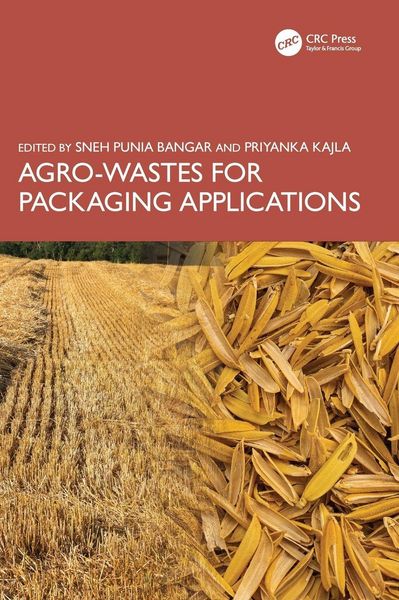
Agro-Wastes for Packaging Applications
-
- Hardcover ausgewählt
- Taschenbuch
- eBook
-
Sprache:Englisch
279,99 €
inkl. gesetzl. MwSt.,
Beschreibung
Produktdetails
Einband
Gebundene Ausgabe
Erscheinungsdatum
01.08.2024
Abbildungen
67 SW-Abb., 40 SW-Fotos, 27 SW-Zeichn., 29 Tabellen
Herausgeber
Sneh Punia Bangar + weitereVerlag
Taylor & FrancisSeitenzahl
310
Maße (L/B/H)
26/18,3/2,1 cm
Gewicht
781 g
Sprache
Englisch
ISBN
978-1-03-258312-9
Food and agricultural waste is a huge global issue that has detrimental effects on society, the economy, and the environment. Plant leaves, stems, roots and peels (outer leaves and stems) are among the wastes and by-products from agriculture and the food business, along with residues from oil production, fruit and vegetable peels, and seeds. High concentrations of dietary fiber, phytochemicals, cellulose, and hemicellulose are typically found in these residues. As the next environmentally conscious step of waste valorization, research from recent years has demonstrated that employing organic ingredients/biodegradable fibers generated from waste and by-products in the food packaging business may be an efficient strategy to reduce the quantity of food waste and by-products. In recent years, there has been a lot of interest in finding alternative polymer materials as high-value novel packaging materials through the valorization of agricultural waste. Thus, utilizing agricultural wastes and by-products as raw materials for food packaging could help cut down on the amount of waste produced.
Agro-Wastes for Packaging Applications provides an update on the strategies for valuing agricultural waste and how these might be used in packaging. It also includes recent research on these approaches and presents an innovative strategy for developing sustainable, green, and biodegradable packaging options. A detailed overview of the packaging application of valorized agricultural waste materials is discussed, and concept clarification is achieved using flowcharts and figures supported by the latest research investigations. These agricultural leftovers are abundant sources of polysaccharides, such as cellulose, hemicellulose, and lignin, which can be processed further utilizing various physicochemical techniques and other unconventional techniques to create nanocellulose fibers or crystals. The main goal of this book is to provide food experts and the general public with superior, environmentally friendly, sustainable packaging materials that can be used in place of plastic polymers.
Key Features
- Contains abundant information on advanced valorization techniques for different types of agricultural wastes
- Provides information on possible applications of component/constituents obtained by the valorization
- Discusses the impact of the incorporation of these valorized components in different packaging systems
- Reviews the legal standards and future trends in the commercialization of these derived polymers in food packaging industries
Noch keine Bewertungen vorhanden
Verfassen Sie die erste Bewertung zu diesem Artikel
Helfen Sie anderen Kundinnen und Kunden durch Ihre Meinung.
Kurze Frage zu unserer Seite
Vielen Dank für Ihr Feedback
Wir nutzen Ihr Feedback, um unsere Produktseiten zu verbessern. Bitte haben Sie Verständnis, dass wir Ihnen keine Rückmeldung geben können. Falls Sie Kontakt mit uns aufnehmen möchten, können Sie sich aber gerne an unseren Kund*innenservice wenden.
zum Kundenservice