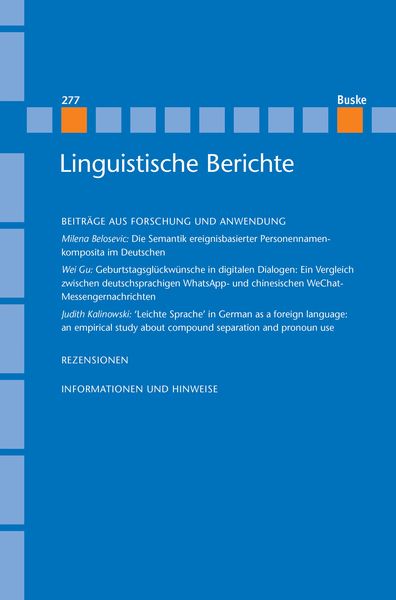
Band 277
Linguistische Berichte Heft 277
Aus der Reihe
Linguistische Berichte
-
- Einzelkauf Download ausgewählt
-
Sprache:Deutsch, Englisch
68,00 €
inkl. gesetzl. MwSt.Beschreibung
Produktdetails
Format
Kopierschutz
Nein
Family Sharing
Ja
Text-to-Speech
Nein
Erscheinungsdatum
16.02.2024
Herausgeber
Markus Steinbach + weitereVerlag
Helmut BuskeSeitenzahl
124 (Printausgabe)
Dateigröße
3444 KB
Auflage
Unverändertes eJournal der 1. Auflage von 2024
Sprache
Deutsch, Englisch
EAN
9783967693959
Beiträge aus Forschung und Anwendung
- Milena Belosevic: Die Semantik ereignisbasierter Personennamenkomposita im Deutschen
Abstract: The paper aims to account for the semantic properties of eventive personal name compounds in German (e.g. Brezel-Bush/Pretzel-Bush). These are compounds where the compound constituents are combined based on the discursive event in which the name bearer has participated. In this regard, the question arises of how the relationship between the compound constituents can be modelled given that the knowledge about the discursive event plays a central role. Starting from the corpus data collected from the German Reference Corpus (DeReKo), the Digital Dictionary of the German Language (DWDS) and Twitter (X), we test the hypothesis that the relationships between the constituents of eventive personal name compounds cannot be captured by existing approaches to the semantics of compounds. Instead we apply two frame semantics approaches to this compound type: an approach based on the German FrameNet and an approach based on Barsalou frames and show how they contribute to the linguistic operationalization of discursive events that underlie the relationship between the constituents. The analysis indicates that well-known advantages and disadvantages of both frame semantic approaches also apply to the eventive personal name compounds. Whereas the limited set of frame elements from the German FrameNet in combination with construction morphology can account for the non-compositional compound meaning, Barsalou-Frames are recursive and therefore provide better evidence for different aspects of knowledge involved in the interpretation of eventive personal name compounds.
- Wei Gu: Geburtstagsglückwünsche in digitalen Dialogen: Ein Vergleich zwischen deutschsprachigen WhatsApp- und chinesischen WeChat-Messengernachrichten
Abstract: This article is a contrastive study of birthday interactions in German and Chinese on WhatsApp and WeChat, respectively. The congratulatory formulas of both languages are examined, along with communicative and culture-specific phenomena related to written languages and pictograms in digital writing. This article attempts to explain the theoretical basis of general routine formulas and formulaic language, as well as greetings in messenger writing, and linguistic cultural analysis. In addition, the author has conducted an empirical investigation. At the textual level, high-frequency expressions in German and Chinese congratulatory dialogues have been collected quantitatively and presented in two word clouds. Apart from this, concrete acts of communication in both contexts will be analyzed qualitatively. The associated image-related discussion is conducted based on an overview of the general use of image symbols in messenger messages and, in particular, of the 15 emojis that are identified to be most frequently used as non-verbal components of congratulations. This is followed by examples of the use of figurative signs and a qualitative discussion of their culture-specific characteristics. This article also identifies the relationship building in birthday congratulations in Chinese WeChat and German WhatsApp. This research explains the change of the use of emojis and stickers in messenger writing and whether new communication possibilities in messenger messages can be expected in the future.
- Judith Kalinowski: 'Leichte Sprache' in German as a foreign language: an empirical study about compound separation and pronoun use
Abstract: 'Leichte Sprache' is a variety of German that is linguistically and structurally reduced in its complexity. It intends to facilitate reading and thus to make it easier for people with poor reading skills to participate in society. The target groups of Leichte Sprache are very heterogeneous, therefore, it is an open question which target groups benefit from which rules of Leichte Sprache.
- Milena Belosevic: Die Semantik ereignisbasierter Personennamenkomposita im Deutschen
Abstract: The paper aims to account for the semantic properties of eventive personal name compounds in German (e.g. Brezel-Bush/Pretzel-Bush). These are compounds where the compound constituents are combined based on the discursive event in which the name bearer has participated. In this regard, the question arises of how the relationship between the compound constituents can be modelled given that the knowledge about the discursive event plays a central role. Starting from the corpus data collected from the German Reference Corpus (DeReKo), the Digital Dictionary of the German Language (DWDS) and Twitter (X), we test the hypothesis that the relationships between the constituents of eventive personal name compounds cannot be captured by existing approaches to the semantics of compounds. Instead we apply two frame semantics approaches to this compound type: an approach based on the German FrameNet and an approach based on Barsalou frames and show how they contribute to the linguistic operationalization of discursive events that underlie the relationship between the constituents. The analysis indicates that well-known advantages and disadvantages of both frame semantic approaches also apply to the eventive personal name compounds. Whereas the limited set of frame elements from the German FrameNet in combination with construction morphology can account for the non-compositional compound meaning, Barsalou-Frames are recursive and therefore provide better evidence for different aspects of knowledge involved in the interpretation of eventive personal name compounds.
- Wei Gu: Geburtstagsglückwünsche in digitalen Dialogen: Ein Vergleich zwischen deutschsprachigen WhatsApp- und chinesischen WeChat-Messengernachrichten
Abstract: This article is a contrastive study of birthday interactions in German and Chinese on WhatsApp and WeChat, respectively. The congratulatory formulas of both languages are examined, along with communicative and culture-specific phenomena related to written languages and pictograms in digital writing. This article attempts to explain the theoretical basis of general routine formulas and formulaic language, as well as greetings in messenger writing, and linguistic cultural analysis. In addition, the author has conducted an empirical investigation. At the textual level, high-frequency expressions in German and Chinese congratulatory dialogues have been collected quantitatively and presented in two word clouds. Apart from this, concrete acts of communication in both contexts will be analyzed qualitatively. The associated image-related discussion is conducted based on an overview of the general use of image symbols in messenger messages and, in particular, of the 15 emojis that are identified to be most frequently used as non-verbal components of congratulations. This is followed by examples of the use of figurative signs and a qualitative discussion of their culture-specific characteristics. This article also identifies the relationship building in birthday congratulations in Chinese WeChat and German WhatsApp. This research explains the change of the use of emojis and stickers in messenger writing and whether new communication possibilities in messenger messages can be expected in the future.
- Judith Kalinowski: 'Leichte Sprache' in German as a foreign language: an empirical study about compound separation and pronoun use
Abstract: 'Leichte Sprache' is a variety of German that is linguistically and structurally reduced in its complexity. It intends to facilitate reading and thus to make it easier for people with poor reading skills to participate in society. The target groups of Leichte Sprache are very heterogeneous, therefore, it is an open question which target groups benefit from which rules of Leichte Sprache.
Noch keine Bewertungen vorhanden
Verfassen Sie die erste Bewertung zu diesem Artikel
Helfen Sie anderen Kundinnen und Kunden durch Ihre Meinung.
Kurze Frage zu unserer Seite
Vielen Dank für Ihr Feedback
Wir nutzen Ihr Feedback, um unsere Produktseiten zu verbessern. Bitte haben Sie Verständnis, dass wir Ihnen keine Rückmeldung geben können. Falls Sie Kontakt mit uns aufnehmen möchten, können Sie sich aber gerne an unseren Kund*innenservice wenden.
zum Kundenservice