KI-Beratung Beta

Gutscheinbedingungen

**Gültig am 20.11.2026 ab einem Mindestbestellwert von 30€ auf Spielzeug, Schreibwaren, Filme, Geschenke & Trends, Musik, tolino eReader & Zubehör, Hörbücher und Hörbuch-Downloads, nicht preisgebundene Bücher und Kalender online auf thalia.at und in der Thalia App. Einzelne Artikel können ausgeschlossen sein. Aufgrund der Buchpreisbindung sind deutschsprachige Bücher und eBooks ausgenommen. Zusätzlich ausgenommen sind Abos & Flatrates, Games, Geschenkkarten/-boxen, Shelfies, Software, Zeitschriften sowie einzelne Artikel von tonies®. Pro Einkauf einmal einlösbar. Click & Collect nur bei Onlinevorabzahlung möglich. Keine Barauszahlung. Nicht kombinierbar mit anderen Aktionen und Gutscheinen. Gutschein wird auf max. 500€ Bestellwert angerechnet. Nicht gültig für Versandkosten und Services. Preisgebundene Artikel sind vom Mindestbestellwert ausgeschlossen.

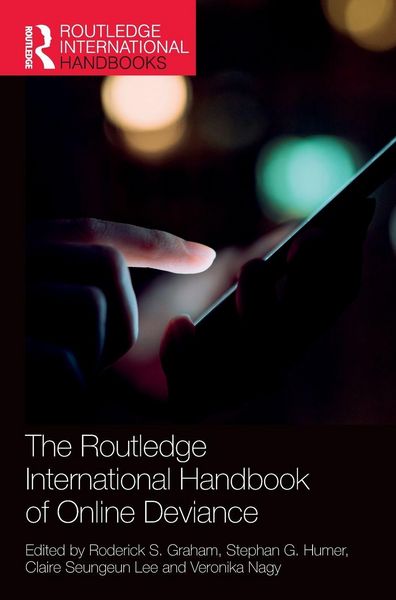
  • Produktbild: The Routledge International Handbook of Online Deviance
  • Produktbild: The Routledge International Handbook of Online Deviance

The Routledge International Handbook of Online Deviance

346,99 €

inkl. gesetzl. MwSt., Versandkostenfrei


Beschreibung

Covering a wide range of different online platforms, including social media sites and chatrooms, this volume is a comprehensive exploration of the current state of sociological and criminological scholarship focused on online deviance.

Understanding deviance broadly, the handbook acknowledges both an...

Beschreibung

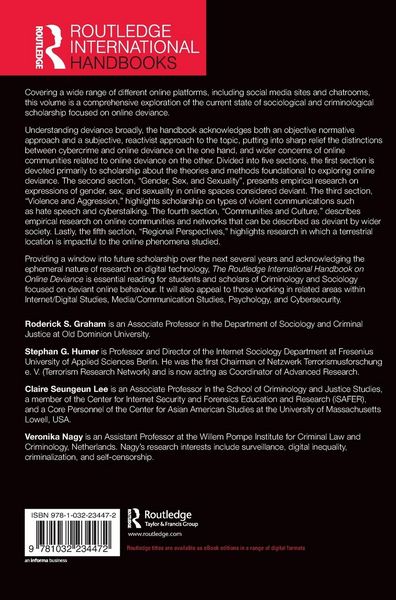
Covering a wide range of different online platforms, including social media sites and chatrooms, this volume is a comprehensive exploration of the current state of sociological and criminological scholarship focused on online deviance.

Understanding deviance broadly, the handbook acknowledges both an objective normative approach and a subjective, reactivist approach to the topic, putting into sharp relief the distinctions between cybercrime and online deviance on the one hand, and wider concerns of online communities related to online deviance on the other. Divided into five sections, the first section is devoted primarily to scholarship about the theories and methods foundational to exploring online deviance. The second section, "Gender, Sex, and Sexuality", presents empirical research on expressions of gender, sex, and sexuality in online spaces considered deviant. The third section, "Violence and Aggression," highlights scholarship on types of violent communications such as hate speech and cyberstalking. The fourth section, "Communities and Culture," describes empirical research on online communities and networks that can be described as deviant by wider society. Lastly, the fifth section, "Regional Perspectives," highlights research in which a terrestrial location is impactful to the online phenomena studied.

Providing a window into future scholarship over the next several years and acknowledging the ephemeral nature of research on digital technology, The Routledge International Handbook on Online Deviance is essential reading for students and scholars of Criminology and Sociology focused on deviant online behaviour. It will also appeal to those working in related areas within Internet/Digital Studies, Media/Communication Studies, Psychology, and Cybersecurity.

Produktdetails

Einband

Gebundene Ausgabe

Erscheinungsdatum

16.09.2024

Abbildungen

30 SW-Abb., 12 SW-Fotos, 18 SW-Zeichn., 33 Tabellen

Herausgeber Roderick S. Graham + weitere

Produktdetails

Einband

Gebundene Ausgabe

Erscheinungsdatum

16.09.2024

Abbildungen

30 SW-Abb., 12 SW-Fotos, 18 SW-Zeichn., 33 Tabellen

Herausgeber
Verlag Taylor & Francis
Seitenzahl

794

Maße (L/B/H)

25/17,5/4,7 cm

Gewicht

1467 g

Sprache

Englisch

ISBN

978-1-03-223447-2

Herstelleradresse

Libri GmbH
Europaallee 1
36244 Bad Hersfeld
DE

Email: gpsr@libri.de

Noch keine Bewertungen vorhanden

Verfassen Sie die erste Bewertung zu diesem Artikel

Helfen Sie anderen Kundinnen und Kunden durch Ihre Meinung.

Kundinnen und Kunden meinen

Bewertungen (0)

Die Leseprobe wird geladen.
  • Produktbild: The Routledge International Handbook of Online Deviance
  • Produktbild: The Routledge International Handbook of Online Deviance
  • Part 1. Foundations

    1. Routine activities theory as a framework for explaining online victimization: a discussion of contributions, limitations and future work, Troy Smith and Kevin Haines

    2. Measuring Cybercrime and Cyberdeviance in Surveys, David Buil-Gil, Nicolas Trajtenberg, and Marcelo F. Aebi

    3. The victim-perpetrator? A gendered theory of incel digital deviance, Stuart Lucy

    4. Ethics of covert surveillance in online deviance research using honeypots, Francisco J. Castro-Toledo and Ana B. Gómez-Bellvís

    5. Grooming to defraud, Martina Dove

    6. Perspectives of paid panel survey research in cybercrime victimization and offending: Validity of global online market research sampling and data collection, Katalin Parti, Thomas Dearden, and James Hawdon

    7. Assessing the weight of social capital theory in digital victimization patterns via the Oxford Internet Surveys, 'Shawn Smith

    8. Methodological and ethical considerations on cyberbullying research, Ales Bucar Rucman and Ajda Sulc

    9. Contextual factors of online deception and harmful information: Multidisciplinary perspectives, Kristjan Kikerpill, Elisabeth Carter, Marju Himma-Kadakas, and Sten Hansson

    10. Cyber outsiders. Julian Assange and the labeling of online activists, Vincenzo Scalia

    11. Moving from risk factors to positive online behaviors: An integrated behavioral change approach, Troy Smith, Eric Rutger Leukfeldt, and Steve van de Weijer

    12. The cultural milieus of online offending, Maryja Supa

    Part 2. Gender, Sex, and Sexuality

    13. Gender gap and online deviance behavior. Is cyberspace democratizing cybercrime? The case of digital piracy, Ana B. Gómez-Bellvís and Francisco J. Castro-Toledo

    14. Sextortion online: Characteristics, challenges, and pathways forward, Roberta L. O'Malley

    15. Online sex work: Deviance and innovation, Aaron Hammes and Danielle Blunt

    16. The struggle with stigma in sex work: Webcam models' strategies for stigma management, Hannah DeLacey

    17. A sentiment analysis of men's comments on a sex work forum, Roderick Graham

    18. "I do not believe that talking about this kind of stuff is a way to diminish feminist battles": An online controversy in the Italian manosphere, Oscar Ricci

    19. "Is my fear of transphobia just a little out of control?": A qualitative exploration of the use of online forums by trans people, Susana Avalos

    20. Other as self-identity, safety, and perception of deviance concerning sexual minorities, Helidth Ravenholm

    21. Female extremists and the role of gender, sex and sexuality, Nina Käsehage and Sybille Reinke de Buitrago

    Part 3. Violence and Aggression

    22. Self-Reported Ethnic-Based Cyberbullying Victimization in Portugal: Prevalence and Implications for Criminology, Gloria Fernández- Pacheco Alises, Paula C. Martins, and Sílvia M. Mendes

    23. Moral Disaffiliation in Cyber Incitement to Hatred and Violence: A Discourse Semantic Approach, Awni Etaywe

    24. Follower weaponization: Reimagining violence in the technological landscape, Alice Fox