KI-Beratung Beta

Gutscheinbedingungen

**Gültig bis 30.11.2026 auf Spielzeug, Schreibwaren, Filme, Geschenke & Trends, Musik, tolino eReader & Zubehör, Hörbücher und Hörbuch-Downloads, nicht preisgebundene Bücher und Kalender online auf thalia.at und in der Thalia App. Einzelne Artikel können ausgeschlossen sein. Aufgrund der Buchpreisbindung sind deutschsprachige Bücher und eBooks ausgenommen. Zusätzlich ausgenommen sind Abos & Flatrates, Games, Geschenkkarten/-boxen, Shelfies, Software, Zeitschriften sowie einzelne Artikel von tonies®. Pro Einkauf einmal einlösbar. Nur gültig mit im Onlineshop hinterlegter Bonuscard. Click & Collect nur bei Onlinevorabzahlung möglich. Keine Barauszahlung. Nicht kombinierbar mit anderen Aktionen und Gutscheinen. Gutschein wird auf max. 500€ Bestellwert angerechnet. Nicht gültig für Versandkosten und Services.

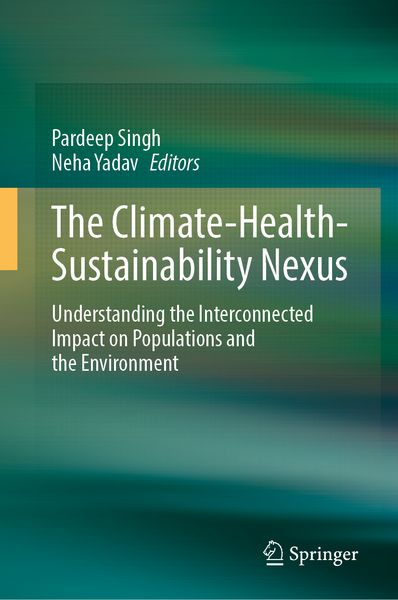
  • Produktbild: The Climate-Health-Sustainability Nexus
  • Produktbild: The Climate-Health-Sustainability Nexus
- 16%

The Climate-Health-Sustainability Nexus Understanding the Interconnected Impact on Populations and the Environment

16% sparen

136,99 € UVP 164,99 €

inkl. gesetzl. MwSt., Versandkostenfrei


Beschreibung

In a compelling scholarly journey, this book unfolds the intricate narratives of human progress and its environmental repercussions catalyzed by the Industrial Revolution. It thoughtfully contrasts the exploitative environmental ideologies stemming from colonization and industrialization against the...

Beschreibung

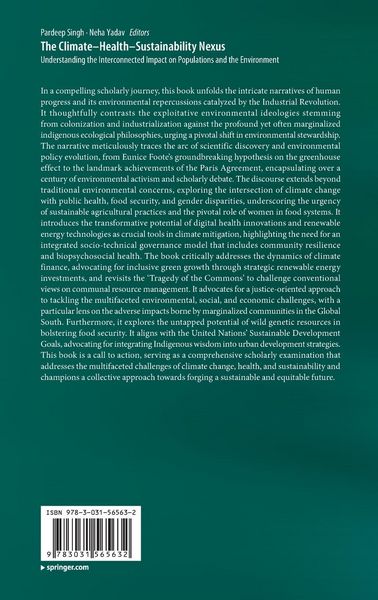
In a compelling scholarly journey, this book unfolds the intricate narratives of human progress and its environmental repercussions catalyzed by the Industrial Revolution. It thoughtfully contrasts the exploitative environmental ideologies stemming from colonization and industrialization against the profound yet often marginalized indigenous ecological philosophies, urging a pivotal shift in environmental stewardship. The narrative meticulously traces the arc of scientific discovery and environmental policy evolution, from Eunice Foote’s groundbreaking hypothesis on the greenhouse effect to the landmark achievements of the Paris Agreement, encapsulating over a century of environmental activism and scholarly debate. The discourse extends beyond traditional environmental concerns, exploring the intersection of climate change with public health, food security, and gender disparities, underscoring the urgency of sustainable agricultural practices and the pivotal role of women in food systems. It introduces the transformative potential of digital health innovations and renewable energy technologies as crucial tools in climate mitigation, highlighting the need for an integrated socio-technical governance model that includes community resilience and biopsychosocial health. The book critically addresses the dynamics of climate finance, advocating for inclusive green growth through strategic renewable energy investments, and revisits the ‘Tragedy of the Commons’ to challenge conventional views on communal resource management. It advocates for a justice-oriented approach to tackling the multifaceted environmental, social, and economic challenges, with a particular lens on the adverse impacts borne by marginalized communities in the Global South. Furthermore, it explores the untapped potential of wild genetic resources in bolstering food security. It aligns with the United Nations’ Sustainable Development Goals, advocating for integrating Indigenous wisdom into urban development strategies. This book is a call to action, serving as a comprehensive scholarly examination that addresses the multifaceted challenges of climate change, health, and sustainability and champions a collective approach towards forging a sustainable and equitable future.

Portrait

Pardeep Singh is an Assistant professor in the Department of Environmental Studies, PGDAV College, University of Delhi, New Delhi, India. He obtained his master’s degree from the Department of Environmental Science, Banaras Hindu University, Varanasi, India. He obtained his doctorate from the Indian Institute of Technology (Banaras Hindu University) in Varanasi. He has published more than 75 papers in international journals. He has also edited more than 65 books with various global publishers.


Neha Yadav is a Public Health researcher at Jawaharlal Nehru University (JNU), New Delhi, India; her transdisciplinary research focuses on food systems and community-based climate adaptation in the Indian Himalayas. As a recipient of the Commonwealth split-site scholarship, she furthered her research at the Institute of Development Studies (IDS) at the University of Sussex, United Kingdom (UK). Her wide-ranging professional engagements include working on research projects funded by the UN Food and Agriculture Organization (FAO), UK Research and Innovation (UKRI), Chronic Poverty Advisory Network (CPAN), and the World Resources Forum Association (WRFA). She holds an MPhil in Social Sciences in Health from JNU. Neha’s work interests straddle sustainability, food-climate nexus, climate adaptation, and COVID-19 impacts. Her publication repertoire includes several opinion pieces, editorials and research articles.


Produktdetails

Einband

Gebundene Ausgabe

Erscheinungsdatum

01.05.2024

Abbildungen

IX, 503 p. 80 illus., 71 illus. in color.

Herausgeber Pardeep Singh + weitere

Produktdetails

Einband

Gebundene Ausgabe

Erscheinungsdatum

01.05.2024

Abbildungen

IX, 503 p. 80 illus., 71 illus. in color.

Herausgeber
Verlag Springer
Seitenzahl

503

Maße (L/B/H)

24,1/16/3,4 cm

Gewicht

882 g

Auflage

2024

Sprache

Englisch

ISBN

978-3-031-56563-2

Herstelleradresse

Springer-Verlag KG
Sachsenplatz 4-6
1201 Wien
AT

Email: ProductSafety@springernature.com

Noch keine Bewertungen vorhanden

Verfassen Sie die erste Bewertung zu diesem Artikel

Helfen Sie anderen Kundinnen und Kunden durch Ihre Meinung.

Kundinnen und Kunden meinen

Bewertungen (0)

  • Produktbild: The Climate-Health-Sustainability Nexus
  • Produktbild: The Climate-Health-Sustainability Nexus
  • Climate Change Foundations and Sustainability Emergence.- Climate Impacts on Food, Agriculture, and Health.- Ecosystems, Water Resources, and Sustainable Practices.- Urban Sustainability and Technological Solutions.- Social Equity, Finance, and Education in Climate Adaptation.