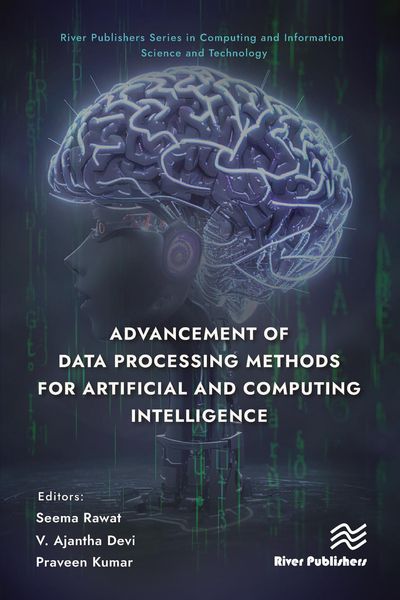
Advancement of Data Processing Methods for Artificial and Computing Intelligence
-
Form:Einzelkauf Download
-
Sprache:Englisch
-
eBook Format:ePUB 3
- ePUB 3 159,40 € ausgewählt
- PDF 159,40 €
159,40 €
inkl. gesetzl. MwSt.Beschreibung
Produktdetails
Format
ePUB 3
Kopierschutz
Ja
Family Sharing
Nein
Text-to-Speech
Ja
Erscheinungsdatum
26.04.2024
Herausgeber
Seema Rawat + weitereVerlag
Taylor & Francis eBooksSeitenzahl
430 (Printausgabe)
Auflage
1. Auflage
Sprache
Englisch
EAN
9781003810988
This book emphasizes the applications of advances in data processing methods for Artificial Intelligence in today's fast-changing world, as well as to serve society through research, innovation, and development in this field. This book is applicable to a wide range of data that contribute to data science concerns and can be used to promote research in this high-potential new field. People's perceptions of the world and how they conduct their lives have changed dramatically as a result of technological advancements. The world has been gripped by technology, and the advances that are being made every day are undeniably transforming the planet. In the domains of Big Data, engineering, and data science, this cutting-edge technology is ready to support us.
Artificial intelligence (AI) is a current research topic because it can be applied to a wide range of applications and disciplines to solve complicated problems and find optimal solutions. In research, medicine, technology, and the social sciences, the benefits of AI have already been proven. Data science, also known as pattern analytics and mining, is a technique for extracting useful and relevant information from databases, enabling better decision-making and strategy formulation in a range of fields. As a result of the exponential growth of data in recent years, the combined notions of big data and AI have given rise to many study areas, such as scale-up behaviour from classical algorithms. Furthermore, combining numerous AI technologies from other areas (such as vision, security, control, and biology) in order to build efficient and durable systems that interact in the real world is a new problem. Despite recent improvements in fundamental AI technologies, the integration of these skills into larger, trustworthy, transparent, and maintainable systems is still in its development. Both conceptually and practically, there are a number of unanswered issues.
Noch keine Bewertungen vorhanden
Verfassen Sie die erste Bewertung zu diesem Artikel
Helfen Sie anderen Kundinnen und Kunden durch Ihre Meinung.
Kurze Frage zu unserer Seite
Vielen Dank für Ihr Feedback
Wir nutzen Ihr Feedback, um unsere Produktseiten zu verbessern. Bitte haben Sie Verständnis, dass wir Ihnen keine Rückmeldung geben können. Falls Sie Kontakt mit uns aufnehmen möchten, können Sie sich aber gerne an unseren Kund*innenservice wenden.
zum Kundenservice