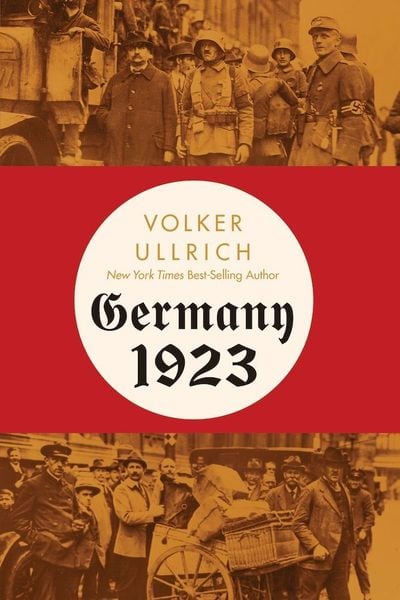
Germany 1923 Hyperinflation, Hitler's Putsch, and Democracy in Crisis
-
- Hardcover
- Taschenbuch ausgewählt
- eBook
- Hörbuch
-
Sprache:Englisch
- Deutsch 19,00 €
- Englisch 25,99 € ausgewählt
25,99 €
inkl. gesetzl. MwSt.,
- Kostenlose Lieferung ab 30 € Einkaufswert
- Versandkostenfrei für Bonuscard-Kund*innen
Beschreibung
Produktdetails
Einband
Taschenbuch
Erscheinungsdatum
01.11.2024
Abbildungen
24 illustrations
Verlag
Norton & CompanySeitenzahl
432
Maße (L/B/H)
20,6/13,7/2,8 cm
Gewicht
366 g
Farbe
Cognac / Altweiß
Übersetzt von
Jefferson Chase
Sprache
Englisch
ISBN
978-1-324-09565-1
As the great Austrian writer Stefan Zweig confided in his autobiography, written in exile, "I have a pretty thorough knowledge of history, but never, to my recollection, has it produced such madness in such gigantic proportions." He was referring to the situation in Germany in 1923. It was a "year of lunacy", defined by hyperinflation, a political system on the verge of collapse and separatist movements that threatened Germany's territorial integrity. Most significantly, Adolf Hitler launched his infamous Beer Hall Putsch in Munich-a failed coup that nonetheless drew international attention and demonstrated the Nazis' ruthless determination to seize power.
In Germany 1923, award-winning historian Volker Ullrich draws on letters, memoirs, newspaper articles and other sources from the time to present a captivating new history of those explosive twelve months. The crisis began when the French invaded the Ruhr Valley in January to force Germany to pay the reparations it owed under the Treaty of Versailles, which had ended the Great War. For years, German leaders had embraced inflationary policies to finance the costs of defeat, and, as Ullrich demonstrates, the invasion utterly destroyed the value of the German mark. Before the war, the exchange rate was 4.2 marks to the dollar. By 20 November 1923, a dollar was worth an incomprehensible 4.2 trillion marks and a loaf of bread cost 200 billion. Facing the abyss, many ordinary Germans called for a national messiah. Among the figures to vie for that role was Hitler, a thirty-four-year-old veteran who possessed a uniquely malevolent personal magnetism. Although the Nazi coup in November was put down and Hitler arrested, the putsch showed just how tenuous the first German democracy, the Weimar Republic, was at its core.
As Ullrich's panoramic narrative reveals, other Germans responded to the successive crises by launching a cultural revolution: 1923 witnessed the emergence of a multitude of new movements, from Dada to Bauhaus, and of such iconoclasts as Bertolt Brecht, George Grosz and Franz Kafka. Yet most observers were amazed that the Weimar Republic was able to survive, and the more astute realised that the feral undercurrents unleashed could lead to much worse. Publishing a century after that fateful year, Germany 1923 is a riveting chronicle of one of the most challenging times any modern democracy has faced, one with haunting parallels to our own political moment.
Noch keine Bewertungen vorhanden
Verfassen Sie die erste Bewertung zu diesem Artikel
Helfen Sie anderen Kundinnen und Kunden durch Ihre Meinung.
Kurze Frage zu unserer Seite
Vielen Dank für Ihr Feedback
Wir nutzen Ihr Feedback, um unsere Produktseiten zu verbessern. Bitte haben Sie Verständnis, dass wir Ihnen keine Rückmeldung geben können. Falls Sie Kontakt mit uns aufnehmen möchten, können Sie sich aber gerne an unseren Kund*innenservice wenden.
zum Kundenservice