Gutscheinbedingungen

**Gültig bis 06.07.2026 auf fremdsprachige Bücher online auf thalia.at, in der Thalia App ab einem Mindestbestellwert von 30€ und in allen Thalia Buchhandlungen in Österreich. In den Buchhandlungen nur gültig auf lagernde Ware. Einzelne Artikel können ausgeschlossen sein. Ausgenommen sind preisgebundene Artikel & eBooks. Pro Einkauf einmal einlösbar. Nur gültig gegen Vorlage oder im Onlineshop hinterlegter Bonuscard. Infos zur Einlösung in der Buchhandlung sind auf der Bonuscard-Vorteilspreisseite zu finden. Click & Collect nur bei Onlinevorabzahlung möglich. Keine Einlösung bei Scan & Go-Bezahlung. Keine Barauszahlung. Nicht kombinierbar mit anderen Aktionen und Gutscheinen. Gutschein wird auf max. 500€ Bestellwert angerechnet. Nicht gültig für Versandkosten und Services.

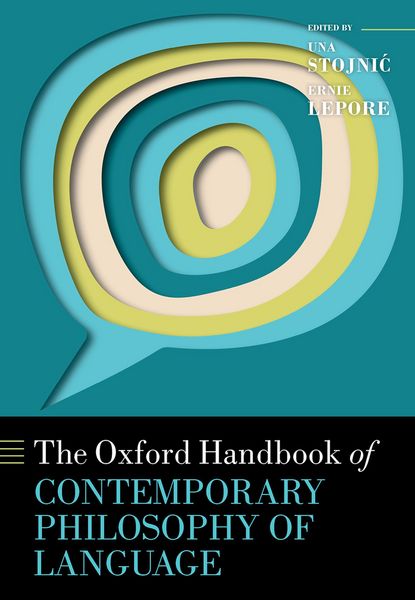
Produktbild: The Oxford Handbook of Contemporary Philosophy of Language

The Oxford Handbook of Contemporary Philosophy of Language

209,99 €

inkl. gesetzl. MwSt., Versandkostenfrei


Beschreibung

Produktdetails

Einband

Gebundene Ausgabe

Erscheinungsdatum

19.02.2025

Herausgeber

Una Stojnić + weitere

Verlag

Oxford University Press

Seitenzahl

736

Maße (L/B/H)

25,1/17,9/4,7 cm

Gewicht

1410 g

Sprache

Englisch

ISBN

978-0-19-285685-2

Beschreibung

Produktdetails

Einband

Gebundene Ausgabe

Erscheinungsdatum

19.02.2025

Herausgeber

Verlag

Oxford University Press

Seitenzahl

736

Maße (L/B/H)

25,1/17,9/4,7 cm

Gewicht

1410 g

Sprache

Englisch

ISBN

978-0-19-285685-2

Herstelleradresse

Libri GmbH
Europaallee 1
36244 Bad Hersfeld
DE

Email: GPSR Kontakt

Noch keine Bewertungen vorhanden

Verfassen Sie die erste Bewertung zu diesem Artikel

Helfen Sie anderen Kundinnen und Kunden durch Ihre Meinung.

Kundinnen und Kunden meinen

Bewertungen (0)

Die Leseprobe wird geladen.
  • Produktbild: The Oxford Handbook of Contemporary Philosophy of Language
    • Preface

    • Part I: Languages and Language

    • 1: Robert J. Stainton and Christopher Viger: Do Languages Really Exist?

    • 2: Zoltán Gendler Szabó: Possible Human Languages

    • 3: Guillermo Del Pinal: The Logicality of Language, Meaning-Driven Unacceptability, and Modulated Logic forms

    • Part II: Semantic Content and Propositional Attitudes

    • 4: Samuel Cumming: Report and Content

    • 5: David Sosa: A Plea for Innocence

    • 6: Eleni Manolakaki: Contemporary Foundational Accounts of Propositions

    • 7: Kathrin Glüer and Peter Pagin: Multiple Intensions Semantics

    • Part III: Communication and Speech Acts

    • 8: Seth Yalcin: States of Conversation

    • 9: Peter Hanks: The Distinction Between Content and Force

    • 10: Cameron Domenico Kirk-Giannini: Do Not Diagonalize

    • Part IV: Meta-semantics and Foundations of Meaning Theory

    • 11: Herman Cappelen and Max Deutsch: Reference without Deference

    • 12: Paul M. Pietroski: One Word, Many Concepts: Endorsing Polysemous Meanings

    • 13: Emma Borg: The Problem of Polysemy

    • 14: Henry Jackman: Truth, Normativity, and Interpretational Theories of Meaning

    • 15: Claudine Verheggen: Semantic Non-Reductionism

    • 16: Wayne A. Davis: Foundations of Semantics

    • 17: Jeffrey C. King: Quantifier Domain Restriction and the Problem of Incomplete Quantifiers

    • Part V: Tense and Modality

    • 18: Fabrizio Cariani: Future Displacement and Modality

    • 19: Paolo Santorio: The Semantics and Logic of Counterfactuals

    • 20: J. L. Dowell: Deontic Modal Expressions

    • Part VI: Semantics and Linguistic Theory

    • 21: John Collins: Indefinites: Scope and Context

    • 22: Michael Glanzberg: Information Structure for Philosophers

    • Part VII: Expressive, Evaluative, Subjective, and Social Aspects of Language

    • 23: Isidora Stojanovic: Evaluativity

    • 24: Robin Jeshion: How Vocatives Illuminate Slurs

    • 25: Christopher Hom and Robert May: The Metatheoretic Foundation for Racial Epithets

    • 26: Malte Willer: Subjectivity

    • 27: Elisabeth Camp and Ethan Nowak: Linguistic Variation, Agency, and Style