
• Produktbild: Quantitative Psychology
  • Produktbild: Quantitative Psychology
Band 452 - 16%

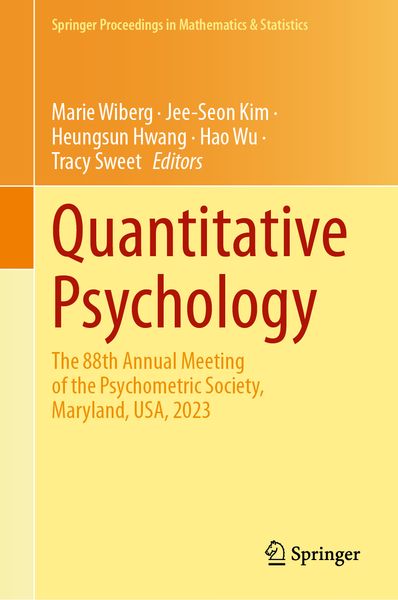
Quantitative Psychology The 88th Annual Meeting of the Psychometric Society, Maryland, USA, 2023

16% sparen

209,99 € UVP 252,99 €

inkl. gesetzl. MwSt., Versandkostenfrei


Beschreibung

Produktdetails

Einband

Gebundene Ausgabe

Erscheinungsdatum

19.06.2024

Abbildungen

IX, 395 p. 81 illus., 57 illus. in color.

Herausgeber

Heungsun Hwang + weitere

Verlag

Springer

Seitenzahl

395

Maße (L/B/H)

24,1/16/2,8 cm

Gewicht

776 g

Auflage

2024

Sprache

Englisch

ISBN

978-3-031-55547-3

Beschreibung

Produktdetails

Einband

Gebundene Ausgabe

Erscheinungsdatum

19.06.2024

Abbildungen

IX, 395 p. 81 illus., 57 illus. in color.

Herausgeber

Verlag

Springer

Seitenzahl

395

Maße (L/B/H)

24,1/16/2,8 cm

Gewicht

776 g

Auflage

2024

Sprache

Englisch

ISBN

978-3-031-55547-3

Herstelleradresse

Springer-Verlag KG
Sachsenplatz 4-6
1201 Wien
AT

Email: ProductSafety@springernature.com

Noch keine Bewertungen vorhanden

Verfassen Sie die erste Bewertung zu diesem Artikel

Helfen Sie anderen Kundinnen und Kunden durch Ihre Meinung.

Kundinnen und Kunden meinen

Bewertungen (0)

  • Produktbild: Quantitative Psychology
  • Produktbild: Quantitative Psychology

  • Chapter 1. Repeated measurement analysis for non-linear data in small samples.- Chapter 2. Examining the Measurement Invariance of the Chinese Short Grit Scale.- Chapter 3. Data Preprocessing Techniques using Machine Learning Algorithms in Large-scale Assessment.- Chapter 4. A two-stage approach to a latent variable mixed-effects location scale model.- Chapter 5. Sparse Bayesian joint modal estimation for item factor analysis.- Chapter 6. Investigating the impact of equating on measurement error using generalizability theory.- Chapter 7. Method Effects of Item Wording: MIRT Estimation Based on Equivalence Method.- Chapter 8. Item Response Theory Modeling with Response Times: Some Issue.- Chapter 9. Validity evidence for the Teach ECE classroom observation tool.- Chapter 10. Application of topic modeling techniques in meta-analysis studies.- Chapter 11. Validation of the Household Food Security Survey Module (HFSSM) using Factor Analysis and Rasch Modeling.- Chapter 12. Testing CDM local independence assumptions using nested model selection criteria.- Chapter 13. The Impact of Generating Model on Pre-knowledge Detection in CAT.- Chapter 14. Exploring Attenuation of Reliability in Categorical Subscore Reporting.- Chapter 15. Diagnosing skills and misconceptions with Bayesian Networks applied to diagnostic multiple-choice tests.- Chapter 16. Investigating variable selection techniques under missing data: a simulation study .- Chapter 17. Optimal Implementation of Propensity-Score Matching Methods: A Monte Carlo Study on Estimating Binary Treatment Effects on Binary Outcomes.- Chapter 18. Using machine/deep learning algorithms for the fixed effect prediction in non-linear Mixed Effects Models - the mixedML framework.- Chapter 19. Psychometric evaluation of Positive and Negative Symptom Scale (PANSS): Harmonizing Classical Item Response Theory with the Perspective from Network Approach.- Chapter 20. Fitting IRT Diffusion Model to complex cognition response times.- Chapter 21. Empirical evaluations for DIF detection methods.- Chapter 22. Fisher Information-Based Difficulty and Discrimination Measures in Binary IRT.- Chapter 23. Empirical comparisons among models in detecting extreme response styles.- Chapter 24. A Hierarchical Prior for Bayesian Variable Selection in Regression Model.- Chapter 25. Comparing Different Correlation Test Methods.- Chapter 26. Priors in Bayesian Estimation under the Graded Response Model.- Chapter 27. Information matrix test misspecification assessment in cognitive diagnostic models.- Chapter 28. Impact of Ignoring Rater Effects in Objective Structured Clinical Examinations.- Chapter 29. The Gumbel-Reverse Gumbel (GRG) Model for Binary Data: A New Asymmetric Item Response Model.- Chapter 30. Nonparametric estimation of the risk and odds ratio in rare events meta analysis with arm based and contrast based approaches.- Chapter 31. Differential Step Functioning with Scale Purification for Polytomous Items.- Chapter 32. Comparing maximum likelihood and MCMC estimation of the multivariate social relations model.- Chapter 33. Using Mantel-Haenszel for Detecting Testlet Effects: Testing it All at Once.- Chapter 34. Identifiability Conditions in Cognitive Diagnosis:Implications for Q-Matrix Estimation Algorithms.- Chapter 35. Psychometric Perspectives on Modeling and Assessing Synergies.- Chapter 36. Global validity of assessments: Location and currency.- Chapter 37. Gaussian graphical model for evaluating local item dependency in response times.- Chapter 38. Assessment Engineering Meets Generative AI: Unlocking New Opportunities for Digital Assessment.- Chapter 39. Bayesian Mixture Multilevel Vector Autoregressive (B-MMVAR) Modeling.- Chapter 40. Enhancing Learning and Assessment: Exploring the Potential of Performance Factor Analysis in attribute-oriented performance and difficulty parameters estimation.- Chapter 41. DIF Detection in a Response Time Measure: An LRT Method.- Chapter42. Nonparametric Estimation of CATE with Cluster-Robust Confidence Bands.- Chapter 43. A Causal Mediation Framework for Investigating Treatment Effects in Longitudinal Studies.- Chapter 44. Are we playing the same game: Translating fairness content.- Chapter 45. Revisiting the 1PL-AG item response model: Bayesian estimation and application.- Chapter 46. Maximum Likelihood Estimation using a Possibly Misspecified Parameter Redundant Model.- Chapter 47. Comparing non-parametric estimations of treatment effect heterogeneity in the context of clustered data.- Chapter 48. Extreme and Midpoint Response Styles: Two Sides of the Same Coin?- Chapter 49. A family of discrete kernels for presmoothing.- Chapter 50. The deconstruction of measurement invariance (and DIF).- Chapter 51. Efficient additive Gaussian process models for large-scale balanced multi-level data.- Chapter 52. An Investigation of Missing Data Analytical Methods in Longitudinal Research: Traditional and Machine Learning Approaches.- Chapter 53. Test Analysis Method using Piecewise Linear ICCs.- Chapter 54. Relationship among measurement invariance, differential item functioning andmean comparison.- Chapter 55. Generative Distractor Modeling with Generative AI.- Chapter 56. Q-matrix identification using text classification.- Chapter 57. The Nonparametric Item Selection Method for Multiple-Choice Items in CD-CAT.