
Gutscheinbedingungen

**Gültig am 28.06.2026 auf Spielzeug, Schreibwaren, Filme, Geschenke & Trends, Musik, tolino eReader & Zubehör, Hörbücher und Hörbuch-Downloads (außer Abo), nicht preisgebundene Bücher und Kalender online auf thalia.at und in der Thalia App. Einzelne Artikel können ausgeschlossen sein. Aufgrund der Buchpreisbindung sind deutschsprachige Bücher und eBooks ausgenommen. Zusätzlich ausgenommen sind preisgebundene Artikel, Abos & Flatrates, eBooks, Games, Geschenkkarten/-boxen, Shelfies, Software, Zeitschriften sowie einzelne Artikel von tonies®. Pro Einkauf einmal einlösbar. Click & Collect nur bei Onlinevorabzahlung möglich. Keine Barauszahlung. Nicht kombinierbar mit anderen Aktionen und Gutscheinen. Gutschein wird auf max. 500€ Bestellwert angerechnet. Nicht gültig für Versandkosten und Services.

  • Produktbild: Don Quixote's Impossible Quest for the Absolute in Literature
  • Produktbild: Don Quixote's Impossible Quest for the Absolute in Literature

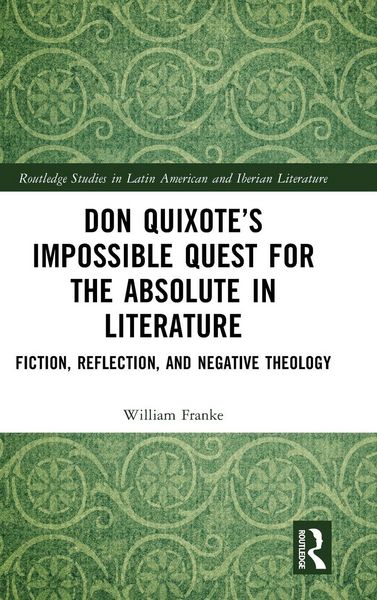
Don Quixote's Impossible Quest for the Absolute in Literature Fiction, Reflection, and Negative Theology

182,99 €

inkl. gesetzl. MwSt., Versandkostenfrei


Beschreibung

Produktdetails

Einband

Gebundene Ausgabe

Erscheinungsdatum

31.07.2024

Abbildungen

schwarz-weiss Illustrationen, Raster, schwarz-weiss

Verlag

Taylor & Francis

Seitenzahl

256

Maße (L/B/H)

23,5/15,7/1,9 cm

Gewicht

500 g

Sprache

Englisch

ISBN

978-1-03-268896-1

Beschreibung

Rezension

"This is one of the very best, most interesting studies of Cervantes' Don Quixote that I have read in some time. . . . I consistently found myself engaged by the argument, fascinated by the detailed analyses, and impressed by the depth of thought in evidence in this work. It's clear that Franke really "gets" the complexity and the importance of Don Quixote, and he does a superb job communicating this to the reader. . . .In a scholarly landscape that is littered with studies of Don Quixote that often fail to do justice to Cervantes' text, Franke's study stands out for the way in which it truly captures the profundity of the work."

-Anthony J. Cascardi, Sidney and Margaret Distinguished Professor of Comparative Literature, University of California, Berkeley

A celebrated scholar of Dante and of the discipline known as apophatic theology or negative theology, William Franke in Don Quixote's Impossible Quest for the Absolute in Literature offers us a tour-de force interpretation of how Cervantes searches for God's revelation of truth in theologically diverse apophatic discourses. Franke's exegetical reflections converse with Ortega's, Unamuno's, and Zambrano's respective meditations on Cervantes's masterpiece, allowing the reader to get a taste of the parodic laughter in Don Quixote, a mode of discourse that speaks (or rather un-speaks) of the impossible quest for the transcendent and the divine. Franke's is a complex and excellent book that sheds insight upon Don Quixote's experience of the divine around him.

-Antonio Cortijo Ocaña, Professor, University of California, Santa Barbara

William Franke's Don Quixote's Impossible Quest for the Absolute in Literature: Fiction, Reflection, and Negative Theology could hardly be a more ambitious project, and I believe that the results are brilliant. Professor Franke has analyzed Don Quixote using his unique and wide-ranging background in literature, culture, theology, and philosophy, not to mention his familiarity with the meta- offspring of Cervantes's work. I find the framing of the theses and arguments to be superb. The critic lays the foundations for his particular readings, upon which readers can reflect and debate.

-Edward H. Friedman, Gertrude Conaway Vanderbilt Professor in the Humanities, Vanderbilt University, Tennessee

Produktdetails

Einband

Gebundene Ausgabe

Erscheinungsdatum

31.07.2024

Abbildungen

schwarz-weiss Illustrationen, Raster, schwarz-weiss

Verlag

Taylor & Francis

Seitenzahl

256

Maße (L/B/H)

23,5/15,7/1,9 cm

Gewicht

500 g

Sprache

Englisch

ISBN

978-1-03-268896-1

EU-Ansprechpartner

Taylor & Francis Verlag GmbH
Kaufingerstraße 24
80331 München
DE
GPSR@taylorandfrancis.com

Herstelleradresse

Taylor & Francis Group
5 Howick Place
SW1P 1WG London
UK
GPSR@taylorandfrancis.com

Kundinnen und Kunden meinen

0 Bewertungen

Informationen zu Bewertungen

Zur Abgabe einer Bewertung ist eine Anmeldung im Konto notwendig. Die Authentizität der Bewertungen wird von uns nicht überprüft. Wir behalten uns vor, Bewertungstexte, die unseren Richtlinien widersprechen, entsprechend zu kürzen oder zu löschen.

Die Bewertungen sind nach Format, Anzahl Sterne und Datum sortiert.

Verfassen Sie die erste Bewertung zu diesem Artikel

Helfen Sie anderen Kund*innen durch Ihre Meinung

Kundinnen und Kunden meinen

0 Bewertungen filtern

Die Leseprobe wird geladen.
  • Produktbild: Don Quixote's Impossible Quest for the Absolute in Literature
  • Produktbild: Don Quixote's Impossible Quest for the Absolute in Literature
  • List of Figures

    Acknowledgments

    Prologue Concerning Apophatic Theology in Literary Representation and Reflection

    Chapter 1 The Revelation of Laughter: Cervantes's Comic Christian Muse

                The Power of Laughter-The Wisdom of Folly

                A Negative Theological Reading of Don Quixote

                Fool for Christ as Universal Sage

                Don Quixote's Contemporaneity and Universality

                The Holy Fool as Christian Saint and Crusader

                Unamuno and Ortega: Dialectic of the Religious and the Secular 


    Chapter 2 Self-reflective Dynamics of Revelation in Literature

    A. Self-subversive Mirroring Between and Among the Protagonists

         The Knight of Mirrors and of the White Moon as Self-reflection of Don Quixote

         Don Quixote's Ideal Reflected in Sancho-and Inversely

         Self-reflexivity as Self-fulfilling Ideal

         Becoming a Book and Reading One's Life


    B. Self-reflection and Undermining the Authority of the Author

           Self-reflective Questioning of Authorship

           Cervantes's Self-representations in the Prologues

           Authorship and Originality

           Self-reflexivity in the Narrative Structure of Fiction

           Fictionalization of Author by Self-reflection-Kafka and Borges

           The Dialectic of Self-reflection and Negative Theology


    Chapter 3 Negative Theology of the Novel

    The Novel as Breaking Down the Separation of Styles-Auerbach           

    Recognition Scenes: Epiphanies and Theophanies

    The Novel as Subjective Reflective Medium and Genre Reflecting Concrete Reality

    The Novel as Subjectively Lived Experience

    The Novel as a New and Comprehensive Genre

    Dialectics of Wholeness

    The In-breaking of External Reality Into Fiction

    Mutual Contamination of History and Fiction and Their Exposure to Externality

    Maese Pedro's Puppet Show and Unamuno's Move Through Fiction to Reality

    Ortega on Literary Genre: From Epic Myth to Novelistic Formal Reality

    Novelistic Creation of Formal Reality-Ortega and Maese Pedro's Puppet Theatre

    Fiction and Realization of the Ideal

    Chapter 4 Visionary Experience in the Cave of Montesinos as Revelation via Parody

    The Vision of Montesinos, or the Part of Fiction in the Construction of Prophetic Revelation

    The Question of Truth Raised by the Vision in the Cave

    Artifice and the Limits of the Control of the Author

    The Reality that Our Fictions Become

    The Ontological Argument for Dulcinea's Existence

    Real Costs of One's Fictive Inventions

    Repetitions of Visionary Revelation following Montesinos

    Sancho's Perversion of Visionary Experience-Clavileño

    Visionary Revelation After the Cave of Montesinos-Its Translation Into the Everyday


    Chapter 5 Dialectic of Religious Truth and Its Secular Simulation

    Religious and Anti-religious Interpretations of the Quixote: Religion Versus Secularity

    Velázquez's Las Meninas: Self-reflexivity and the Other

    Camacho's Wedding as Theatrical Artifice and Its Sacramental Transfiguration

    Baroque Aesthetics of Contrast, the Grotesque, and Theatricalization of the World

    Feminine Beauty as Ideal and as Simulation

    Transvestism, Love of Artifice, and the Transhuman

    Formal Dimension of Reality-Names as Revelation-Antonomasia

    Archetypal Image and Primal Naming-Spitzer's Linguistic Perspectivism

    The Epistolary Novel and the Scriptural Ideal

    Dialectic of Self-reflective Desengaño and Disinterested Dedication


    Chapter 6 A Political Novel: Representation of an Idealized World Versus Contemporary Reality

    The Baroque Age: Aesthetics of the Ideal, Realism, and the Unrepresentable

    Barataria as Anti-utopia of a Perfectly Artificial State

    Knowing One's Limits and Becoming Oneself: Sancho in "Hell"

    The Contemporary Expulsion Drama and the Apotheosis of Fiction

    The Realistic Political Novel as an Overture to Modernity

    Barcelona and the New Materialism


    Chapter 7 The Passion of Sancho Panza and the Death of Don Quixote

    The Wise Fool-Like Master Like Servant: Sancho's Governance

    Sancho's Assuming the Lead Position in the Duo

    Visionary Revisitations-Sancho in the Role of the Christ Figure

    Altisidora's Invention of a Visionary Revelation

    Don Quixote's Death and Bequest-The Heroism of the Common Person?

    The Christian Death of Alonso Quijano-and Sancho's Passion to Live


    Chapter 8 The Metaphysics of Fiction

    The Force of Fiction

    Real Tragedy in Fiction-Carl Schmitt

    Ambiguity of Fictive Truth in Epic Tradition and Its Modern Parody

    What Makes a Book of Poetic Literature Great-or Revelatory?

    The Integration of Fiction into Reality and Vice Versa-Vargas Llosa

    Self-reflection at the Juncture of Fiction and Ultimate Reality

    The Apophatic in Literature-An Aesthetic Dimension of the Real


    Chapter 9 Philosophies of Quixotism

    Unamuno's Quixotesque Turning of Philosophy into Religion

    Ortega's Cervantesque Philosophy of Desengaño as a Theory of Genres

    Unamuno on Quixotism as the True Philosophy and Religion of the Spanish People

    Unamuno's Staging of the Battle Between Reason and Faith-Reason's Self-undermining

    The Novel as Philosophy, Don Quixote as Tragicomedy

    Towards Ortega's Philosophy of Relations as a Type of Secular Revelation

    Maria Zambrano's Mediation of Two Philosophical Masters


    A Parting Reflection


    Index