KI-Beratung Beta

Gutscheinbedingungen

**Gültig bis 18.11.2026 auf englischsprachige Klassiker (klassiker-32728) online auf thalia.at und in der Thalia App. Einzelne Artikel können ausgeschlossen sein. Ausgenommen sind preisgebundene Artikel & eBooks. Pro Einkauf einmal einlösbar. Click & Collect nur bei Onlinevorabzahlung möglich. Keine Barauszahlung. Nicht kombinierbar mit anderen Aktionen und Gutscheinen. Gutschein wird auf max. 500€ Bestellwert angerechnet. Nicht gültig für Geschenkkarten, Versandkosten und Services.

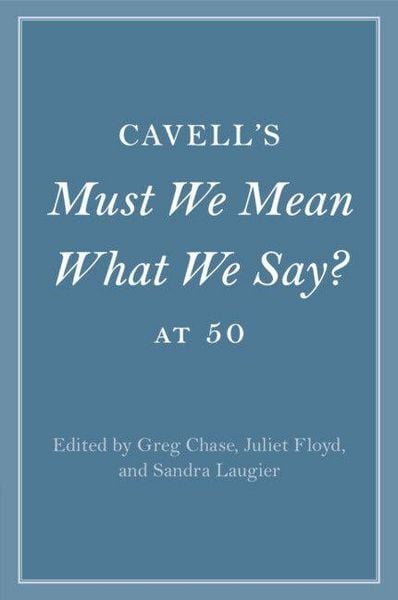
  • Produktbild: Cavell's Must We Mean What We Say? at 50
  • Produktbild: Cavell's Must We Mean What We Say? at 50

Cavell's Must We Mean What We Say? at 50

45,99 €

inkl. gesetzl. MwSt., Versandkostenfrei


Beschreibung

In 1969 Stanley Cavell's Must We Mean What We Say? revolutionized philosophy of ordinary language, aesthetics, ethics, tragedy, literature, music, art criticism, and modernism. This volume of new essays offers a multi-faceted exploration of Cavell's first and most important book, fifty years after its...

Beschreibung

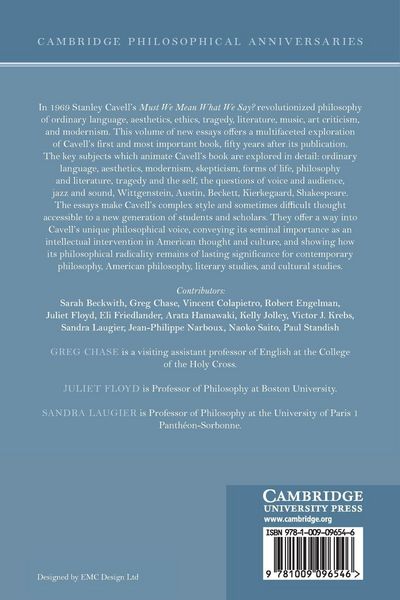
In 1969 Stanley Cavell's Must We Mean What We Say? revolutionized philosophy of ordinary language, aesthetics, ethics, tragedy, literature, music, art criticism, and modernism. This volume of new essays offers a multi-faceted exploration of Cavell's first and most important book, fifty years after its publication. The key subjects which animate Cavell's book are explored in detail: ordinary language, aesthetics, modernism, skepticism, forms of life, philosophy and literature, tragedy and the self, the questions of voice and audience, jazz and sound, Wittgenstein, Austin, Beckett, Kierkegaard, Shakespeare. The essays make Cavell's complex style and sometimes difficult thought accessible to a new generation of students and scholars. They offer a way into Cavell's unique philosophical voice, conveying its seminal importance as an intellectual intervention in American thought and culture, and showing how its philosophical radicality remains of lasting significance for contemporary philosophy, American philosophy, literary studies, and cultural studies.

Produktdetails

Einband

Taschenbuch

Erscheinungsdatum

04.04.2024

Herausgeber Greg Chase + weitere
Verlag Cambridge Academic

Produktdetails

Einband

Taschenbuch

Erscheinungsdatum

04.04.2024

Herausgeber
Verlag Cambridge Academic
Seitenzahl

260

Maße (L/B/H)

22,9/15,2/1,4 cm

Gewicht

390 g

Sprache

Englisch

ISBN

978-1-00-909654-6

Herstelleradresse

Libri GmbH
Europaallee 1
36244 Bad Hersfeld
DE

Email: gpsr@libri.de

Noch keine Bewertungen vorhanden

Verfassen Sie die erste Bewertung zu diesem Artikel

Helfen Sie anderen Kundinnen und Kunden durch Ihre Meinung.

Kundinnen und Kunden meinen

Bewertungen (0)

Die Leseprobe wird geladen.
  • Produktbild: Cavell's Must We Mean What We Say? at 50
  • Produktbild: Cavell's Must We Mean What We Say? at 50
  • Introduction: Part I. Ordinary Language and its Philosophy: 1. Must we mean what we say? and ordinary language philosophy Sandra Laugier; 2. Revolutionary uses of Wittgenstein in must we mean what we say? Juliet Floyd; 3. Actions and their elaboration Jean-Philippe Narboux; 4., Faces of the ordinary Eli Friedlander; Part II. Aesthetics and the Modern: 5. Language-games and 'forms of life': Cavell's reading of Wittgenstein and its relevance to literary studies Greg Chase; 6. Philosophic and aesthetic appeal: Stanley Cavell on the irreducibility of the first person in aesthetics and in philosophy Arata Hamawaki; 7. Reading into it or hearing it out? Cavell on modernism and the art critic's hermeneutical risk Robert Engelman; 8. Must we sing what we mean?: 'Music discomposed' and philosophy composed Vincent Colapietro; Part III. Tragedy and the Self: 9. Philosophy as autobiography: From must we mean what we say? to little did I know Naoko Saito; 10. The finer weapon: Cavell, philosophy and praise Victor J. Krebs; 11. On Cavell's on Kierkegaard's on authority and revelation-with constant reference to Austen Kelly Jolley; 12.Tragic Implication Sarah Beckwith; 13. Gored states and theatrical guises Paul Standis.