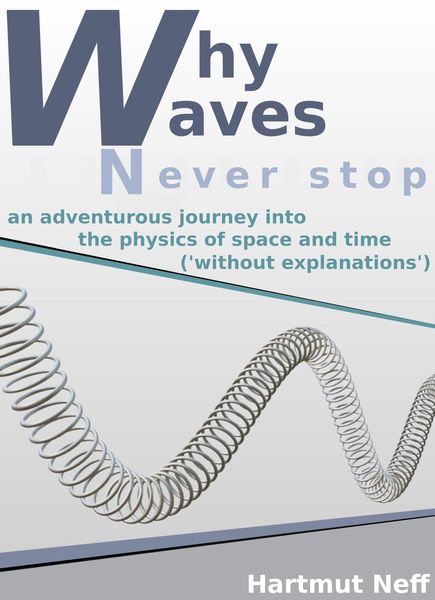
Why Waves Never Stop
-
- Einzelkauf Download ausgewählt
-
Sprache:Englisch
0,00 €
inkl. gesetzl. MwSt.Artikel erhalten
Beschreibung
Produktdetails
Format
ePUB
Kopierschutz
Ja
Family Sharing
Ja
Text-to-Speech
Ja
Verkaufsrang
53964
Erscheinungsdatum
08.01.2024
Verlag
Hartmut NeffSeitenzahl
(Printausgabe)
Dateigröße
784 KB
Sprache
Englisch
EAN
9798224824632
This is a book about the physics of space and time. The main goal of this book is to explain why time passes slower on a moving train. Unfortunately, this is not easy to explain. Or rather, it cannot be explained at all. This is, of course, a provocative statement, whose meaning will depend on the interpretation of the word to explain.
We will therefore first deal with explanations in themselves and analyse the question of what it means to explain, of how explanations work. That, you may think, is of no concern to you. After all, finding explanations is my job. But, we are in the same boat, as explanations are, obviously, closely linked to how we understand. In this context, we will encounter rules, that will be very simple in their structure, but lead to very complicated consequences. Understanding has more to do with the complicated consequences than with the simple rules. This is what makes explaining and understanding difficult. In fact, we will even see, that those complicated consequences cannot really be understood at all, but that we rather just get used to them. Understanding is therefore an inappropriate vocabulary to describe what we are about to do in this book, and so is explaining. This are good news, as now, there cannot be anything in the book that cannot be understood. Instead, you just have to get used to it. That, I think, should be doable.
Nonetheless, we will then embark on a search for explanatory models through the history of physics. This search will be successful because we will find the only true, the ultimate language for an objective description of nature. What language might this be?
With this language we will explore how classical physics uses the quantities space and time. We will wonder why it takes time to move through space. What does time have to do with it? Waves will teach us that space and time have to be treated on an equal footing. Shouldn't it then take space to move through time? Shouldn't time depend on how something is moving through space? Shouldn't time be individual, relative and not absolute?
Time is not what we think it is. We will discover, by looking at a water bottle and by throwing dice, that the flow of time is an illusion. The way physics describes time is fundamentally different from the way we experience it, from what we think time is.
In a slightly more technical chapter, we will learn how different observers can compare their locations and clocks, that is, space and time, with each other and, based on that, how they can converse about their respective views on nature. It is a curious thing that this type of conversations, that such a theoretical argument, will directly lead to the most famous equation of all, $E = m c^2$, with all of its dramatic consequences for the real world.
Finally, we will learn how waves force us to treat space and time on an equal footing and how this merges space and time into a union, into spacetime. Waves are, furthermore, responsible for the constant speed of light. Just think of your last visit to the beach. Have you ever wondered why waves seem to always go at the same speed? Have you ever asked yourself,
Why Waves Never Stop?
Kundinnen und Kunden meinen
Verfassen Sie die erste Bewertung zu diesem Artikel
Helfen Sie anderen Kund*innen durch Ihre Meinung
Kurze Frage zu unserer Seite
Vielen Dank für Ihr Feedback
Wir nutzen Ihr Feedback, um unsere Produktseiten zu verbessern. Bitte haben Sie Verständnis, dass wir Ihnen keine Rückmeldung geben können. Falls Sie Kontakt mit uns aufnehmen möchten, können Sie sich aber gerne an unseren Kund*innenservice wenden.
zum Kundenservice