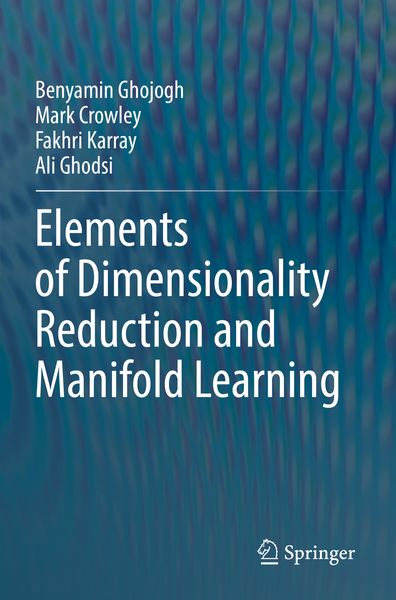
Elements of Dimensionality Reduction and Manifold Learning
-
- Hardcover
- Taschenbuch ausgewählt
- eBook
-
Sprache:Englisch
67,99 €
UVP
76,99 €
inkl. gesetzl. MwSt.,
Beschreibung
Produktdetails
Einband
Taschenbuch
Erscheinungsdatum
03.02.2024
Abbildungen
XXVIII, 606 p. 59 illus., 32 illus. in color.
Verlag
SpringerSeitenzahl
606
Maße (L/B/H)
23,5/15,5/3,4 cm
Gewicht
949 g
Sprache
Englisch
ISBN
978-3-031-10604-0
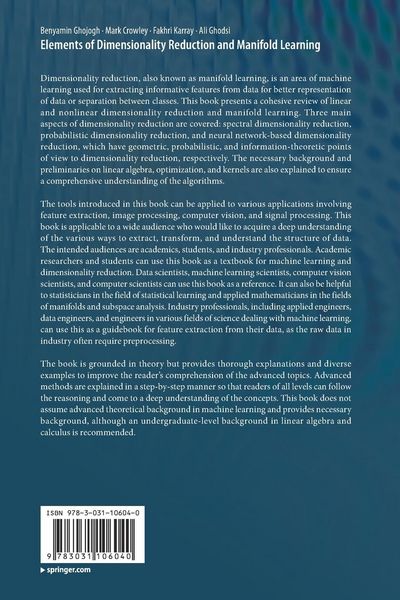
Dimensionality reduction, also known as manifold learning, is an area of machine learning used for extracting informative features from data for better representation of data or separation between classes. This book presents a cohesive review of linear and nonlinear dimensionality reduction and manifold learning. Three main aspects of dimensionality reduction are covered: spectral dimensionality reduction, probabilistic dimensionality reduction, and neural network-based dimensionality reduction, which have geometric, probabilistic, and information-theoretic points of view to dimensionality reduction, respectively. The necessary background and preliminaries on linear algebra, optimization, and kernels are also explained to ensure a comprehensive understanding of the algorithms.
The tools introduced in this book can be applied to various applications involving feature extraction, image processing, computer vision, and signal processing. This book is applicable to a wide audience who would like to acquire a deep understanding of the various ways to extract, transform, and understand the structure of data. The intended audiences are academics, students, and industry professionals. Academic researchers and students can use this book as a textbook for machine learning and dimensionality reduction. Data scientists, machine learning scientists, computer vision scientists, and computer scientists can use this book as a reference. It can also be helpful to statisticians in the field of statistical learning and applied mathematicians in the fields of manifolds and subspace analysis. Industry professionals, including applied engineers, data engineers, and engineers in various fields of science dealing with machine learning, can use this as a guidebook for feature extraction from their data, as the raw data in industry often require preprocessing.
The book is grounded in theory but provides thorough explanations and diverseexamples to improve the reader’s comprehension of the advanced topics. Advanced methods are explained in a step-by-step manner so that readers of all levels can follow the reasoning and come to a deep understanding of the concepts. This book does not assume advanced theoretical background in machine learning and provides necessary background, although an undergraduate-level background in linear algebra and calculus is recommended.
Noch keine Bewertungen vorhanden
Verfassen Sie die erste Bewertung zu diesem Artikel
Helfen Sie anderen Kundinnen und Kunden durch Ihre Meinung.
Kurze Frage zu unserer Seite
Vielen Dank für Ihr Feedback
Wir nutzen Ihr Feedback, um unsere Produktseiten zu verbessern. Bitte haben Sie Verständnis, dass wir Ihnen keine Rückmeldung geben können. Falls Sie Kontakt mit uns aufnehmen möchten, können Sie sich aber gerne an unseren Kund*innenservice wenden.
zum Kundenservice