• Produktbild: Waste-To-Energy
  • Produktbild: Waste-To-Energy

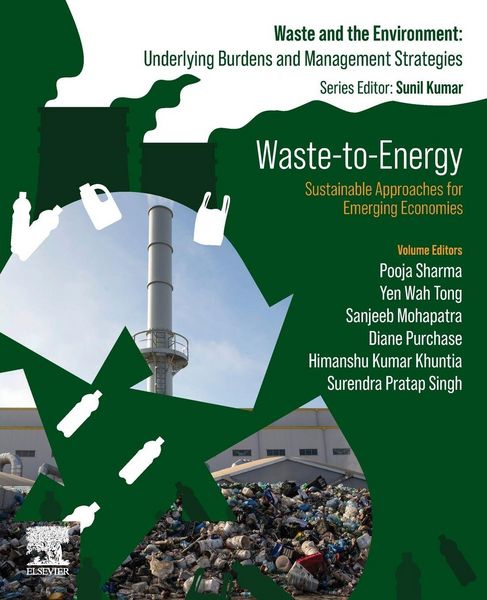
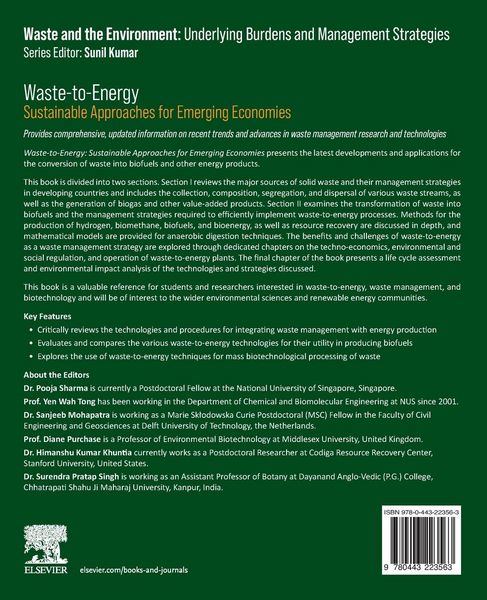
Waste-To-Energy Sustainable Approaches for Emerging Economies

206,99 €

inkl. gesetzl. MwSt., Versandkostenfrei


Portrait

Dr. Pooja Sharma is currently a Postdoctoral fellow at the National University of Singapore, Singapore. Her major areas of research are Environmental Microbiology/Biotechnology with a focus on waste-to-energy and bioremediation. Dr. Sharma has published 105 papers, citation-2558, and h-index-30 publications in different National and International Journals and Books (Elsevier, Springer, CRC Press, etc.) on various aspects of biofuel and microbiology covering her interests.

Prof. Yen Wah Tong is working in the Department of Chemical and Biomolecular Engineering at NUS since 2001, with research in biomimicry of living systems for medical and environmental applications. Since 2012, he has been the co-program Director of E2S2-CREATE, a major international research program with Shanghai Jiao Tong University, funded by the National Research Foundation, studying waste management in megacities. Prof Tong has published 285 papers in different National and International Journals and Books on various aspects of biofuel and microbiology covering her interests.

Dr. Sanjeeb Mohapatra works as a Marie Sklodowska Curie Postdoctoral (MSC) Fellow at the Faculty of Civil Engineering and Geosciences, Delft University of Technology, The Netherlands. Prior to this position, he worked as a Postdoctoral Research Scientist at the National University of Singapore. His research interest broadly covers the monitoring of emerging contaminants (ECs), photoelectrochemical (PEC) degradation of ECs, the role of dissolved organic matter in deciding the fate of such contaminants, and the circular economy approach to wastewater treatment. He is a recipient of the Water Advanced Research Innovation (WARI) Fellowship awarded by the Department of Science and Technology (DST), India, University of Nebraska Lincoln, USA, Daugherty Water for Food Global Institute (DWFI), USA, and Indo-U.S. Science and Technology Forum (IUSSTF). He is a recipient of the Newton-Bhabha Fellowship jointly awarded by DST, India, and British Council, U.K. He is also a recipient of the DST-INSPIRE fellowship offered by DST, India.

Prof. Diane Purchase is a Professor of Environmental Biotechnology at Middlesex University, UK. She has over 25 years of experience in environmental biotechnology, exploring the role of microorganisms as part of nature-based solutions to address environmental challenges such as climate change. She is a Fellow of the Royal Society of Biology and the Institution of Environmental Sciences in the UK. Diane has published widely and in many international journals and book series. She is the Editor of Environmental Science and Pollution Research (Springer), the Co-Editor-in-Chief of Environmental Geochemistry and Health (Springer), and the editor of several books on bioresources and biotechnologies published by Springer, De Gruyter, and World Scientific.

Dr. Himanshu Kumar Khuntia, currently works as a postdoctoral researcher at Codiga Resource Recovery Center, Stanford University, USA. He obtained his Ph.D. from Centre for Sustainable Technologies, Indian Institute of Science, India, and subsequently worked held a postdoctoral position at the same institution for three years.. His research focuses on the interconnections between water, energy, and food, with a particular emphasis on developing engineering solutions for emerging challenges in biowaste, biomass residues, and wastewater. Dr Khuntia has been recognized for his contributions, receiving the Water Advanced Research Innovation (WARI) Fellowship from the Indo-U.S. Science and Technology Forum (IUSSTF) to conduct research in environmental microbiology at the University of Nebraska-Lincoln, USA. Additionally, he was awarded a fellowship from the Indo-French Centre for the Promotion of Advanced Research (IFCPAR/CEFIPRA) to carry out research on process optimization at the Laboratory of Environmental Biotechnology in Narbonne, France.

Dr. Surendra Pratap Singh is working as Assistant Professor of Botany at Dayanand Anglo-Vedic (P.G.) College, Chhatrapati Shahu Ji Maharaj University, Kanpur. His research group is involved in characterizing various autophagy-related genes (ATG) in cotton fiber and other tapetum development, molecular plant-microbe interaction, transcriptomics in heavy metal stress, and metagenomics. Dr. Singh has published 29 papers in different National and International Journals and Books on various aspects of biofuel and microbiology covering her interests.

Produktdetails

Einband

Taschenbuch

Erscheinungsdatum

08.11.2024

Herausgeber

Pooja Sharma + weitere

Verlag

Elsevier

Seitenzahl

418

Maße (L/B/H)

23,5/19,1/2,2 cm

Gewicht

717 g

Sprache

Englisch

ISBN

978-0-443-22356-3

Portrait

Produktdetails

Einband

Taschenbuch

Erscheinungsdatum

08.11.2024

Herausgeber

Verlag

Elsevier

Seitenzahl

418

Maße (L/B/H)

23,5/19,1/2,2 cm

Gewicht

717 g

Sprache

Englisch

ISBN

978-0-443-22356-3

Herstelleradresse

Libri GmbH
Europaallee 1
36244 Bad Hersfeld
DE

Email: gpsr@libri.de

Kundinnen und Kunden meinen

0 Bewertungen

Informationen zu Bewertungen

Zur Abgabe einer Bewertung ist eine Anmeldung im Konto notwendig. Die Authentizität der Bewertungen wird von uns nicht überprüft. Wir behalten uns vor, Bewertungstexte, die unseren Richtlinien widersprechen, entsprechend zu kürzen oder zu löschen.

Die Bewertungen sind nach Format, Anzahl Sterne und Datum sortiert.

Verfassen Sie die erste Bewertung zu diesem Artikel

Helfen Sie anderen Kund*innen durch Ihre Meinung

Kundinnen und Kunden meinen

0 Bewertungen filtern

Die Leseprobe wird geladen.
  • Produktbild: Waste-To-Energy
  • Produktbild: Waste-To-Energy
  • Section I: Sources of waste and their re-use
    1. Waste collection, composition, segregation, and dispersal: Current state of the art Value-added product formation from food waste
    2. Anaerobic digestion of waste and generation of biogas
    3. Generation of hydrogen and methane from waste
    4. Biomethane production using co-additives from waste
    5. Biochar adding anaerobic digestion of waste
    6. Advancement in the technology and novel strategies for utilizing food waste
    7. Generation of value-added products
    8. Biofertilizer from food waste for agriculture sustainability

    Section II: Waste transformation into biofuels
    9. Anaerobic co-digestion improve major parameters impacting biofuel generation from food waste
    10. Mathematical modeling of anaerobic digestion
    11. Summary of developing sustainable waste to biofuel prospects
    12. Production of solid waste and its use in bioenergy
    13. Operational challenges during biofuel production from waste
    14. Generation of hydrogen and methane from waste through biological routes
    15. Contaminants of emerging concern and waste digestion
    16. Thermochemical methods of solid waste treatment
    ¿¿17. Treatment and resource recovery from solid waste via thermochemical catalytic reactions