KI-Beratung Beta

Gutscheinbedingungen

**Gültig bis 30.11.2026 auf Spielzeug, Schreibwaren, Filme, Geschenke & Trends, Musik, tolino eReader & Zubehör, Hörbücher und Hörbuch-Downloads, nicht preisgebundene Bücher und Kalender online auf thalia.at und in der Thalia App. Einzelne Artikel können ausgeschlossen sein. Aufgrund der Buchpreisbindung sind deutschsprachige Bücher und eBooks ausgenommen. Zusätzlich ausgenommen sind Abos & Flatrates, Games, Geschenkkarten/-boxen, Shelfies, Software, Zeitschriften sowie einzelne Artikel von tonies®. Pro Einkauf einmal einlösbar. Nur gültig mit im Onlineshop hinterlegter Bonuscard. Click & Collect nur bei Onlinevorabzahlung möglich. Keine Barauszahlung. Nicht kombinierbar mit anderen Aktionen und Gutscheinen. Gutschein wird auf max. 500€ Bestellwert angerechnet. Nicht gültig für Versandkosten und Services.

  • Produktbild: Emerging Developments in Constructed Wetlands
  • Produktbild: Emerging Developments in Constructed Wetlands

Emerging Developments in Constructed Wetlands

159,99 €

inkl. gesetzl. MwSt., Versandkostenfrei


Beschreibung

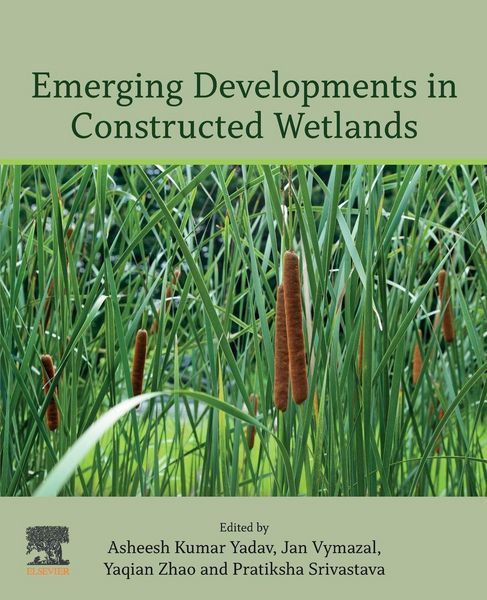
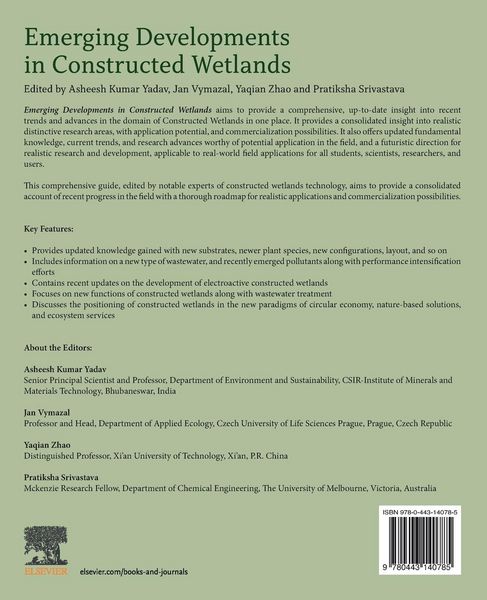
Emerging Developments in Constructed Wetlands aims to provide comprehensive, up-to-date information on recent trends and advances in the domain of constructed wetlands. The book contains consolidated insights into distinctive research areas with application potential and commercialization possibilities....

Beschreibung

Emerging Developments in Constructed Wetlands aims to provide comprehensive, up-to-date information on recent trends and advances in the domain of constructed wetlands. The book contains consolidated insights into distinctive research areas with application potential and commercialization possibilities. It also offers access to updated fundamental knowledge, current trends, and research advances worthy of potential implementations in the field. Although there has been significant research progress in the domain of constructed wetlands over the last years, there is no book available with actual case studies to meet growing demands.

Portrait

Asheesh Kumar Yadav is a Principal Scientist and Associate Professor at CSIR-Institute of Minerals and Materials Technology, Bhubaneswar, India. He completed his doctoral study at the Indian Institute of Technology Delhi and postdoctoral studies at Princeton University, Princeton, NJ, USA. Currently, he is working as Marie Curie Fellow at Rey Juan Carlos, Madrid, Spain. He is the pioneer of constructed wetlands coupled microbial Electrochemical technology (CW-MET) for energy production, wastewater treatment, and other environmental applications. He received numerous awards like Marie Curie Fellowship; Indo-American Research Professorship (American Society of Microbiology); Four times winner of Erasmus Mundus Scholar Awards for teaching and research in universities in Germany, Poland, Sweden, Portugal; Winner of VLIR scholarships of Belgium; and Nuffic fellowship of the Netherlands. Besides this, He got an adjunct faculty position at the University of Tasmania, Australia. He is interested in developing low-cost energy generating and saving wastewater treatment systems with capabilities of resource recovery. Moreover, he is invested in developing circularity and sustainability in water and wastewater treatment systems.Jan Vymazal graduated from the Institute of Chemical Technology in Prague, the Czech Republic in 1980 and received a Ph.D. at ITC in 1985. Between 1985 and 1991 he was affiliated with Water Research Institute in Prague at the department of wastewater treatment. In 1991 Jan joined Duke University Wetland Center, North Carolina, the USA as a visiting scholar. During his stay at
Duke University until 1993, he focused on the wetland plant communities in Florida Everglades. Between 1994 and 2006 Jan worked as a freelance researcher focusing mostly on constructed wetlands for wastewater treatment.
In 2007, he joined the Faculty of Environmental Sciences at the Czech University of Life Sciences in Prague. He is currently a professor and Head of the Department of Applied Ecology and vice-rector for research and science. Jan has authored more than 160 papers indexed in the Web of Sciences with over 11,000 citations an and H-index of 51, wrote two books and edited nine books on
natural and constructed wetlands. He is chief editor in the Ecological Engineering (Elsevier publication) journal and Editor in Science of the Total Environment (Elsevier publication).Yaqian Zhao is an Irish Chinese, distinguished professor at the Xi'an University of Technology; distinguished professor of "Hundred Talents Program" in Shaanxi province; chair professor of "Apsaras Scholars" in Gansu province; Fellow of the International Water Association (FIWA). Prof. Yaqian Zhao's research covers a number of issues in the areas of water, wastewater, and biosolids/residual treatment engineering, with specific achievements in the areas of: (1) constructed wetland systems for wastewater treatment; (2) phosphorus removal/immobilization/adsorption and (3) waterworks sludge conditioning, dewatering and beneficial disposal/reuse. In recent years, he has developed several practical, low cost and environmentally friendly technologies for wastewater treatment. A novel constructed wetland system developed by Dr. Zhao for high strength wastewater treatment has been reported by The Irish Times (2008, 2012), ICE(UK) (2009), Water 21 (magazine of Int. Water Association) (2010), and "The Source” (IWA magazine) (2021).
Prof. Zhao is a highly active researcher at an international level with over 400 research papers published in refereed journals, book contributions, and international conferences. He has been invited to deliver over 100 lectures at international conferences, research seminars, universities, and research organizations internationally (including Cambridge University, Edinburgh University, UK, etc.). Dr. Zhao is a journal founder member and 9 journal editorial board members as well as 57 journal reviewers. He has solely supervised 4 Postdocs and 15 Ph.D. and several Master's students since 2004. Due to Prof. Zhao's significant academic contribution to water science and technology, he has been elected as a Fellow of IWA (International Water Association) in 2016. In 2021, he received the "Shamrock Environmental Awards” in Ireland.Dr Pratiksha Srivastava is currently a Postdoctoral fellow at Rey Juan Carlos University, Madrid, Spain. She did her Ph.D. studies at the University of Tasmania, Australia. She has a large number of publications in the domain METs. Her main focus is on high-rate wastewater treatment using METs. She is among the pioneer who developed electrode-dependent anaerobic ammonium oxidation in Constructed wetlands coupled with microbial electrochemical technology. The work has gained considerable attention among scientists. Based on her significant contribution to sustainability research, she received the prestigious Green Talent award from the German Federal Ministry in 2017. She is also a recipient of the Nuffic fellowship, the Netherlands, and many other competitive grants and national and international levels.
Produktdetails

Einband

Taschenbuch

Erscheinungsdatum

29.11.2024

Herausgeber Asheesh Kumar Yadav + weitere
Verlag Elsevier Science & Technology

Produktdetails

Einband

Taschenbuch

Erscheinungsdatum

29.11.2024

Herausgeber
Verlag Elsevier Science & Technology
Seitenzahl

826

Maße (L/B/H)

23,5/19,1/4,2 cm

Gewicht

1393 g

Sprache

Englisch

ISBN

978-0-443-14078-5

EU-Ansprechpartner

Elsevier B.V.
Radarweg 29
1043 NX Amsterdam
NL
productsafety@elsevier.com

Herstelleradresse

Elsevier Science & Technology
London Wall 125
EC2Y 5AS London
GB
tradeorders@elsevier.com

Noch keine Bewertungen vorhanden

Verfassen Sie die erste Bewertung zu diesem Artikel

Helfen Sie anderen Kundinnen und Kunden durch Ihre Meinung.

Kundinnen und Kunden meinen

Bewertungen (0)

  • Produktbild: Emerging Developments in Constructed Wetlands
  • Produktbild: Emerging Developments in Constructed Wetlands
  • I. New research experience with microbial assemblage, vegetation, substrate materials, pollutants, and wastewater
    1. An updated overview of plant species used in constructed wetlands
    2. A global scenario of new substrates utilized in constructed wetlands
    3. Coupling of constructed wetlands with other technologies for optimum performance
    4. Development, advances, and mathematical modeling in treatment wetlands for eutrophic aquatic ecosystems
    5. Understanding of biogeochemical network of redox-active elements in constructed wetlands for controlling/improving the treatment performance
    6. Life cycle assessment of constructed wetlands: measuring their contribution to sustainable development
    7. A revisit of constructed wetlands technology-microbial density and diversity and their relation to pollutant removal
    8. Constructed wetlands clogging-a deeper understanding and remediation strategies
    II. Experience on New generation of constructed wetlands coupled with microbial electrochemical technologies
    9. The emergence of constructed wetlands coupled with microbial electrochemical technology: historical development and the potential applications
    10. Pollutants removal in constructed wetlands coupled with microbial electrochemical technology
    11. Bioelectrochemically assisted wetland: the METland concept
    12. Microbial electrochemical technology for biosensing purposes in constructed wetlands
    13. Greenhouse gases emission control using constructed wetlands coupled with microbial electrochemical technology
    III. New experiments with design, configuration, and layout
    14. Modular and transportable constructed wetlands
    15. TAYA-an intensified constructed wetlands technology
    16. Constructed wetlands inspired Phytorid technology for wastewater treatment application using
    17. Green walls for wastewater treatment
    18. Design recommendations to support green walls for urban water reuse guidelines
    19. Green walls and green roof-some experiences from the field
    20. Floating treatment wetlands: a futuristic approach for industrial wastewater treatment
    IV. Performance intensification of constructed wetlands
    21. Intensification of French-type verticalflow treatment wetlands using complementary treatment steps and adapted operating conditions
    22. Emerging development in application, design, and operations & maintenance of aerated treatment wetlands
    23. Bioaugmentation in constructed wetlands for performance enhancement
    24. New experiences to address the performance slowness in constructed wetlands in a cold climate
    25. Application of biochar as an innovative substrate in constructed wetlands/biofilters for wastewater treatment: performance and ecological benefits
    26. Combining the large-scale rotating biological contactors and integrated constructed wetlands for improving river quality
    27. Estimating the removal rate coefficient for intensified wetlands utilizing reactive media for treating high-strength wastewater: an N-k-C* approach
    V. News functions
    28. Wetland community expertise in the new nature-based solutions and circular economy vision
    29. Valorization prospects of plant biomass generated in constructed wetland for bioenergy production
    30. Fecal sludge management using constructed wetlands
    31. Understanding removal of microplastics in constructed wetlands: processes, performance, and impacts
    32. Implementing constructed wetlands for wastewater and sludge treatment in hot and arid climates: existing solutions and future challenges