Gutscheinbedingungen

**Gültig bis 06.07.2026 auf fremdsprachige Bücher online auf thalia.at, in der Thalia App ab einem Mindestbestellwert von 30€ und in allen Thalia Buchhandlungen in Österreich. In den Buchhandlungen nur gültig auf lagernde Ware. Einzelne Artikel können ausgeschlossen sein. Ausgenommen sind preisgebundene Artikel & eBooks. Pro Einkauf einmal einlösbar. Nur gültig gegen Vorlage oder im Onlineshop hinterlegter Bonuscard. Infos zur Einlösung in der Buchhandlung sind auf der Bonuscard-Vorteilspreisseite zu finden. Click & Collect nur bei Onlinevorabzahlung möglich. Keine Einlösung bei Scan & Go-Bezahlung. Keine Barauszahlung. Nicht kombinierbar mit anderen Aktionen und Gutscheinen. Gutschein wird auf max. 500€ Bestellwert angerechnet. Nicht gültig für Versandkosten und Services.

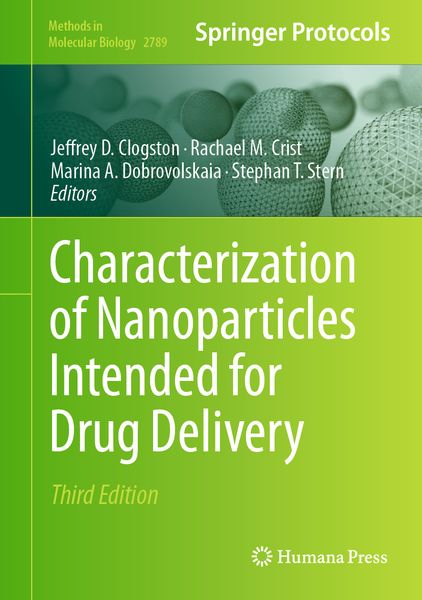
Produktbild: Characterization of Nanoparticles Intended for Drug Delivery
Band 2789 - 15%

Characterization of Nanoparticles Intended for Drug Delivery

15% sparen

166,99 € UVP 197,99 €

inkl. gesetzl. MwSt., Versandkostenfrei


Beschreibung

Produktdetails

Einband

Gebundene Ausgabe

Erscheinungsdatum

21.03.2024

Abbildungen

XII, 1 illus., schwarz-weiss Illustrationen

Herausgeber

Jeffrey D. Clogston + weitere

Verlag

Springer Us

Seitenzahl

324

Maße (L/B/H)

26/18,3/2,4 cm

Gewicht

831 g

Auflage

Third Edition 2024

Sprache

Englisch

ISBN

978-1-07-163785-2

Beschreibung

Produktdetails

Einband

Gebundene Ausgabe

Erscheinungsdatum

21.03.2024

Abbildungen

XII, 1 illus., schwarz-weiss Illustrationen

Herausgeber

Verlag

Springer Us

Seitenzahl

324

Maße (L/B/H)

26/18,3/2,4 cm

Gewicht

831 g

Auflage

Third Edition 2024

Sprache

Englisch

ISBN

978-1-07-163785-2

Herstelleradresse

Libri GmbH
Europaallee 1
36244 Bad Hersfeld
DE

Email: GPSR Kontakt

Noch keine Bewertungen vorhanden

Verfassen Sie die erste Bewertung zu diesem Artikel

Helfen Sie anderen Kundinnen und Kunden durch Ihre Meinung.

Kundinnen und Kunden meinen

Bewertungen (0)

  • Produktbild: Characterization of Nanoparticles Intended for Drug Delivery
  • Advancements in Nanoparticle Characterization.- Nanoparticle Size Distribution and Stability Assessment Using Asymmetric-Flow Field-Flow Fractionation.- Assessment of Protein Binding Using Asymmetric-Flow Field-Flow Fractionation Combined with Multi-Angle Light Scattering and Dynamic Light Scattering.- Quantitation of Active Pharmaceutical Ingredients in Polymeric Drug Products Using Elemental Analysis.- Particle Size and Concentration Measurement Using the Spectradyne nCS1 Instrument.- Measuring Size and Number Concentration of Metallic Nanoparticles Using spICP-MS.- Ion Quantitation in Liposomal Products with RP-HPLC and Charged Aerosol Detection.- A Static Headspace Gas Chromatography Method for Quantitation of Residual Solvents in Nanoformulations.- Current Considerations and Practical Solutions for Overcoming Nanoparticle Interference with LAL Assays and Minimizing Endotoxin Contamination.- Detection of Beta-Glucan Contamination inNanoparticle Formulations.- Detection of Intracellular Complement Activation by Nanoparticles in Human T Lymphocytes.- Analysis of Nanoparticles’ Potential to Induce Autoimmunity.- Analysis of Nanoparticles’ Effects on Drug-Induced Psoriasis.- Detection of Nanoparticle-Mediated Total Oxidative Stress in T-Cells Using CM-H2DCFDA Dye.- Detection of Induction of Mitochondrial Oxidative Stress by Nanoparticles in T-Cells Using MitoSOX Red Dye.- Detection of Nanoparticle-Mediated Change in Mitochondrial Membrane Potential in T-Cells Using JC-1 Dye.- Detection of Antigen Presentation by Murine Bone Marrow-Derived Dendritic Cells After Treatment with Nanoparticles.- Antigen-Specific Stimulation of CD8+ T-Cells by Murine Bone Marrow-Derived Dendritic Cells After Treatment with Nanoparticles.- Detection of Pre-Existing Antibodies to Polyethylene Glycol and PEGylated Liposomes in Human Serum.- In Vitro and In Vivo Methods for Analysis of Nanoparticle Potential to Induce Delayed-Type Hypersensitivity Reactions.- Analysis of Nanoparticle Adjuvant Properties.- Methods for Analysis of Nanoparticle Immunosuppressive Properties.- Evaluation of the Acute Anaphylactoid Reactogenicity of Nanoparticle-Containing Medicines and Vaccines Using the Porcine CARPA Model.- Immunophenotyping, Part I: Instrument Calibration and Reagent Qualification for immunophenotyping Analysis of Human Peripheral Blood Mononuclear Cell Cultures.- Immunophenotyping, Part II: Analysis of Nanoparticle Effects on the Composition and Activation Status of Human Peripheral Blood Mononuclear Cells.- Understanding the Role of Scavenger Receptor A1 in Nanoparticle Uptake by Murine Macrophages.- Assessment of Temperature-Dependent Drug Release of Solubilizing Nanoformulations Using the SITUA.- Evaluation of Nanomedicine Tissue Distribution and Stability by Alexa Fluor 488 and PEG Immunohistochemistry.