• Produktbild: The Austrian School of Economics in the 21st Century
  • Produktbild: The Austrian School of Economics in the 21st Century
- 11%

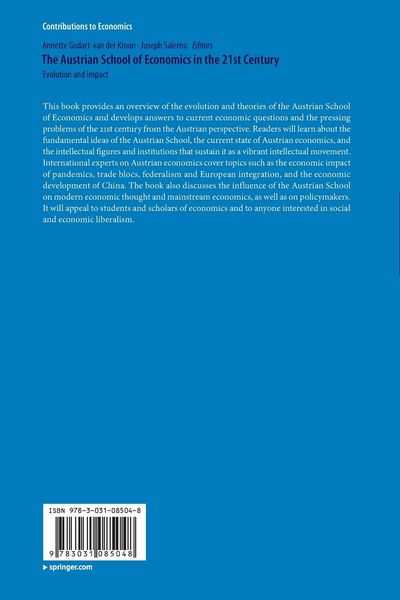
The Austrian School of Economics in the 21st Century Evolution and Impact

11% sparen

62,99 € UVP 71,49 €

inkl. gesetzl. MwSt., Versandkostenfrei


Beschreibung

Produktdetails

Einband

Taschenbuch

Erscheinungsdatum

08.01.2024

Herausgeber

Annette Godart-van der Kroon + weitere

Verlag

Springer

Seitenzahl

336

Maße (L/B/H)

23,5/15,5/2 cm

Gewicht

540 g

Auflage

1st ed. 2022

Sprache

Englisch

ISBN

978-3-031-08504-8

Beschreibung

Portrait

Annette Godart-van der Kroon (LLM) is the President of the Ludwig von Mises Institute – Europe. She also possesses long-term experience as a civil affairs lawyer at the Courts of Roermond and Utrecht in the Netherlands (Brussels, Belgium). In 1996 she became a member of the Mont Pélerin Society, an influential society composed of Nobel Prize winning economists and other leading scholars. She is an author /editor of several books and she presented many articles at Universities such as the University of Athens, Erfurt, Maastricht, Heilbronn, Lviv and others.

Joe Salerno is an American Austrian School economist, who is Professor Emeritus of Economics in the Finance and Graduate Economics departments at the Lubin School of Business at Pace University (USA). He is Academic Vice President of the Ludwig von Mises Institute, and holds the John V. Denson II Endowed Professorship in the economics department at Auburn University (USA). He earned his B.A.at Boston College and his M.A. and Ph.D. at Rutgers University. Salerno has published over 50 scholarly articles and books and is the editor of the Quarterly Journal of Austrian Economics . He is a recognized expert on monetary theory and policy, international monetary reform, and Austrian economics and has testified before the United States Congress on the topics of inflation and of reserve fractional reserve banking.


Produktdetails

Einband

Taschenbuch

Erscheinungsdatum

08.01.2024

Herausgeber

Verlag

Springer

Seitenzahl

336

Maße (L/B/H)

23,5/15,5/2 cm

Gewicht

540 g

Auflage

1st ed. 2022

Sprache

Englisch

ISBN

978-3-031-08504-8

Herstelleradresse

Springer-Verlag KG
Sachsenplatz 4-6
1201 Wien
AT

Email: GPSR Kontakt

Noch keine Bewertungen vorhanden

Verfassen Sie die erste Bewertung zu diesem Artikel

Helfen Sie anderen Kundinnen und Kunden durch Ihre Meinung.

Kundinnen und Kunden meinen

Bewertungen (0)

  • Produktbild: The Austrian School of Economics in the 21st Century
  • Produktbild: The Austrian School of Economics in the 21st Century
  • ¿ Part I. A short introduction to the theories of the Austrian School.- Chapter 1. Emergence of Fundamental Liberalism in the Economics of the Austrian School after WWI: In the Case of Ludwig von Mises (Kiichiro Yagi).- Chapter 2. Capital and time - sources of innovation in the economic development. Austrian economics perspective (Robert Ciborowski).- Part II. History and the present situation.- Chapter 3. The present situation in the USA: Austrian Economics in the 21st Century (Peter Boettke).- Chapter 4. The Austrian School in the USA: Institutions and Entrepreneurship (Christopher J. Coyne).- Chapter 5. The present state of Austrian School of Economics in Europe (Mateusz Machaj).- Chapter 6. Austrian Economics in Japan: The Life and Legacy of Katsuichi Yamamoto (Hiroyuki Okon).- Part III The Austrian School. Finance in the 21st century.- Chapter 7. The Political Realities of the Austrian School: Experiences from Parliament, Central Banks and Global Institutions (Steve Baker).- Chapter 8. Monetary Policy after the Coronavirus Crisis: Ultralow Interest Rates (Arkadiusz Sierö).- Chapter 9. The Economic effects of pandemics (An Austrian Analysis) (Jesús Huerta de Soto).- Part IV. The Institutions.- Chapter 10. The Austrian Perspective of Political Integration: An Overview (Roland Vaubel).- Chapter 11. Hayekian federalism and European integration (Federico Ottavio Reho).- Part V. The future.- Chapter 12. A Passage to Asia: What the future of international trade partnerships can learn from the past (Carmen-Elena Dorobat).- Chapter 13. Does Chinese Economic Development fit the Austrian Perspective? (Erich Weede).- Chapter 14. Will the Antagonism Between the Mainstream Theories and The Theories of the Austrian School of Economics Continue to Exist in the Future or Will More Ideas of The Austrian School Be Incorporated in Mainstream Economics? (Philipp Bagus).