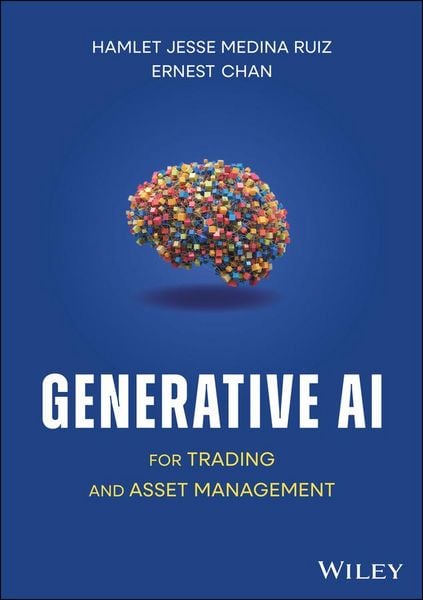
Beschreibung
Produktdetails
Einband
Gebundene Ausgabe
Erscheinungsdatum
06.05.2025
Verlag
WileySeitenzahl
320
Maße (L/B/H)
25,5/18,3/2,2 cm
Gewicht
672 g
Sprache
Englisch
ISBN
978-1-394-26697-5
Praise for GENERATIVE AI FOR TRADING AND ASSET MANAGEMENT
"Kudos to Medina Ruiz and Chan for sharing their hard-earned knowledge and creating a practitioner resource that is timely, relevant, and 'roll up your sleeves' practical. They have the distinction of bringing to life a text that is both information-dense and comprehensive yet highly engaging and readable-a rare combination! Whether you plan to engage with Generative AI as your co-pilot or go deep into coding custom solutions, this book will serve as both a trusted guide and as a foundational reference. The addition of accompanying code repositories and notebooks will allow organizations to hit the ground running with Generative AI. I anticipate that I'll have a well-thumbed copy near my computer monitor in the very near future!"
-JAY VYAS, Chief Strategy Officer, Firinne Capital; former Head of Research and Innovation, Canada Pension Plan Investment Board
"The book by Medina Ruiz and Chan has appeared when people are still wondering what ChatGPT in particular and LLMs in general are all about. Those who will read and implement it first will have an undisputed advantage: they have learned the industry-defining subject from experts who are known for their knack for making the complex easily accessible. The book is not just about LLMs. It is about Generative AI and its intelligent use in trading and, more generally, finance. Highly recommended for practitioners and academics alike."
-PAUL ALEXANDER BILOKON, CEO, Thalesians Ltd; Visiting Professor, Imperial College London
"Generative AI for Trading and Asset Management by renowned quant Hamlet Medina Ruiz and Ernest Chan is the definitive guide to harnessing Generative AI in financial markets. From no-code AI for finance beginners to the fine-tuning of deep, multi-layered models, this book unpacks cutting-edge techniques with clarity and precision. Dive into deep autoregressive models, latent variable architectures, flow-based models, sentiment analysis, GANs, and LLMs-all tailored for quantitative trading and asset management. Whether you're an aspiring quant, a hedge fund strategist, or a Goldman Sachs MD, this book is your blueprint for staying ahead in the AI-driven evolution of finance."
-ALEXANDER FLEISS, CEO of Rebellion Research, AI Asset Manager & Research Think Tank, Advisory Board Member of both Cornell Financial Engineering & Fordham Gabelli Quantitative Finance, Editor of The Journal of Financial Data Science
Kundinnen und Kunden meinen
Verfassen Sie die erste Bewertung zu diesem Artikel
Helfen Sie anderen Kund*innen durch Ihre Meinung
Kurze Frage zu unserer Seite
Vielen Dank für Ihr Feedback
Wir nutzen Ihr Feedback, um unsere Produktseiten zu verbessern. Bitte haben Sie Verständnis, dass wir Ihnen keine Rückmeldung geben können. Falls Sie Kontakt mit uns aufnehmen möchten, können Sie sich aber gerne an unseren Kund*innenservice wenden.
zum Kundenservice