Gutscheinbedingungen

**Gültig bis 25.08.2026 ab einem Mindestbestellwert von 30€ auf Spielzeug, Schreibwaren, Filme, Geschenke & Trends, Musik, tolino eReader & Zubehör, Hörbücher und Hörbuch-Downloads (außer Abo), nicht preisgebundene Bücher und Kalender online auf thalia.at und in der Thalia App. Einzelne Artikel können ausgeschlossen sein. Aufgrund der Buchpreisbindung sind deutschsprachige Bücher und eBooks ausgenommen. Zusätzlich ausgenommen sind preisgebundene Artikel, Abos & Flatrates, eBooks, Games, Geschenkkarten/-boxen, Shelfies, Software, Zeitschriften sowie einzelne Artikel von tonies®. Pro Einkauf einmal einlösbar. Click & Collect nur bei Onlinevorabzahlung möglich. Keine Barauszahlung. Nicht kombinierbar mit anderen Aktionen und Gutscheinen. Gutschein wird auf max. 500€ Bestellwert angerechnet. Nicht gültig für Versandkosten und Services. Preisgebundene Artikel sind vom Mindestbestellwert ausgeschlossen.

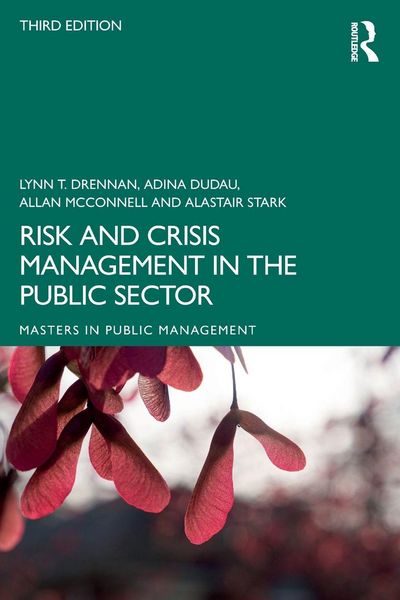
  • Produktbild: Risk and Crisis Management in the Public Sector
  • Produktbild: Risk and Crisis Management in the Public Sector

Risk and Crisis Management in the Public Sector

74,99 €

inkl. gesetzl. MwSt., Versandkostenfrei


Beschreibung

Produktdetails

Einband

Taschenbuch

Erscheinungsdatum

27.06.2024

Abbildungen

3 SW-Abb., 3 SW-Zeichn., 2 Tabellen

Verlag

Taylor & Francis

Seitenzahl

294

Maße (L/B/H)

23,4/15,6/1,6 cm

Gewicht

450 g

Auflage

3. Auflage

Sprache

Englisch

ISBN

978-1-03-243472-8

Beschreibung

Rezension

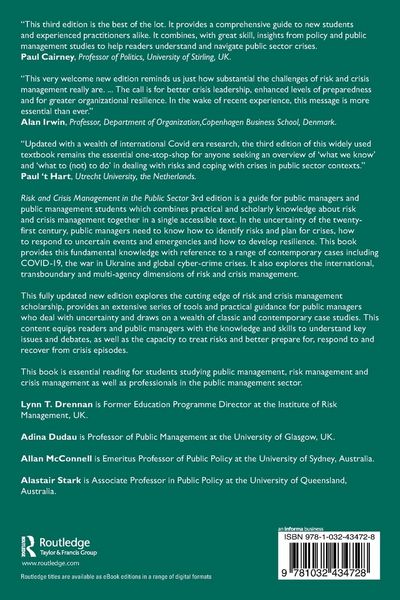
"This third edition is the best of the lot. It provides a comprehensive guide to new students and experienced practitioners alike. It combines, with great skill, insights from policy and public management studies to help readers understand and navigate public sector crises."

Paul Cairney, Professor of Politics, University of Stirling, UK.

"As public managers around the world try to assess the successes and failures of national COVID-19 responses, this very welcome new edition of a key text reminds us just how substantial the challenges of risk and crisis management really are. From risk identification to matters of risk communication, and from contingency planning to post-crisis evaluation and learning, the main issues are presented in a clear, highly informed and well-structured fashion. Promising to meet the practitioner 'halfway', we are taken through the complexities and contradictions of risk and crisis but pointed also to the possibilities for learning from practical and academic experience across several risk domains. The call is for better crisis leadership, enhanced levels of preparedness and for greater organizational resilience in the face of emergent risks. In the wake of recent experience, this message is more essential than ever."

Alan Irwin, Professor, Department of Organization,Copenhagen Business School, Denmark.

"Updated with a wealth of Covid era research from around the globe, the third edition of this widely used textbook easily remains the essential one stop shop for anyone seeking a state of the art overview of 'what we know' and 'what to (not) to do' in dealing with risks and coping with crises in public sector contexts."

Paul 't Hart, Utrecht University, the Netherlands.

Produktdetails

Einband

Taschenbuch

Erscheinungsdatum

27.06.2024

Abbildungen

3 SW-Abb., 3 SW-Zeichn., 2 Tabellen

Verlag

Taylor & Francis

Seitenzahl

294

Maße (L/B/H)

23,4/15,6/1,6 cm

Gewicht

450 g

Auflage

3. Auflage

Sprache

Englisch

ISBN

978-1-03-243472-8

EU-Ansprechpartner

Taylor & Francis Verlag GmbH
Kaufingerstraße 24
80331 München
DE
GPSR@taylorandfrancis.com

Herstelleradresse

Taylor & Francis Group
5 Howick Place
SW1P 1WG London
UK
GPSR@taylorandfrancis.com

Noch keine Bewertungen vorhanden

Verfassen Sie die erste Bewertung zu diesem Artikel

Helfen Sie anderen Kundinnen und Kunden durch Ihre Meinung.

Kundinnen und Kunden meinen

Bewertungen (0)

Die Leseprobe wird geladen.
  • Produktbild: Risk and Crisis Management in the Public Sector
  • Produktbild: Risk and Crisis Management in the Public Sector
  • Figures, Tables, Boxes and Cases xii

    Acknowledgements for the third edition xiv

    Preface xv

    Abbreviations xx

    1 Risk and crisis: definitions, debates and consequences 1

    Risk as probability, threat and opportunity 2

    Strategic and operational risks 4

    Public sector risk 8

    The development of risk management 10

    Defining crises: schools of thought 11

    Understanding the plethora of crisis definitions 16

    The crisis management cycle 28

    Conclusion 30

    Discussion questions 31

    2 Risk and crisis management: drivers and barriers 35

    Adopting a systematic approach to risk and crises 36

    Justifying risk and crisis management 38

    Environmental drivers 42

    Barriers to effective risk and crisis management 49

    Understanding the causes of crises 51

    Identifying crises before they arrive 56

    Conclusion 59

    Discussion questions 60

    3 Risk identification and assessment 66

    Risk identification 67

    Risk assessment 71

    Risk management capacity 74

    Risk to whom? 77

    Objectivist and subjectivist risk assessment 78

    The precautionary principle 79

    Risk management and ethics: guiding principles and rules 81

    Conclusion 83

    Discussion questions 84

    4 Risk response and risk communication 89

    Key terms 90

    Risk response 90

    Risk communication 97

    The role of trust 100

    Risk and learning in the resilient organization 103

    Conclusion 105

    Discussion questions 105

    5 Contingency planning and crisis preparedness 110

    Key terms 111

    Planning and preparedness: a primer 111

    A cycle of preparedness 112

    Stage one: assessing capabilities 114

    Ideal planning vs. public sector reality 133

    Case study 5.1: fantasy documents and the queensland floods 135

    Conclusion 140

    Discussion questions 140

    6 Managing the acute phase of crisis: adapting to uncertainty 145

    Key terms 146

    Acute crisis management: elementary issues 146

    Functions and response patterns 148

    Influences on the acute stage of crisis management 166

    Conclusion 174

    Discussion questions 174

    7 After the crisis: evaluation, learning and accountability 178

    Key terms 179

    Post-crisis evaluation: learning and accountability in context 179

    The challenge of evaluation: what constitutes a successful crisis response? 181

    Post-crisis policy reform and learning 187

    Accountability and blame games 192

    Factors influencing the crisis aftermath 197

    Conclusion 202

    Discussion questions 203

    8 Risk and crisis management in a global world 208

    Key terms 209

    The paradox of globalization 209

    Emerging global risks 210

    Growing risks 212

    Interval risks 218

    Speculative risks 219

    Humanitarian crisis management 220

    Remote crisis management 225

    Transboundary crisis management 229

    Conclusion 231

    Discussion questions 232

    Conclusion 236

    Case study one: lesson learning in the shadow of the pandemic 239

    The 'what' of pandemic lesson-learning 239

    The 'how' of pandemic lesson-learning 242

    Conclusion 243

    Case study two: cyberattacks and personal data breaches 245

    Managing cybersecurity risks 246

    Managing 'successful' hacks 247

    Conclusion 248

    Case study three: wildfires 250

    Greece 251

    USA 252

    Australia 254

    Conclusion: the need for better risk communication 256

    Index 259