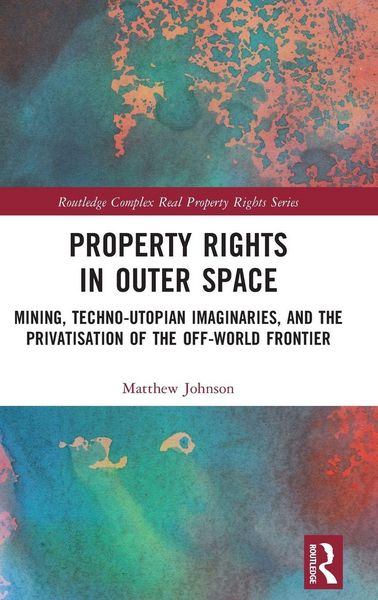

Property Rights in Outer Space Mining, Techno-Utopian Imaginaries, and the Privatisation of the Off-World Frontier
-
- Hardcover ausgewählt
- Taschenbuch
- eBook
-
Sprache:Englisch
197,99 €
inkl. gesetzl. MwSt.,
Beschreibung
Produktdetails
Einband
Gebundene Ausgabe
Erscheinungsdatum
28.05.2024
Abbildungen
5 Farbabb., 5 SW-Fotos
Verlag
Taylor & FrancisSeitenzahl
284
Maße (L/B/H)
24/16,1/2 cm
Gewicht
593 g
Sprache
Englisch
ISBN
978-1-03-222516-6
This book explores the role of private mining rights in the utopian imaginary of space colonisation. It presents a transdisciplinary account of the new and evolving legislative frameworks that have been established in anticipation of commercial exploitation of the mineral resources of the off-world frontier. Written in an engaging style, the book investigates a novel case study in the history of capitalism and 'the commons': the emergence of a nascent space mining industry, undergirded by a contentious legislative framework. In 2015, the US passed laws that would recognise the claims of US corporations to own and sell space resources. This unilateral act of pre-emptive law-making would appear to contravene the terms of the UN Outer Space Treaty (1967), which declared that the exploration and use of outer space should be 'for the benefit of all mankind' and 'not subject to national appropriation'.
Using this central dynamic between privately held mining rights and outer space as a 'global commons', Matthew Johnson constructs an historical sociology of space mining - from the deep historical roots of common and private property to the contemporary networks of neoliberalism that have engaged with the commercialisation of space activity. The anticipatory expansion of private property claims beyond the Earth both resonates with and problematises the 'terrain' of political history, such as the tensions between states and markets, public law and private power, 'the commons' and exclusive property. The emerging cosmopolitics of off-world private property mirrors (and is often explicitly embedded within) neoliberal geopolitics, prompting urgent questions about how we can reaffirm principles of democracy and 'common heritage' in the international laws of Earth and space. This book is compelling reading for anyone interested in the social study of space, law, economics, technology, politics and property rights.
Noch keine Bewertungen vorhanden
Verfassen Sie die erste Bewertung zu diesem Artikel
Helfen Sie anderen Kundinnen und Kunden durch Ihre Meinung.
Kurze Frage zu unserer Seite
Vielen Dank für Ihr Feedback
Wir nutzen Ihr Feedback, um unsere Produktseiten zu verbessern. Bitte haben Sie Verständnis, dass wir Ihnen keine Rückmeldung geben können. Falls Sie Kontakt mit uns aufnehmen möchten, können Sie sich aber gerne an unseren Kund*innenservice wenden.
zum Kundenservice