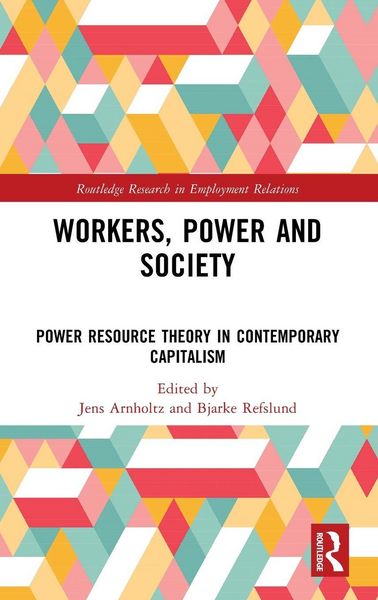

Workers, Power and Society Power Resource Theory in Contemporary Capitalism
-
- Hardcover ausgewählt
- Taschenbuch
- eBook
-
Sprache:Englisch
226,99 €
inkl. gesetzl. MwSt.,
Beschreibung
Produktdetails
Einband
Gebundene Ausgabe
Erscheinungsdatum
03.06.2024
Abbildungen
5 SW-Abb., 5 SW-Zeichn., 7 Tabellen
Herausgeber
Jens Arnholtz + weitereVerlag
Taylor & FrancisSeitenzahl
274
Maße (L/B/H)
24/16,1/1,9 cm
Gewicht
578 g
Sprache
Englisch
ISBN
978-1-03-254786-2
The book addresses how power and power resources remain important analytically as well as empirically dimensions for analysing contemporary capitalism. It provides a theoretical framework for studying, understanding, and explaining changes in the world of work and how that leads to changes in contemporary capitalist societies. Changes in the world of work are closely related to increasing inequality, growing social unrest, and societal polarisation. Hence the book seeks to deepen our understanding of how developments in the sphere of work have implication far beyond the direct impact on workers. The book focuses on how workers and unions utilise their various power resources to off-set the power advantage of employers and capital in the sphere of labour politics, which have crucial linkages with both cultural life, politics, and the market. Although workers' and unions' power and influence have been declining almost universally across the world, the argument in the book is that they still hold power resources that can challenge and sometimes alter outcomes in another direction than what employers and capital wants. Hence the theory can help understand the possibilities that workers and unions still have and how these resources affect the outcomes of the labour-capital struggle. A core contribution of the book is that it develops theoretical propositions about power resource theory, provides clear definitions of the core concepts as well as apply the power resource theory to a range of new or emerging topic fields like global value chains, minimum wages, and migrant workers.
Noch keine Bewertungen vorhanden
Verfassen Sie die erste Bewertung zu diesem Artikel
Helfen Sie anderen Kundinnen und Kunden durch Ihre Meinung.
Kurze Frage zu unserer Seite
Vielen Dank für Ihr Feedback
Wir nutzen Ihr Feedback, um unsere Produktseiten zu verbessern. Bitte haben Sie Verständnis, dass wir Ihnen keine Rückmeldung geben können. Falls Sie Kontakt mit uns aufnehmen möchten, können Sie sich aber gerne an unseren Kund*innenservice wenden.
zum Kundenservice