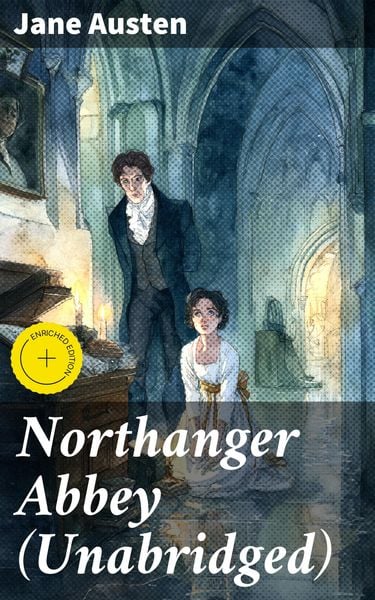
Northanger Abbey (Unabridged) Enriched edition. Exploring love, status, and imagination in Georgian society
2-
- Hardcover
- Taschenbuch
- eBook ausgewählt
- Hörbuch
- Bunt / Beige
-
Form:Einzelkauf Download
-
Sprache:Englisch
- Deutsch 7,49 €
- Englisch ausgewählt
- Deutsch, Englisch 8,99 €
-
eBook Format:ePUB
- ePUB 3 0,49 €
- ePUB ausgewählt
-
Verlag:Good Press
- Dreamscape Media 0,50 €
- Merkaba Press 0,91 €
- Top Five Books 0,50 €
- Apebook Verlag 0,99 €
- Andura Publishing 0,99 €
- Seltzer Books 0,91 €
- Classica Libris 0,49 €
- Flip 0,49 €
- BoD - Books on Demand 0,99 €
- Biblioteca Nacional de España 0,00 €
- Paperless 0,99 €
- HarperCollins Canada 0,84 €
- Avia Artis 0,99 €
- The Masterpieces 0,49 €
- Jazzybee Verlag 0,49 €
- Booklassic 0,88 €
- Good Press ausgewählt
0,49 €
0,99 €
*
*befristete Preissenkung des Verlages.
Beschreibung
Produktdetails
Format
ePUB
Kopierschutz
Nein
Family Sharing
Ja
Text-to-Speech
Ja
Erscheinungsdatum
30.11.2023
Herausgeber
Good PressVerlag
Good PressSeitenzahl
214 (Printausgabe)
Dateigröße
1626 KB
Sprache
Englisch
EAN
8596547682165
Set against the backdrop of the late 18th century, Jane Austen's "Northanger Abbey" masterfully intertwines satire and romance through the lens of its spirited protagonist, Catherine Morland. This unabridged edition showcases Austen's keen observational wit and her talent for character-driven storytelling, offering readers a poking commentary on Gothic literature and the societal expectations of women. The novel illuminates Catherine's journey from naivety to self-awareness, revealing the dangers of excessive imagination and the distinctions between reality and fiction. Austen's stylistic use of free indirect discourse invites readers to experience Catherine's thoughts and feelings intimately, ultimately reflecting the broader themes of personal growth and moral judgement inherent in her works. Jane Austen, a prominent figure of early 19th-century literature, is renowned for her incisive critique of the social mores of her time. Growing up in a family of avid readers and writers, Austen's exposure to literature fostered her literary aspirations. "Northanger Abbey," initially penned in the 1790s but published posthumously in 1817, is often regarded as both a parody of Gothic novels and a precursor to her more famous works, delving deep into the nature of love, loyalty, and self-discovery. This engaging narrative is highly recommended for readers seeking both an enjoyable and thought-provoking experience. "Northanger Abbey" offers a delightful exploration of the follies of youth, the intricacies of human relations, and the transformative power of literature itself. Austen's sharp humor and sophisticated insights invite you to reflect on the complexities of growing up, making it a timeless contribution to the canon of English literature.
In this enriched edition, we have carefully created added value for your reading experience:
- A succinct Introduction situates the work's timeless appeal and themes.
- The Synopsis outlines the central plot, highlighting key developments without spoiling critical twists.
- A detailed Historical Context immerses you in the era's events and influences that shaped the writing.
- An Author Biography reveals milestones in the author's life, illuminating the personal insights behind the text.
- A thorough Analysis dissects symbols, motifs, and character arcs to unearth underlying meanings.
- Reflection questions prompt you to engage personally with the work's messages, connecting them to modern life.
- Hand-picked Memorable Quotes shine a spotlight on moments of literary brilliance.
- Interactive footnotes clarify unusual references, historical allusions, and archaic phrases for an effortless, more informed read.
In this enriched edition, we have carefully created added value for your reading experience:
- A succinct Introduction situates the work's timeless appeal and themes.
- The Synopsis outlines the central plot, highlighting key developments without spoiling critical twists.
- A detailed Historical Context immerses you in the era's events and influences that shaped the writing.
- An Author Biography reveals milestones in the author's life, illuminating the personal insights behind the text.
- A thorough Analysis dissects symbols, motifs, and character arcs to unearth underlying meanings.
- Reflection questions prompt you to engage personally with the work's messages, connecting them to modern life.
- Hand-picked Memorable Quotes shine a spotlight on moments of literary brilliance.
- Interactive footnotes clarify unusual references, historical allusions, and archaic phrases for an effortless, more informed read.
Kundinnen und Kunden meinen
Kurze Frage zu unserer Seite
Vielen Dank für Ihr Feedback
Wir nutzen Ihr Feedback, um unsere Produktseiten zu verbessern. Bitte haben Sie Verständnis, dass wir Ihnen keine Rückmeldung geben können. Falls Sie Kontakt mit uns aufnehmen möchten, können Sie sich aber gerne an unseren Kund*innenservice wenden.
zum Kundenservice