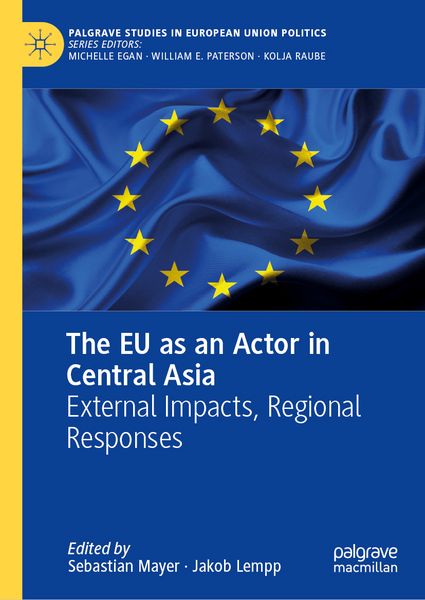
The EU as an Actor in Central Asia External Impacts, Regional Responses
-
- Hardcover ausgewählt
- Taschenbuch
- eBook
-
Sprache:Englisch
146,99 €
UVP
175,99 €
inkl. gesetzl. MwSt.,
Beschreibung
Produktdetails
Einband
Gebundene Ausgabe
Erscheinungsdatum
01.10.2024
Abbildungen
XXIII, 318 p. 11 illus., 5 illus. in color.
Herausgeber
Sebastian Mayer + weitereVerlag
SpringerSeitenzahl
318
Maße (L/B/H)
21,6/15,3/2,4 cm
Gewicht
558 g
Auflage
2024
Sprache
Englisch
ISBN
978-3-031-51353-4
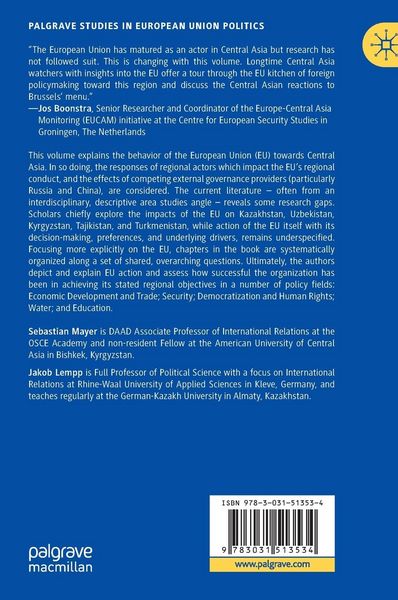
This volume explains the behavior of the European Union (EU) towards Central Asia. In so doing, the responses of regional actors which impact the EU’s regional conduct, and the effects of competing external governance providers (particularly Russia and China), are considered. The current literature – often from an interdisciplinary, descriptive area studies angle – reveals some research gaps. Scholars chiefly explore the impacts of the EU on Kazakhstan, Uzbekistan, Kyrgyzstan, Tajikistan, and Turkmenistan, while action of the EU itself with its decision-making, preferences, and underlying drivers, remains underspecified. Focusing more explicitly on the EU, chapters in the book are systematically organized along a set of shared, overarching questions. Ultimately, the authors depict and explain EU action and assess how successful the organization has been in achieving its stated regional objectives in a number of policy fields: Economic Development and Trade; Security; Democratizationand Human Rights; Water; and Education.
Noch keine Bewertungen vorhanden
Verfassen Sie die erste Bewertung zu diesem Artikel
Helfen Sie anderen Kundinnen und Kunden durch Ihre Meinung.
Kurze Frage zu unserer Seite
Vielen Dank für Ihr Feedback
Wir nutzen Ihr Feedback, um unsere Produktseiten zu verbessern. Bitte haben Sie Verständnis, dass wir Ihnen keine Rückmeldung geben können. Falls Sie Kontakt mit uns aufnehmen möchten, können Sie sich aber gerne an unseren Kund*innenservice wenden.
zum Kundenservice