Gutscheinbedingungen

**Gültig bis 25.06.2026 auf fremdsprachige Bücher online auf thalia.at und in der Thalia App. Einzelne Artikel können ausgeschlossen sein. Ausgenommen sind preisgebundene Artikel & eBooks. Pro Einkauf einmal einlösbar. Click & Collect nur bei Onlinevorabzahlung möglich. Keine Barauszahlung. Nicht kombinierbar mit anderen Aktionen und Gutscheinen. Gutschein wird auf max. 500€ Bestellwert angerechnet. Nicht gültig für Geschenkkarten, Versandkosten und Services.

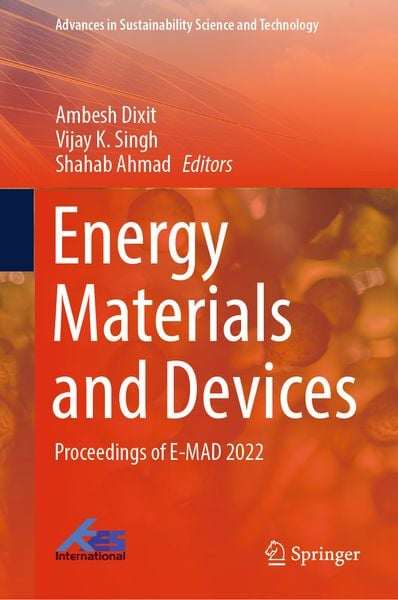
Produktbild: Energy Materials and Devices
- 13%

Energy Materials and Devices Proceedings of E-MAD 2022

13% sparen

238,99 € UVP 274,99 €

inkl. gesetzl. MwSt., Versandkostenfrei


Beschreibung

Produktdetails

Einband

Gebundene Ausgabe

Erscheinungsdatum

27.02.2024

Herausgeber

Ambesh Dixit + weitere

Verlag

Springer Singapore

Seitenzahl

362

Maße (L/B/H)

24,1/16/2,5 cm

Gewicht

804 g

Auflage

2024

Sprache

Englisch

ISBN

978-981-9990-08-5

Beschreibung

Portrait

Dr. Ambesh Dixit (M.S. and Ph.D. from Wayne State University, MI, USA, and Masters and Bachelor from the University of Allahabad, Allahabad, India) is professor at the Indian Institute of Technology Jodhpur. He has wide experience in computational and experimental materials and device physics with a special emphasis on the design and development of materials for different applications. He is leading Advanced Materials and Device (A-MAD) Laboratory, and his current research efforts are in developing functional nanomaterials and related products for energy generation and storage including lithium and beyond lithium-ion energy storage materials and devices, H2 generation, and storage. He is an expert in multifunctional materials and was the first one to demonstrate that iron vanadate (FeVO4) is a multiferroic system to the scientific community. He has published more than 100 research articles, and two Indian patents are in progress. 

Dr. Shahab Ahmad isworking as a associate professor at the Department of Physics, Indian Institute of Technology (IIT) Jodhpur. Dr. Shahab has received Ph.D. in Physics from IIT-Delhi, India, in 2014. During Ph.D., he has been visiting researcher at NanoPhotonics Centre, Cavendish Laboratory, University of Cambridge, UK. He has worked as a post-doctoral fellow at NanoManufacturing Centre, Department of Engineering, University of Cambridge, UK, from 2014–2017. Dr. Shahab has worked as an assistant professor at IIT Jodhpur and Centre for Nanoscience and Nanotechnology, Jamia Millia Islamia (Central University), New Delhi, India for two years. So far, he has authored more than 40 research articles in internationally reputed journals including Advanced Materials, Nano Letters, Advanced Energy Materials, Nature, ACS Nano, JACS, etc. Dr. Vijay Kumar Singh received his Master from Indian Institute of Technology Kanpur India, Bachelor and Ph.D. from Banaras Hindu University, Varanasi India. Thenhe moved to Jeonbuk National University, Jeonju, South Korea, for Postdoctoral Research. He is currently working as an inspire faculty in the Department of Physics Indian Institute of Technology Jodhpur, India. He has wide expertise in the atomically controlled synthesis and applications of carbon and transition metal chalcogenides-based quantum materials. He has developed high-speed 2D FET, 2D-0D heterostructure-based UV photodetector, and biosensor for cancer detection. His current research efforts are in developing the quantum materials-based next-generation electronic, optical, and biosensing devices. He is also working on generation, storage, and applications of green hydrogen. He has published more than 20 research articles in the journals of international repute. 
Produktdetails

Einband

Gebundene Ausgabe

Erscheinungsdatum

27.02.2024

Herausgeber

Verlag

Springer Singapore

Seitenzahl

362

Maße (L/B/H)

24,1/16/2,5 cm

Gewicht

804 g

Auflage

2024

Sprache

Englisch

ISBN

978-981-9990-08-5

Herstelleradresse

Springer-Verlag GmbH
Tiergartenstr. 17
69121 Heidelberg
DE

Email: ProductSafety@springernature.com

Kundinnen und Kunden meinen

0 Bewertungen

Informationen zu Bewertungen

Zur Abgabe einer Bewertung ist eine Anmeldung im Konto notwendig. Die Authentizität der Bewertungen wird von uns nicht überprüft. Wir behalten uns vor, Bewertungstexte, die unseren Richtlinien widersprechen, entsprechend zu kürzen oder zu löschen.

Die Bewertungen sind nach Format, Anzahl Sterne und Datum sortiert.

Verfassen Sie die erste Bewertung zu diesem Artikel

Helfen Sie anderen Kund*innen durch Ihre Meinung

Kundinnen und Kunden meinen

0 Bewertungen filtern

  • Produktbild: Energy Materials and Devices
  • Na-rich layered cathode materials for high energy sodium-ion batteries: A computational study.- In-Situ X-ray diffraction studies of battery electrode materials for microscopic understanding the phase stability and performance correlation.- In-Situ Raman Characterization of Electrode Materials for Rechargeable Li/Na ion batteries Mo2C: A potential anode material for lithium and sodium ion battery.- Diffusion and ion-ion correlations in EC-LiTFSI electrolytes.- Photo-Enhanced Li-Ion Batteries based on Conversion Type Hematite Phase Iron Oxide Nanostructures.- Experimental study on dead-lithium formation in lithium-ion battery.- Cost-effective Aluminum-Air Battery with enhanced performance using V2O5 catalyst together with NH4VO3 Additive in an alkaline medium.- Low-cost Aqueous Rechargeable Iron-ion battery in Ambient conditions using C3N4-based cathode.- High-performance aqueous asymmetric supercapacitor based on hybrid electrodes.- Exfoliated graphite as a potential host for ZnONanorods- based Symmetric Flexible Supercapacitor.- SrTiO3/CNT/PANI Ternary Composite for  Supercapacitor Applications.- Enhance the Electrochemical parameters of Supercapacitor Using ZnO based Electrode Material.- Characterization and analysis of (1-x) Ba0.96Sr0.04Zr0.1Ti0.9O3– xNaNbO3: A study onStructural, Dielectric and Energy Storage Behaviour.- Recent Progress and Challenges in Hydrogen Storage Medium and Transportation for Boosting Hydrogen Economy.- A Comparative Review of Hydrogen Production by Membrane Water Electrolysis (MWE) Technologies.- Concentrated Solar Thermal-based Hydrogen Generation: Some Recent Findings and a Proposal for Experiment Setup.