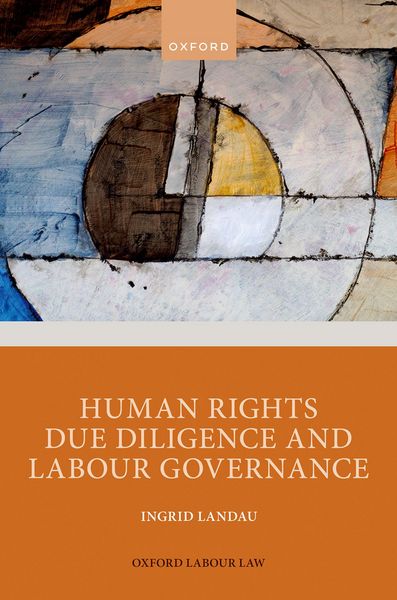
Human Rights Due Diligence and Labour Governance
-
Form:Einzelkauf Download
-
Sprache:Englisch
-
eBook Format:PDF
- PDF 95,60 € ausgewählt
- ePUB 95,60 €
95,60 €
inkl. gesetzl. MwSt.Beschreibung
Produktdetails
Format
Kopierschutz
Ja
Family Sharing
Nein
Text-to-Speech
Nein
Erscheinungsdatum
13.11.2023
Verlag
OUP eBookSeitenzahl
256 (Printausgabe)
Dateigröße
12300 KB
Sprache
Englisch
EAN
9780198876090
Human rights due diligence (HRDD) has emerged as a dominant frame through which to conceptualise and operationalise responsible business conduct with respect to workers' rights in global supply chains. Legislation mandating HRDD is now found in several European countries and across various national regulatory agendas. Many scholars, practitioners, and activists are actively calling for further legalisation, believing that this will broaden respect for human rights.
Yet to date, there has been little sustained scholarly analysis from a labour rights perspective. Observing that HRDD, as originally articulated in the UN Guiding Principles on Business and Human Rights, is open to multiple interpretations, this book examines global debates on the role and status of the concept. It also considers the implications of HRDD's ascension for transnational labour law as a distinct field of law, scholarship, and activism.
Combining insights from transnational governance and business regulation with empirical analysis, this book argues that HRDD is not being institutionalised at either the global or national level in a way that renders it a transformative or even robust mechanism of transnational labour law. It also draws attention to the important, but largely overlooked, ways in which the rise of HRDD is leading to subtle shifts in the configuration of actors and institutions in labour governance.
Yet to date, there has been little sustained scholarly analysis from a labour rights perspective. Observing that HRDD, as originally articulated in the UN Guiding Principles on Business and Human Rights, is open to multiple interpretations, this book examines global debates on the role and status of the concept. It also considers the implications of HRDD's ascension for transnational labour law as a distinct field of law, scholarship, and activism.
Combining insights from transnational governance and business regulation with empirical analysis, this book argues that HRDD is not being institutionalised at either the global or national level in a way that renders it a transformative or even robust mechanism of transnational labour law. It also draws attention to the important, but largely overlooked, ways in which the rise of HRDD is leading to subtle shifts in the configuration of actors and institutions in labour governance.
Noch keine Bewertungen vorhanden
Verfassen Sie die erste Bewertung zu diesem Artikel
Helfen Sie anderen Kundinnen und Kunden durch Ihre Meinung.
Kurze Frage zu unserer Seite
Vielen Dank für Ihr Feedback
Wir nutzen Ihr Feedback, um unsere Produktseiten zu verbessern. Bitte haben Sie Verständnis, dass wir Ihnen keine Rückmeldung geben können. Falls Sie Kontakt mit uns aufnehmen möchten, können Sie sich aber gerne an unseren Kund*innenservice wenden.
zum Kundenservice