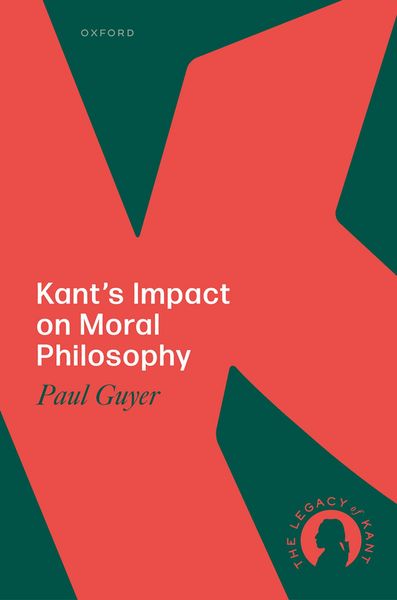
Kant's Impact on Moral Philosophy
222,99 €
inkl. gesetzl. MwSt.,
Beschreibung
Produktdetails
Einband
Gebundene Ausgabe
Erscheinungsdatum
01.05.2024
Verlag
Oxford University PressSeitenzahl
684
Maße (L/B/H)
23,6/16,4/4,3 cm
Gewicht
1216 g
Sprache
Englisch
ISBN
978-0-19-959245-6
Immanuel Kant introduced a new paradigm into modern moral philosophy, first with his Groundwork for the Metaphysics of Morals in 1785, followed by his Critique of Practical Reason in 1788, Religion within the Boundaries of Mere Reason in 1793, and Metaphysics of Morals in 1798. For Kant, the fundamental goal of morality is not the realization of the greatest happiness for the greatest number, under some interpretation of that formula, but the realization of human autonomy governed by pure reason in the form of the "categorical imperative." Kant's ideal of autonomy is nothing less than the greatest possible freedom of each human being to set his or her own ends compatible with the equal freedom of every other human being to do the same. As Kant put it in lectures to his own students, freedom "not restrained under certain rules . . . is the most terrible thing there could ever be," but the condition "under which alone the greatest use of freedom is possible, and under which it can be self-consistent" is the "essential end of humankind" and the "inner worth of the world." Kant's work immediately drew the attention of both critics and supporters. While some argued that Kant's categorical imperative was an "empty formalism," that he left no room for happiness in his morality, that he could not explain responsibility for evil, and that he allowed no room for moral feeling in morally worthy motivation, others have found inspiration in his underlying idea that maximal but equal freedom is the "inner worth of the world." This book examines the response to Kant by other significant moral philosophers from Fichte, Schelling, and Hegel to through T.H. Green, Josiah Royce, and Friedrich Nietzsche, to John Rawls, Onora O'Neill, Christine Korsgaard, and Derek Parfit, with many stops along the way. The book is not a history of Kant scholarship, but an examination of Kant's impact on other major moral philosophers from his time to our own. While it attempts to do justice to the arguments of every philosopher discussed, the book argues that the most profound responses to Kant have been precisely those that have developed in their own way Kant's ideal of freedom as the inner worth of the world.
Noch keine Bewertungen vorhanden
Verfassen Sie die erste Bewertung zu diesem Artikel
Helfen Sie anderen Kundinnen und Kunden durch Ihre Meinung.
Kurze Frage zu unserer Seite
Vielen Dank für Ihr Feedback
Wir nutzen Ihr Feedback, um unsere Produktseiten zu verbessern. Bitte haben Sie Verständnis, dass wir Ihnen keine Rückmeldung geben können. Falls Sie Kontakt mit uns aufnehmen möchten, können Sie sich aber gerne an unseren Kund*innenservice wenden.
zum Kundenservice