Gutscheinbedingungen

**Gültig bis 06.07.2026 auf fremdsprachige Bücher online auf thalia.at, in der Thalia App ab einem Mindestbestellwert von 30€ und in allen Thalia Buchhandlungen in Österreich. In den Buchhandlungen nur gültig auf lagernde Ware. Einzelne Artikel können ausgeschlossen sein. Ausgenommen sind preisgebundene Artikel & eBooks. Pro Einkauf einmal einlösbar. Nur gültig gegen Vorlage oder im Onlineshop hinterlegter Bonuscard. Infos zur Einlösung in der Buchhandlung sind auf der Bonuscard-Vorteilspreisseite zu finden. Click & Collect nur bei Onlinevorabzahlung möglich. Keine Einlösung bei Scan & Go-Bezahlung. Keine Barauszahlung. Nicht kombinierbar mit anderen Aktionen und Gutscheinen. Gutschein wird auf max. 500€ Bestellwert angerechnet. Nicht gültig für Versandkosten und Services.

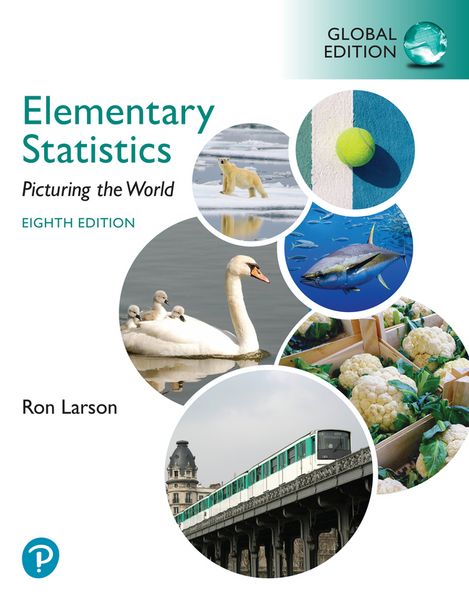
Produktbild: Elementary Statistics: Picturing the World, Global Edition
- 19%

Elementary Statistics: Picturing the World, Global Edition

19% sparen

78,99 € UVP 97,99 €

inkl. gesetzl. MwSt., Versandkostenfrei


Beschreibung

Produktdetails

ISBN

978-1-292-46927-0

Auflage

8

Erscheinungsdatum

03.05.2024

Einband

Taschenbuch

Verlag

Pearson Studium

Seitenzahl

760

Maße (L/B/H)

27,6/21,6/4,1 cm

Gewicht

1623 g

Sprache

Englisch

Beschreibung

Produktdetails

ISBN

978-1-292-46927-0

Auflage

8

Erscheinungsdatum

03.05.2024

Einband

Taschenbuch

Verlag

Pearson Studium

Seitenzahl

760

Maße (L/B/H)

27,6/21,6/4,1 cm

Gewicht

1623 g

Sprache

Englisch

Herstelleradresse

Pearson Benelux B.V.
St.-Martin-Straße 82
81541 München
DE

Email: salesde@pearson.com

Noch keine Bewertungen vorhanden

Verfassen Sie die erste Bewertung zu diesem Artikel

Helfen Sie anderen Kundinnen und Kunden durch Ihre Meinung.

Kundinnen und Kunden meinen

Bewertungen (0)

  • Produktbild: Elementary Statistics: Picturing the World, Global Edition

  • NOTE: Each chapter begins with "Where You've Been" and "Where You're Going" features. Each chapter concludes with Chapter Summary, Review Exercises, Chapter Quiz, and Chapter Test.I. DESCRIPTIVE STATISTICS


    • 1. Introduction to Statistics

      • 1.1 An Overview of Statistics

      • 1.2 Data Classification

      • 1.3 Data Collection and Experimental Design


    • 2. Descriptive Statistics

      • 2.1 Frequency Distributions and Their Graphs

      • 2.2 More Graphs and Displays

      • 2.3 Measures of Central Tendency

      • 2.4 Measures of Variation

      • 2.5 Measures of Position

      • Cumulative Review: Chapters 1 & 2


    II. PROBABILITY AND PROBABILITY DISTRIBUTIONS


    • 3. Probability

      • 3.1 Basic Concepts of Probability and Counting

      • 3.2 Conditional Probability and the Multiplication Rule

      • 3.3 The Addition Rule

      • 3.4 Additional Topics in Probability and Counting


    • 4. Discrete Probability Distributions

      • 4.1 Probability Distributions

      • 4.2 Binomial Distributions

      • 4.3 More Discrete Probability Distributions


    • 5. Normal Probability Distributions

      • 5.1 Introduction to Normal Distributions and the Standard Normal Distribution

      • 5.2 Normal Distributions: Finding Probabilities

      • 5.3 Normal Distributions: Finding Values

      • 5.4 Sampling Distributions and the Central Limit Theorem

      • 5.5 Normal Approximations to Binomial Distributions

      • Cumulative Review: Chapters 3-5


    III. STATISTICAL INFERENCE


    • 6. Confidence Intervals

      • 6.1 Confidence Intervals for the Mean (Known)

      • 6.2 Confidence Intervals for the Mean (Unknown)

      • 6.3 Confidence Intervals for Population Proportions

      • 6.4 Confidence Intervals for Variance and Standard Deviation


    • 7. Hypothesis Testing with One Sample

      • 7.1 Introduction to Hypothesis Testing

      • 7.2 Hypothesis Testing for the Mean (Known)

      • 7.3 Hypothesis Testing for the Mean (Unknown)

      • 7.4 Hypothesis Testing for Proportions

      • 7.5 Hypothesis Testing for Variance and Standard Deviation


    • 8. Hypothesis Testing with Two Samples


      • 8.1 Testing the Difference Between Means (Independent Samples,
        1
        and
        2
        Known)


      • 8.2 Testing the Difference Between Means (Independent Samples,
        1
        and
        2
        Unknown)

      • 8.3 Testing the Difference Between Means (Dependent Samples)

      • 8.4 Testing the Difference Between Proportions

      • Cumulative Review: Chapters 6-8


    IV. MORE STATISTICAL INFERENCE


    • 9. Correlation and Regression

      • 9.1 Correlation

      • 9.2 Linear Regression

      • 9.3 Measures of Regression and Prediction Intervals

      • 9.4 Multiple Regression


    • 10. Chi-Square Tests and the F-Distribution

      • 10.1 Goodness-of-Fit Test

      • 10.2 Independence

      • 10.3 Comparing Two Variances

      • 10.4 Analysis of Variance

      • Cumulative Review: Chapters 9 & 10


    • 11. Nonparametric Tests (Online Only)*

      • 11.1 The Sign Test

      • 11.2 The Wilcoxon Tests

      • 11.3 The Kruskal-Wallis Test

      • 11.4 Rank Correlation

      • 11.5 The Runs Test

      • * Available in MyLab Statistics


    Appendix A: Alternative Presentation of the Standard Normal Distribution

    • Standard Normal Distribution Table

    • Alternative Presentation of the Standard Normal Distribution


    Appendix B: Tables

    • Table 1 Random Numbers

    • Table 2 Binomial Distribution

    • Table 3 Poisson Distribution

    • Table 4 Standard Normal Distribution

    • Table 5 t-Distribution

    • Table 6 Chi-Square Distribution

    • Table 7 F-Distribution

    • Table 8 Critical Values for the Sign Test

    • Table 9 Critical Values for the Wilcoxon Signed-Rank Test

    • Table 10 Critical Values for the Spearman Rank Correlation Coefficient

    • Table 11 Critical Values for the Pearson Correlation Coefficient

    • Table 12 Critical Values for the Number of Runs


    Appendix C:Normal Probability PlotsAppendix D: Key FormulasAnswers to the Try It Yourself ExercisesAnswers to the Odd-Numbered ExercisesIndex