KI-Beratung Beta

Gutscheinbedingungen

**Gültig bis 11.11.2026 auf Spielzeug, Schreibwaren, Filme, Geschenke & Trends, Musik, tolino eReader & Zubehör, Hörbücher und Hörbuch-Downloads, nicht preisgebundene Bücher und Kalender online auf thalia.at und in der Thalia App. Einzelne Artikel können ausgeschlossen sein. Aufgrund der Buchpreisbindung sind deutschsprachige Bücher und eBooks ausgenommen. Zusätzlich ausgenommen sind Abos & Flatrates, Games, Geschenkkarten/-boxen, Shelfies, Software, Zeitschriften sowie einzelne Artikel von tonies®. Pro Einkauf einmal einlösbar. Click & Collect nur bei Onlinevorabzahlung möglich. Keine Barauszahlung. Nicht kombinierbar mit anderen Aktionen und Gutscheinen. Gutschein wird auf max. 500€ Bestellwert angerechnet. Nicht gültig für Versandkosten und Services.

  • Produktbild: Biotechnological Advances for Disease Tolerance in Plants
  • Produktbild: Biotechnological Advances for Disease Tolerance in Plants
- 20%

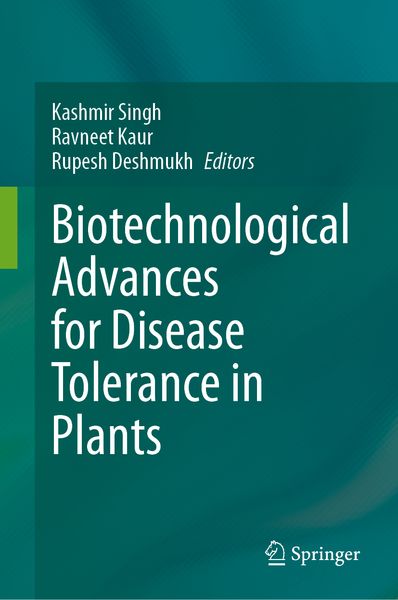
Biotechnological Advances for Disease Tolerance in Plants

20% sparen

175,99 € UVP 219,99 €

inkl. gesetzl. MwSt., Versandkostenfrei


Beschreibung

This book covers the biotechnological advances being used for the understanding of plant diseases and the subsequent enhancement of disease resistance in crop plants. Chapters are focused on recent advances in sequencing technologies, computational resources and genomics tools useful for the identification...

Beschreibung

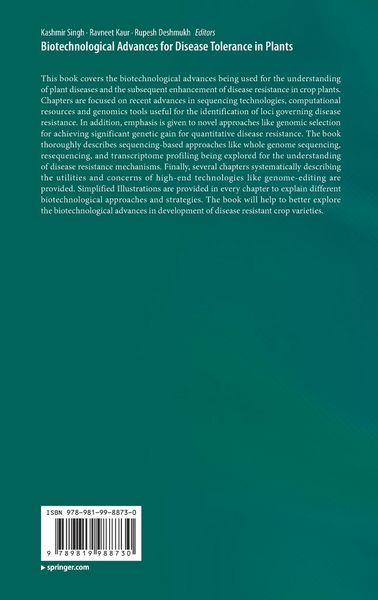
This book covers the biotechnological advances being used for the understanding of plant diseases and the subsequent enhancement of disease resistance in crop plants. Chapters are focused on recent advances in sequencing technologies, computational resources and genomics tools useful for the identification of loci governing disease resistance. In addition, emphasis is given to novel approaches like genomic selection for achieving significant genetic gain for quantitative disease resistance. The book thoroughly describes sequencing-based approaches like whole genome sequencing, resequencing, and transcriptome profiling being explored for the understanding of disease resistance mechanisms. Finally, several chapters systematically describing the utilities and concerns of high-end technologies like genome-editing are provided. Simplified Illustrations are provided in every chapter to explain different biotechnological approaches and strategies. The book will help to better explore the biotechnological advances in development of disease resistant crop varieties. 
 

Portrait


Prof. (Dr.) Kashmir Singh,
is the professor of Biotechnology and Coordinator, DST- Centre for Policy Research (CPR), at Panjab University (PU), Chandigarh. He has over  18 years of teaching and research experience with active participation in administrative activities as well. He has vast international exposure and worked as Marie Curie Post Doc Fellow in Adam Mickiewicz University, Poland, Research Associate, at Missouri State University, USA and visiting scientist at McGill University, Canada. He has authored more than 100 national and international publications and editor of reputed international journals. Three patents are credit to him and 01 successful technology transfer to the industry. He is having an active association with different scientific societies and academies around the world. Prof. Singh has made his mark in the scientific communities with his contributions and received wide recognition from various agencies around the world. Prof. Kashmir Singh's major research interest involves Plant Genetic Engineering and Biotechnology, Intellectual Properties (IP) and Technology Transfer and Public Private Partnerships.


Dr. Ravneet Kaur
is currently working as a Women Scientist at the Department of Biotechnology, Panjab University, India. She carried out her PhD studies in India (Guru Nanak Dev University), where she got specialized in Plant tissue culture and biotechnology. She is the recipient of international fellowships such as  Marie Curie post doc Fellowship at Adam Mickiewicz university, Poland, Post-doctoral fellow, McGill University, Canada and post-doctoral fellow, Missouri State University, US. She has more than 25 publications in various national and international journals. Her research is  focused on using functional genomics tools to understand secondary metabolism and stress tolerance in crops.


Dr. Rupesh Deshmukh
currently working as Associate Professor at the Department of Biotechnology, Central University of Haryana, Mahendergarh, India. He earned his Ph.D. in agricultural biotechnology from SRTMU, Nanded, India. During his postdoctoral research in Quebec, Canada, Dr. Deshmukh delved into the molecular mechanisms underpinning the uptake of silicon, a beneficial metalloid, in plants. His pioneering work included the identification of metalloid transporter genes in various plant species, showcasing the power of whole-genome sequencing in gene discovery and its subsequent application in breeding programs. Subsequently, he pursued another postdoctoral research opportunity at Missouri University, USA, where he contributed to research focused on enhancing abiotic stress tolerance in plants. His wide-ranging interests in plant science encompass computational biology, gene identification methodologies such as QTL mapping and GWAS, as well as the elucidation of molecular mechanisms through the integration of omics approaches. Dr. Deshmukh possesses an impressive publication record, with more than one hundred fifty articles published in esteemed journals. He has also lent his expertise as a Visiting Professor at University Laval, Canada, to a project aimed at improving biotic and abiotic stress resilience in plants through genomics interventions. Currently, his research group is actively engaged in translational genomics endeavours centred around rice and tomato. 

Produktdetails

Einband

Gebundene Ausgabe

Erscheinungsdatum

19.03.2024

Abbildungen

XIII, 397 p. 1 illus.

Herausgeber Kashmir Singh + weitere

Produktdetails

Einband

Gebundene Ausgabe

Erscheinungsdatum

19.03.2024

Abbildungen

XIII, 397 p. 1 illus.

Herausgeber
Verlag Springer Singapore
Seitenzahl

397

Maße (L/B/H)

24,1/16/2,8 cm

Gewicht

730 g

Auflage

1. Auflage

Sprache

Englisch

ISBN

978-981-9988-73-0

Herstelleradresse

Springer-Verlag KG
Sachsenplatz 4-6
1201 Wien
AT

Email: ProductSafety@springernature.com

Noch keine Bewertungen vorhanden

Verfassen Sie die erste Bewertung zu diesem Artikel

Helfen Sie anderen Kundinnen und Kunden durch Ihre Meinung.

Kundinnen und Kunden meinen

Bewertungen (0)

  • Produktbild: Biotechnological Advances for Disease Tolerance in Plants
  • Produktbild: Biotechnological Advances for Disease Tolerance in Plants

  • 1. Advances in genetic mapping of loci governing disease resistance in plants.- 2. Genome editing to improve nutrition status of crop plants.- 3. Genomic selection for quantitative disease resistance in plants.- 4. Imperative role of Rgenes and associated molecular mechanisms in plant disease resistance.- 5. Applications of high throughput sequencing chemistries in decoding pathogen genomes.- 6. Effectors mediated pathogenicity.- 7. Role of Non-coding RNAs in disease resistance in plants.- 8. Implication of phytohormonal signaling and their molecular cross-talk during disease resistance in plants.- 9. Integrated omics approaches for plant disease resistance.- 10. Biotechnological tools for disease diagnostic.- 11.Transgenic plants for bacterial and fungal disease tolerance.- 12. Genome-editing advances for disease resistance in plants.- 13. Tomato as a model plant to understand Plant-microbial interactions.- 14. Transcription factors and their regulatory role in Plant defence response. 15. Role of effectors in plant-pathogen interactions
    .-
    16
    . 
    Transcriptomics of host-pathogen interaction.