Gutscheinbedingungen

**Gültig bis 06.07.2026 auf fremdsprachige Bücher online auf thalia.at, in der Thalia App ab einem Mindestbestellwert von 30€ und in allen Thalia Buchhandlungen in Österreich. In den Buchhandlungen nur gültig auf lagernde Ware. Einzelne Artikel können ausgeschlossen sein. Ausgenommen sind preisgebundene Artikel & eBooks. Pro Einkauf einmal einlösbar. Nur gültig gegen Vorlage oder im Onlineshop hinterlegter Bonuscard. Infos zur Einlösung in der Buchhandlung sind auf der Bonuscard-Vorteilspreisseite zu finden. Click & Collect nur bei Onlinevorabzahlung möglich. Keine Einlösung bei Scan & Go-Bezahlung. Keine Barauszahlung. Nicht kombinierbar mit anderen Aktionen und Gutscheinen. Gutschein wird auf max. 500€ Bestellwert angerechnet. Nicht gültig für Versandkosten und Services.

  • Produktbild: Qualitative Research in Criminology
  • Produktbild: Qualitative Research in Criminology

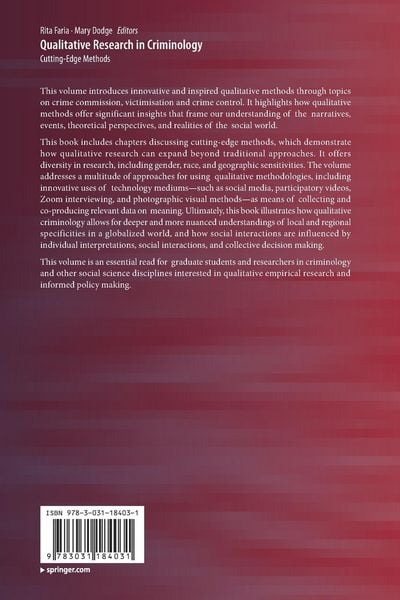
Qualitative Research in Criminology Cutting-Edge Methods

158,99 €

inkl. gesetzl. MwSt., Versandkostenfrei


Beschreibung

Produktdetails

Einband

Taschenbuch

Erscheinungsdatum

19.11.2023

Herausgeber

Rita Faria + weitere

Verlag

Springer

Seitenzahl

256

Maße (L/B/H)

23,5/15,5/1,5 cm

Gewicht

411 g

Auflage

1st ed. 2023

Sprache

Englisch

ISBN

978-3-031-18403-1

Beschreibung

Portrait

Rita Faria, School of Criminology and Interdisciplinary Research Center on Crime, Justice and Security, University of Porto

Rita Faria is Assistant Professor at the School of Criminology - University of Porto, Director of the Interdisciplinary Research Center on Crime, Justice and Security and Director of the only Ph.D. program in Criminology in Portugal. She earned her Ph.D in Criminology in 2016, and has a B.A. in Law and an M.A. in Sociology. Currently, she is co-chair of the Working Group on Qualitative Research Methodologies and Epistemologies (WG-QRME) and president of the Working Group on Organisational Crime (EUROC), both from the European Society of Criminology. She has extensive experience in teaching, supervising and researching and her preferred topics of research include white-collar, occupational and corporate crime and, more recently, environmental crimes. She has also developed her expertise on the uses of qualitative methods in criminological research and onethics and integrity in research.

Mary Dodge, School of Public Affairs, University of Colorado Denver

Mary Dodge earned her Ph.D. in 1997 in criminology, law and society from the School of Social Ecology at the University of California, Irvine. She received her B.A. and M.A. in psychology from the University of Colorado at Colorado Springs. She is a full professor at the University of Colorado Denver in the School of Public Affairs. She and Gilbert Geis co-edited the book Lessons of Criminology and share authorship on the book Stealing Dreams: A Fertility Clinic Scandal . She is the author of Women and White-Collar Crime and co-author of Introduction to Criminal Justice: Systems, Diversity, and Change .  She is the recipient of numerous University awards for excellence in teaching, research, and service. Her applied and policy research involves collaboration with law enforcement agencies including organizational assessments, victims focusgroups, system responses to sexual assault victims, driving under the influence of marijuana, and research with California POST.


Produktdetails

Einband

Taschenbuch

Erscheinungsdatum

19.11.2023

Herausgeber

Verlag

Springer

Seitenzahl

256

Maße (L/B/H)

23,5/15,5/1,5 cm

Gewicht

411 g

Auflage

1st ed. 2023

Sprache

Englisch

ISBN

978-3-031-18403-1

Herstelleradresse

Springer-Verlag KG
Sachsenplatz 4-6
1201 Wien
AT

Email: GPSR Kontakt

Noch keine Bewertungen vorhanden

Verfassen Sie die erste Bewertung zu diesem Artikel

Helfen Sie anderen Kundinnen und Kunden durch Ihre Meinung.

Kundinnen und Kunden meinen

Bewertungen (0)

  • Produktbild: Qualitative Research in Criminology
  • Produktbild: Qualitative Research in Criminology
  • Part I. Adapting to a New World.- Chapter 1. Photo-Based Research with Vulnerable Groups: Breaking Frames for Researchers, Participants, and Audiences.- Chapter 2. Breaking the Shackles of Academic Capitalism: Academic Life, Liberation and Ethnographic Innovation.- Chapter 3. Mixed Methods: A Justification, Explication, and Example.- Part II. The Growing Relevance of the Online World.- Chapter 4. Smart Researching in Criminology: Virtual Ethnography at the Edge.- Chapter 5. Researching Political Corruption and White-Collar Crime on the Internet .- Chapter 6. Online Methods in Qualitative Criminology.- Part III. Methodological Innovations.- Chapter 7. Trigger Warnings, Feeling Rules and Other Lessons from the Inside: The Emotional Labour of Qualitative Prison Research .- Chapter 8. Sensory “Heteroglossia” and Social Control: Sensory Methodology and Method.- Chapter 9. Towards visual and sensory methodologies in Green Cultural Criminology.- Part IV. The Connecting Power of Languages.- Chapter 10. How to Deal with “Doing Social Inequality” by “Doing Criminological (Qualitative) Research”.- Chapter 11. Shooting Poachers on Site: Reflections in the Use of Photography in Active Offender Research.- Chapter 12. Language Matters: Doing Systematic (Critical) Discourse Analysis in Crimininology .- Part V. Praxis: Pondering and Publishing.- Chapter 13. The Future is Already Here: Covid-19, Criminology, and Crime.- Chapter 14.        “Being” ethical in research.- Chapter 15. What Now and How? Publishing the Qualitative Journal Article.