Gutscheinbedingungen

**Gültig bis 15.06.2026 auf Spiele & Spielzeug online auf thalia.at, in der Thalia App ab einem Mindestbestellwert von 30€ und in allen Thalia Buchhandlungen in Österreich. In den Buchhandlungen nur gültig auf lagernde Ware. Einzelne Artikel können ausgeschlossen sein. Ausgenommen sind preisgebundene Artikel sowie online auf thalia.at und in der Thalia App einzelne Artikel von tonies®. Pro Einkauf einmal einlösbar. Nur gültig gegen Vorlage oder im Onlineshop hinterlegter Bonuscard. Infos zur Einlösung in der Buchhandlung sind auf der Bonuscard-Vorteilspreisseite zu finden. Click & Collect nur bei Onlinevorabzahlung möglich. Keine Einlösung bei Scan & Go-Bezahlung. Keine Barauszahlung. Nicht kombinierbar mit anderen Aktionen und Gutscheinen. Gutschein wird auf max. 500€ Bestellwert angerechnet. Nicht gültig für Geschenkkarten, Versandkosten und Services.

Produktbild: Capitalism in the Platform Age

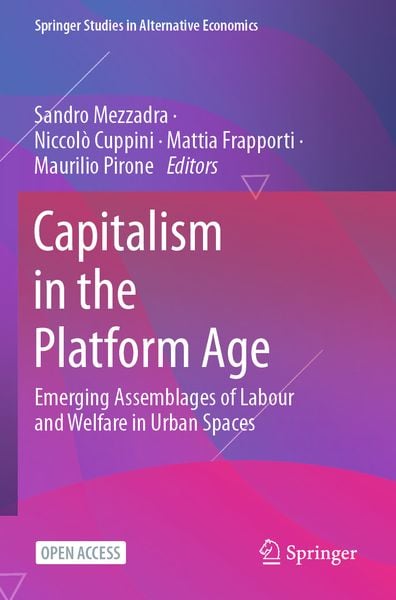
Capitalism in the Platform Age Emerging Assemblages of Labour and Welfare in Urban Spaces

41,99 €

inkl. gesetzl. MwSt., Versandkostenfrei


Beschreibung

Produktdetails

Einband

Taschenbuch

Erscheinungsdatum

29.02.2024

Herausgeber

Sandro Mezzadra + weitere

Verlag

Springer

Seitenzahl

371

Maße (L/B/H)

23,5/15,5/2,1 cm

Gewicht

575 g

Auflage

1st ed. 2024

Sprache

Englisch

ISBN

978-3-031-49149-8

Beschreibung

Portrait

Sandro Mezzadra is a professor of political theory at the University of Bologna (Italy) and is an adjunct fellow at Western Sydney University (Australia). With Brett Neilson, he is the author of Border as Method, or, the Multiplication of Labor (Duke University Press, 2013) and of The Politics of Operations. Excavating Contemporary Capitalism (Duke University Press, 2019) and co-authored with Brett Neilson "The Rest and the West. Capital and Power in a Multipolar World" (Verso, 2024).


Niccolò Cuppini is lecturer and researcher at the University of Applied Sciences and Arts of Southern Switzerland (Manno, Switzerland), editoriale member of the Scienza&Politica, member of the LUCI – Labour, Urbanscapes and Citizenship research area at the Dipartimento economia aziendale, sanità e sociale (DEASS), and founding member of the Into the Black Box research group.


Mattia Frapporti is Junior Researcher within the HorizonEurope INCA project at the Department of Computer Science, University of Bologna. His main interests are the analysis of the political role of infrastructures and the relationship between logistics and politics. Since many years now, his research also focuses on the platform’s world and their impact on urban spaces. He is a founding member of the research group Into the Black Box and he is on the editorial board of Zapruder and on the board of the Foundation Jean Monnet pour l'Europe.


Maurilio Pirone is a Junior Researcher at the Department of Arts of University of Bologna (Italy) working in the Horizon Europe project INCA (Increase Corporate Political Responsibility and Accountability), founding member of the Into the Black Box research group, and member of the editorial board of Work Organisation, Labour and Globalisation Journal.


Produktdetails

Einband

Taschenbuch

Erscheinungsdatum

29.02.2024

Herausgeber

Verlag

Springer

Seitenzahl

371

Maße (L/B/H)

23,5/15,5/2,1 cm

Gewicht

575 g

Auflage

1st ed. 2024

Sprache

Englisch

ISBN

978-3-031-49149-8

Herstelleradresse

Springer-Verlag KG
Sachsenplatz 4-6
1201 Wien
AT

Email: ProductSafety@springernature.com

Kundinnen und Kunden meinen

0 Bewertungen

Informationen zu Bewertungen

Zur Abgabe einer Bewertung ist eine Anmeldung im Konto notwendig. Die Authentizität der Bewertungen wird von uns nicht überprüft. Wir behalten uns vor, Bewertungstexte, die unseren Richtlinien widersprechen, entsprechend zu kürzen oder zu löschen.

Die Bewertungen sind nach Format, Anzahl Sterne und Datum sortiert.

Verfassen Sie die erste Bewertung zu diesem Artikel

Helfen Sie anderen Kund*innen durch Ihre Meinung

Kundinnen und Kunden meinen

0 Bewertungen filtern

  • Produktbild: Capitalism in the Platform Age
  • Part I. Theoretical Foundations.- Chapter 1. Introduction (Sandro Mezzadra).- Chapter 2. Operations of Platforms. A Global Process in a Multipolar World (Sandro Mezzadra).- Chapter 3. The process of valorization in the platform capitalism (Andrea Fumagalli).- Chapter 4. Out of the Standard. Towards a Global Approach to Platform Labour (Maurilio Pirone).- Chapter 5. What Urban Future: Do High-Tech Metropolises Dream of Electric Sheep? (Niccolò Cuppini).- Chapter 6. The Politics of Platforms. Exploring Platform's Infrastructural Role and Power (Mattia Frapporti).- Chapter 7. Managing the Wheel: Managerial Normativity from the Wage Society to the Platform Age (Massimilano Nicoli).- Chapter 8. Digital labour, informal unionism and the rise of a new workers subjectivity (Marco Marrone).- Chapter 9. Platform capitalism: Infrastructuring migration, mobility, and racism (Stefania Animento).- Chapter 10. Affect, precarity and feminised labour inAirbnb in London (Eleni Kambouri).- Part II. Notes from the Field.- Chapter 11. Why the sectoral context matters for platform work (Bettina Haidinger).- Chapter 12. A Variegated Platform Capitalism? Algorithms, Labour Process and Institutions in Deliveroo in Bologna and Uber in Lisbon (Marco Marrone).- Chapter 13. Perceiving platform work as decent work? Views regarding working conditions among platform taxi drivers in Tallinn (Marge Unt).- Chapter 14. Skills development as a political process: Towards new forms of mobilization and digital citizenship among platform workers (Filippo Bignami).- Chapter 15. How to build alternatives to platform capitalism? (Mayo Fuster Morell).- Chapter 16. Labour policies for a fairer gig economy (Annamaria Donini).- Chapter 17. Engaging stakeholders with platform labour: The social lab approach (Raúl Tabarés).- Chapter 18. Local best practices. Urban governance and the ongoing platformization process (Michelangelo Secchi).- Chapter 19. Social protection, basic income and taxation in the Digital economy (Cristina Morini).- Chapter 20. Latent conflict, invisible organisation: Everyday struggles in platform labour (Moritz Altenreid).