
Energy Efficient Computation Offloading in Mobile Edge Computing
-
- Hardcover
- Taschenbuch ausgewählt
- eBook
-
Sprache:Englisch
144,99 €
UVP
164,99 €
inkl. gesetzl. MwSt.,
Beschreibung
Produktdetails
Einband
Taschenbuch
Erscheinungsdatum
31.10.2023
Abbildungen
XIV, 156 p. 38 illus.
Verlag
SpringerSeitenzahl
156
Maße (L/B/H)
23,5/15,5/1 cm
Gewicht
271 g
Auflage
23001 Auflage 1st ed. 2022
Sprache
Englisch
ISBN
978-3-031-16824-6
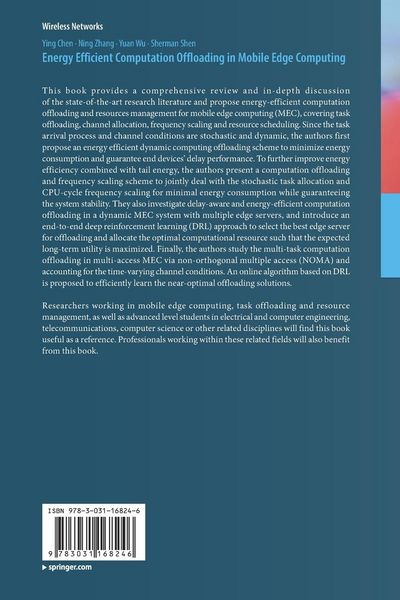
This book provides a comprehensive review and in-depth discussion of the state-of-the-art research literature and propose energy-efficient computation offloading and resources management for mobile edge computing (MEC), covering task offloading, channel allocation, frequency scaling and resource scheduling. Since the task arrival process and channel conditions are stochastic and dynamic, the authors first propose an energy efficient dynamic computing offloading scheme to minimize energy consumption and guarantee end devices’ delay performance. To further improve energy efficiency combined with tail energy, the authors present a computation offloading and frequency scaling scheme to jointly deal with the stochastic task allocation and CPU-cycle frequency scaling for minimal energy consumption while guaranteeing the system stability. They also investigate delay-aware and energy-efficient computation offloading in a dynamic MEC system with multiple edge servers, and introduce anend-to-end deep reinforcement learning (DRL) approach to select the best edge server for offloading and allocate the optimal computational resource such that the expected long-term utility is maximized. Finally, the authors study the multi-task computation offloading in multi-access MEC via non-orthogonal multiple access (NOMA) and accounting for the time-varying channel conditions. An online algorithm based on DRL is proposed to efficiently learn the near-optimal offloading solutions.
Researchers working in mobile edge computing, task offloading and resource management, as well as advanced level students in electrical and computer engineering, telecommunications, computer science or other related disciplines will find this book useful as a reference. Professionals working within these related fields will also benefit from this book.
Noch keine Bewertungen vorhanden
Verfassen Sie die erste Bewertung zu diesem Artikel
Helfen Sie anderen Kundinnen und Kunden durch Ihre Meinung.
Kurze Frage zu unserer Seite
Vielen Dank für Ihr Feedback
Wir nutzen Ihr Feedback, um unsere Produktseiten zu verbessern. Bitte haben Sie Verständnis, dass wir Ihnen keine Rückmeldung geben können. Falls Sie Kontakt mit uns aufnehmen möchten, können Sie sich aber gerne an unseren Kund*innenservice wenden.
zum Kundenservice