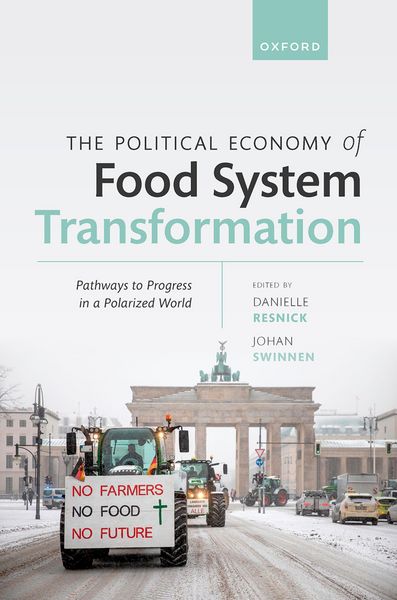
The Political Economy of Food System Transformation Pathways to Progress in a Polarized World
-
Form:Einzelkauf Download
-
Sprache:Englisch
-
eBook Format:PDF
- PDF 115,20 € ausgewählt
- ePUB 103,90 €
115,20 €
inkl. gesetzl. MwSt.Beschreibung
Produktdetails
Format
Kopierschutz
Ja
Family Sharing
Nein
Text-to-Speech
Nein
Erscheinungsdatum
01.10.2023
Herausgeber
Danielle Resnick + weitereVerlag
OUP eBookSeitenzahl
400 (Printausgabe)
Dateigröße
7621 KB
Sprache
Englisch
EAN
9780198882237
This is an open access title available under the terms of a CC BY-NC 4.0 International licence. It is free to read at Oxford Academic and offered as a free PDF download from OUP and selected open access locations.
The current structure of the global food system is increasingly recognized as unsustainable. In addition to the environmental impacts of agricultural production, unequal patterns of food access and availability are contributing to non-communicable diseases in middle- and high-income countries and inadequate caloric intake and dietary diversity among the world's poorest. To this end, there have been a growing number of academic and policy initiatives aimed at advancing food system transformation, including the 2021 UN Food Systems Summit, the Sustainable Development Goals (SDGs), and several UN Climate conferences. Yet, the policy pathways for achieving a transformed food system are highly contested, and the enabling conditions for implementation are frequently absent. Furthermore, a broad range of polarizing factors affect decisions over the food system at domestic and international levels - from debates over values and (mis)information, to concerns over food self-sufficiency, corporate influence, and human rights.
This volume explicitly analyses the political economy dynamics of food system transformation with contributors who span several disciplines, including economics, ecology, geography, nutrition, political science, and public policy. The chapters collectively address the range of interests, institutions, and power in the food system, the diversity of coalitions that form around food policy issues and the tactics they employ, the ways in which policies can be designed and sequenced to overcome opposition to reform, and processes of policy adaptation and learning. Drawing on original surveys, interviews, empirical modelling, and case studies from China, the European Union, Germany, Mexico, South Asia, sub-Saharan Africa, and the United States, the book touches on issues as wide ranging as repurposing agricultural subsidies, agricultural trade, biotechnology innovations, red meat consumption, sugar-sweetened beverage taxes, and much more.
The current structure of the global food system is increasingly recognized as unsustainable. In addition to the environmental impacts of agricultural production, unequal patterns of food access and availability are contributing to non-communicable diseases in middle- and high-income countries and inadequate caloric intake and dietary diversity among the world's poorest. To this end, there have been a growing number of academic and policy initiatives aimed at advancing food system transformation, including the 2021 UN Food Systems Summit, the Sustainable Development Goals (SDGs), and several UN Climate conferences. Yet, the policy pathways for achieving a transformed food system are highly contested, and the enabling conditions for implementation are frequently absent. Furthermore, a broad range of polarizing factors affect decisions over the food system at domestic and international levels - from debates over values and (mis)information, to concerns over food self-sufficiency, corporate influence, and human rights.
This volume explicitly analyses the political economy dynamics of food system transformation with contributors who span several disciplines, including economics, ecology, geography, nutrition, political science, and public policy. The chapters collectively address the range of interests, institutions, and power in the food system, the diversity of coalitions that form around food policy issues and the tactics they employ, the ways in which policies can be designed and sequenced to overcome opposition to reform, and processes of policy adaptation and learning. Drawing on original surveys, interviews, empirical modelling, and case studies from China, the European Union, Germany, Mexico, South Asia, sub-Saharan Africa, and the United States, the book touches on issues as wide ranging as repurposing agricultural subsidies, agricultural trade, biotechnology innovations, red meat consumption, sugar-sweetened beverage taxes, and much more.
Noch keine Bewertungen vorhanden
Verfassen Sie die erste Bewertung zu diesem Artikel
Helfen Sie anderen Kundinnen und Kunden durch Ihre Meinung.
Kurze Frage zu unserer Seite
Vielen Dank für Ihr Feedback
Wir nutzen Ihr Feedback, um unsere Produktseiten zu verbessern. Bitte haben Sie Verständnis, dass wir Ihnen keine Rückmeldung geben können. Falls Sie Kontakt mit uns aufnehmen möchten, können Sie sich aber gerne an unseren Kund*innenservice wenden.
zum Kundenservice