Gutscheinbedingungen

**Gültig nur für Bestellungen an die Wunsch-Poststation bis 10.06.2026 auf Spielzeug, Schreibwaren, Filme, Geschenke & Trends, Musik, tolino eReader & Zubehör, Hörbücher und Hörbuch-Downloads (außer Abo), nicht preisgebundene Bücher und Kalender online auf thalia.at und in der Thalia App. Einzelne Artikel können ausgeschlossen sein. Aufgrund der Buchpreisbindung sind deutschsprachige Bücher und eBooks ausgenommen. Zusätzlich ausgenommen sind preisgebundene Artikel, Abos & Flatrates, eBooks, Games, Geschenkkarten/-boxen, Shelfies, Software, Zeitschriften sowie einzelne Artikel von tonies®. Pro Einkauf einmal einlösbar. Kein Click & Collect möglich. Keine Barauszahlung. Nicht kombinierbar mit anderen Aktionen und Gutscheinen. Gutschein wird auf max. 500€ Bestellwert angerechnet. Nicht gültig für Versandkosten und Services.

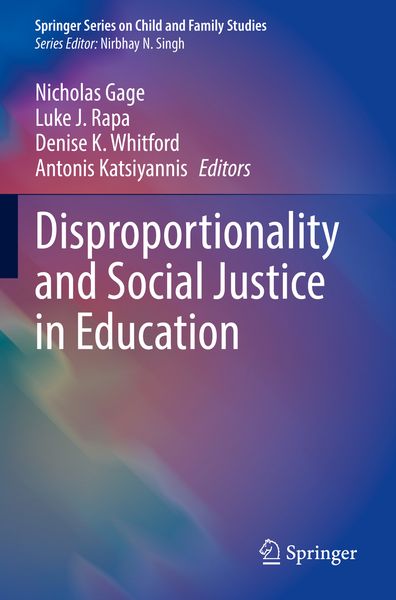
  • Produktbild: Disproportionality and Social Justice in Education
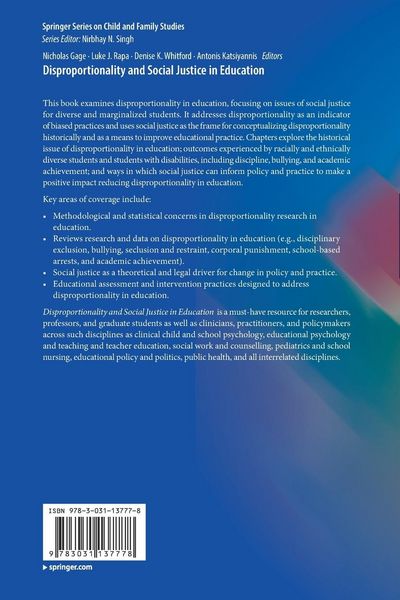
  • Produktbild: Disproportionality and Social Justice in Education
- 16%

Disproportionality and Social Justice in Education

16% sparen

146,99 € UVP 175,99 €

inkl. gesetzl. MwSt., Versandkostenfrei


Beschreibung

Produktdetails

Einband

Taschenbuch

Erscheinungsdatum

27.10.2023

Herausgeber

Nicholas Gage + weitere

Verlag

Springer

Seitenzahl

296

Maße (L/B/H)

23,5/15,5/1,8 cm

Gewicht

482 g

Auflage

1st ed. 2022

Sprache

Englisch

ISBN

978-3-031-13777-8

Beschreibung

Portrait

Nicholas A Gage, Ph.D.,  is a Senior Researcher in Special Education at WestEd focused on advancing rigorous research and evaluation in learner variability and special education. Dr. Gage’s research interests are centered on the identification of policies and practices at the national, state, local, and classroom levels to support the academic, social, and behavioral needs of students with disabilities. This work is grounded in a multitiered systems of support (MTSS) framework, with a particular emphasis on positive behavior interventions and supports (PBIS). His expertise is in supporting researchers, schools, districts, and states in leveraging their data resources to best identify and develop effective and efficient systems of support for students’ academic and behavioral needs.

Luke J. Rapa, Ph.D.,  is an Assistant Professor of Adolescent Development in the department of Education and Human Development at Clemson University. Broadly, Dr. Rapa studies how contextual, sociocultural, and sociopolitical factors shape key developmental and psychological processes and promote or constrain adolescent's development and academic success. Dr. Rapa has particular interest in the development of youth navigating adversity, marginalization, and inequitable societal conditions. Much of his research examines how adolescents critically analyze societal inequities and develop the motivation and agency to redress such inequities or develop "critical consciousness"; and how youth navigate structural constraints or marginalizing systems (e.g., institutional racism, discrimination, stereotypes in school) to achieve academic success and well-being.

Denise K. Whitford, Ph.D.,  is an Associate Professor of Special Education at Purdue University, specializing in discriminatory discipline. She is particularly involved in examining the impact on student achievement, postacademic outcomes, and emotional well-being, in addition to determining methods for decreasing disproportionality in K-12 settings, including through the use of culturally responsive practices and cultural competency training for educators.

Antonis Katsiyannis, Ed.D.,  an Alumni Distinguished Professor at Clemson University, specializes in legal and policy issues in special education. His research interests include legal and policy issues in special education, delinquency, and school violence and discipline. He has served as the president of the Council for Exceptional Children (CEC) and he is the recipient of the 2018 Frederick J. Weintraub Outstanding CEC Leadership Award, the 2018 MSLBD Leadership Award, and the 2017 CCBD Leadership Award.


Produktdetails

Einband

Taschenbuch

Erscheinungsdatum

27.10.2023

Herausgeber

Verlag

Springer

Seitenzahl

296

Maße (L/B/H)

23,5/15,5/1,8 cm

Gewicht

482 g

Auflage

1st ed. 2022

Sprache

Englisch

ISBN

978-3-031-13777-8

Herstelleradresse

Springer-Verlag KG
Sachsenplatz 4-6
1201 Wien
AT

Email: ProductSafety@springernature.com

Kundinnen und Kunden meinen

0 Bewertungen

Informationen zu Bewertungen

Zur Abgabe einer Bewertung ist eine Anmeldung im Konto notwendig. Die Authentizität der Bewertungen wird von uns nicht überprüft. Wir behalten uns vor, Bewertungstexte, die unseren Richtlinien widersprechen, entsprechend zu kürzen oder zu löschen.

Die Bewertungen sind nach Format, Anzahl Sterne und Datum sortiert.

Verfassen Sie die erste Bewertung zu diesem Artikel

Helfen Sie anderen Kund*innen durch Ihre Meinung

Kundinnen und Kunden meinen

0 Bewertungen filtern

  • Produktbild: Disproportionality and Social Justice in Education
  • Produktbild: Disproportionality and Social Justice in Education
  • Part I. Foundations: Understanding Disproportionality in Historical, Legal, Theoretical, and Methodological Terms.- Chapter 1. Ever Since Little Rock: The History of Disciplinary Disparities in America’s Schools.- Chapter 2. Civil Rights and the Birth of Special Education.- Chapter 3. Theoretical Perspectives Guiding the Study of Disproportionality in Education.- Chapter 4. Methodological Issues and Debates in the Study of Disproportionality in Education.- Part II. Understanding Disproportionality through Contemporary Data.- Chapter 5. Disciplinary Exclusions.- Chapter 6. Bullying Victimization and Perpetration.- Chapter 7. Seclusion and Restraint .- Chapter 8. Corporal Punishment .- Chapter 9. School-based Law Enforcement Referrals and Arrests.- Chapter 10. Academic Achievement.- Part III. Addressing Disproportionality: The Current Moment and Beyond.- Chapter 11. A Movement Toward Equity and Social Justice: Grounded in Theory, Realized in Practice.- Chapter 12. Reshaping Disproportionality Educational Research to Advance Social Justice.- Chapter 13. Reshaping Educational Policy to Advance Social Justice.- Chapter 14. Designing Educational Interventions to Advance Social Justice.