KI-Beratung Beta

Gutscheinbedingungen

**Gültig bis 05.10.2026 ab einem Mindestbestellwert von 30€ auf Spielzeug, Schreibwaren, Filme, Geschenke & Trends, Musik, tolino eReader & Zubehör, Hörbücher und Hörbuch-Downloads, nicht preisgebundene Bücher und Kalender online auf thalia.at und in der Thalia App. Einzelne Artikel können ausgeschlossen sein. Aufgrund der Buchpreisbindung sind deutschsprachige Bücher und eBooks ausgenommen. Zusätzlich ausgenommen sind Abos & Flatrates, Games, Geschenkkarten/-boxen, Shelfies, Software, Zeitschriften sowie einzelne Artikel von tonies®. Pro Einkauf einmal einlösbar. Nur gültig mit im Onlineshop hinterlegter Bonuscard. Click & Collect nur bei Onlinevorabzahlung möglich. Keine Barauszahlung. Nicht kombinierbar mit anderen Aktionen und Gutscheinen. Gutschein wird auf max. 500€ Bestellwert angerechnet. Nicht gültig für Versandkosten und Services. Preisgebundene Artikel sind vom Mindestbestellwert ausgeschlossen.

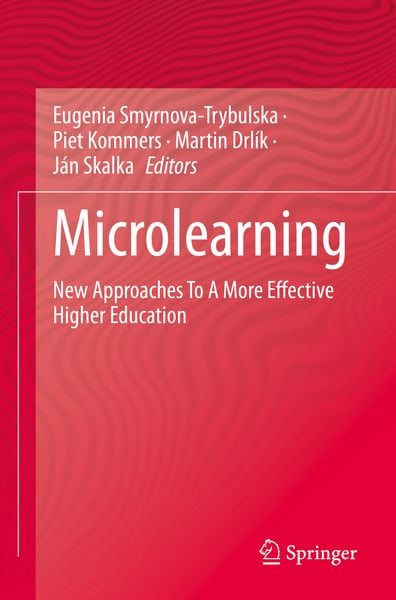
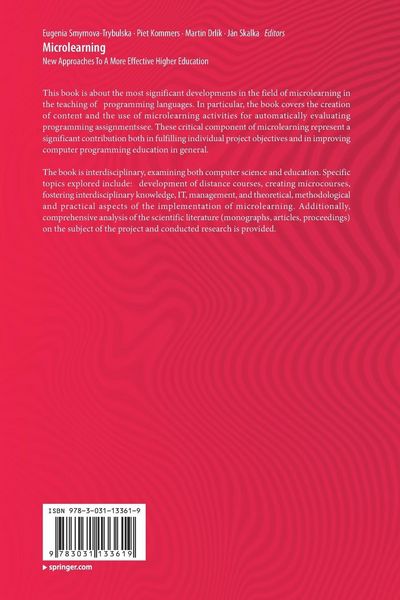
  • Produktbild: Microlearning
  • Produktbild: Microlearning
- 11%

Microlearning New Approaches To A More Effective Higher Education

11% sparen

96,99 € UVP 109,99 €

inkl. gesetzl. MwSt., Versandkostenfrei


Beschreibung

Produktdetails

Einband

Taschenbuch

Erscheinungsdatum

27.10.2023

Abbildungen

VI, 230 p. 107 illus., 92 illus. in color.

Herausgeber

Eugenia Smyrnova-Trybulska + weitere

Verlag

Springer

Seitenzahl

230

Maße (L/B/H)

23,5/15,5/1,3 cm

Gewicht

365 g

Auflage

23001 Auflage 1st ed. 2022

Sprache

Englisch

ISBN

978-3-031-13361-9

Beschreibung

Portrait


Eugenia Smyrnova-Trybulska is
 Associate Professor

Head of Department of Humanistic Education and Auxiliary Sciences of Pedagogy, University of Silesia in Katowice (US), Poland. Coordinator of distance learning platform of the Faculty of the Ethnology and Sciences of Education . Author of more than 180 publications, authors, co-authors, editors of  more than 20 books and monographs. Author and methodology consultant of the elaboration of more than 150 e-learning courses.

Main research projects and organizational activities: 2009-2010 - Coordinator of the international educational project No.10920089
E-learning – as a Road to Communicating in a Multicultural Environment
, co-financed by the International Visehrad Fund (Partners: University of Ostrava, Czech Republic, Matej Bel University in Banska Bystrica, Slovakia). 2007-2008 - Participation in the project funded by the Ministry of Education
Post-graduate studies for teachers in ICT, foreign languages and other subjects
, co-financed by the European Social Fund. 2012 - Participation in the ESF Project
Strengthening of competitive advantages in research and development of information technology In Moravian-Silesian Region
, CZ1.07/2.3.00/09.0197, Methodology consultant for the elaboration of e-learning courses in the Project UPGOW ("University - Partner of the  Knowledge-Based Economy"). The project under the Operational Programme Human Capital, sub. 4.1.1 with support from the European Social Fund (ESF),  task  46. Coordinator of the Theoretical and Practical Aspects of Distance Learning Conference, other.

Piet Kommers is
, Associate Professor in the Faculty of Behavioral Sciences, Department of Media. His actual interest is media, learning and visual communication. From 1990 he is increasingly involved as partner and coordinator in European research projects based and continuous learning. His role in initiating higher education in Eastern Europe led to his UNESCO chair, followed by the award of honorary doctor by Capital Normal University in Beijing in 2000. Main recent functions: Committee Member for the Academy of Sciences; Communication and Organization, UT; Scientific Board Member for New Learning Projects. Ministry of Education, Singapore; Lector at Fontys University of Applied Sciences for the Integration of ICT in Education; Regular Visiting Professor for Human Factors in Multimodal Communication for the European PhD Academy IMPDET at Joensuu University, Finland; Visiting Professor at the Institute of Educational Multimedia and Telematics; University of Hokkaido, Sapporo, Japan; Member of the UNESCO Board
Creative Media Interaction for a Better Future: Trends, Challenges and Priorities
.

Martin Drlík
received the M.S. degree in biophysics from the Faculty of Mathematics, Physics and Computer Science, Comenius University, Bratislava, Slovakia, in 2001, and the Ph.D. degree intheory of computer science education from Constantine the Philosopher University, Nitra, Slovakia, in 2009. Since 2002, he has been an Assistant Professor with the Department of Informatics, Constantine the Philosopher University. His research interests include the learning analytics, educational data mining, software engineering, and database systems. Dr. Drlík has been a member of ACM since 2007. He was a recipient of the Green Group Award (best paper) of the International Conference on Computational Science 2013 and the Workshop on Computational Finance and Business Intelligence (Barcelona, 2013).

Jan Skalka
received the M.S. degree in mathematics and computer science education from the Faculty Naturals Science, Constantine the Philosopher University, Nitra, Slovakia, in 1996, and the Ph.D. degree in education technology, in 2004. Since 2000, he has been an Assistant Professor with the Department of Informatics, Constantine the Philosopher University. His researchinterests include the programming education, software engineering, and database systems. Dr. Skalka leads many educational and developing projects and now he is a main developer of microlearning educational system PRISCILLA.


Produktdetails

Einband

Taschenbuch

Erscheinungsdatum

27.10.2023

Abbildungen

VI, 230 p. 107 illus., 92 illus. in color.

Herausgeber

Verlag

Springer

Seitenzahl

230

Maße (L/B/H)

23,5/15,5/1,3 cm

Gewicht

365 g

Auflage

23001 Auflage 1st ed. 2022

Sprache

Englisch

ISBN

978-3-031-13361-9

Herstelleradresse

Springer-Verlag KG
Sachsenplatz 4-6
1201 Wien
AT

Email: ProductSafety@springernature.com

Noch keine Bewertungen vorhanden

Verfassen Sie die erste Bewertung zu diesem Artikel

Helfen Sie anderen Kundinnen und Kunden durch Ihre Meinung.

Kundinnen und Kunden meinen

Bewertungen (0)

Weitere Artikel finden Sie in

  • Produktbild: Microlearning
  • Produktbild: Microlearning

  • Chapter  (Article) 1: Microlearning and Automated Assessment - a Framework Implementation of Dissimilar Elements to Achieve Better Educational Outcomes.- Chapter  (Article) 2: Microlearning as an educational technology: information requests and bibliometric analysis.- Chapter (Article) 3: Guidance for Introductory Programming Courses Creation Using Microlearning and Automated Assessment.- Chapter  (Article) 4: “Learning by Designing, Imagination and Programming".- Chapter (Article) 5: Micro-learning in improving professional competences of programmers - pilot .-studies.- Chapter (Article)  6: Modern educational methods based on Priscilla tools.- Chapter (Article)  7: Priscilla Evaluation Pilot Study: A Rasch Measurement Analysis.- Chapter (Article) 8: Microlearning formats in crisis? Theses in the field of tension between corona-induced short-term solutions, apodictic rhetorics of no alternatives and perspectives open to the future.- Chapter  (Article) 9: A comprehensive discussion of emerging Automatic Programming Assessment in Learning Management Systems: the VPL example.- Chapter  (Article) 10: Database and SQL microlearning course.- Chapter  (Article) 11: The Architecture of Visual Design in Modern Web Applications.- Chapter  (Article) 12: Virtual Programming Lab For Moodle – Automatic Program Assessment in a First-year University Course.- Chapter  (Article) 13: Evaluation of Primary School Mathematics Education: Applied Research Results.- Chapter  (Article) 14:  Microelerning as a research subject. Basic research problems.