KI-Beratung Beta

Gutscheinbedingungen

**Gültig bis 18.11.2026 auf englischsprachige Klassiker (klassiker-32728) online auf thalia.at und in der Thalia App. Einzelne Artikel können ausgeschlossen sein. Ausgenommen sind preisgebundene Artikel & eBooks. Pro Einkauf einmal einlösbar. Click & Collect nur bei Onlinevorabzahlung möglich. Keine Barauszahlung. Nicht kombinierbar mit anderen Aktionen und Gutscheinen. Gutschein wird auf max. 500€ Bestellwert angerechnet. Nicht gültig für Geschenkkarten, Versandkosten und Services.

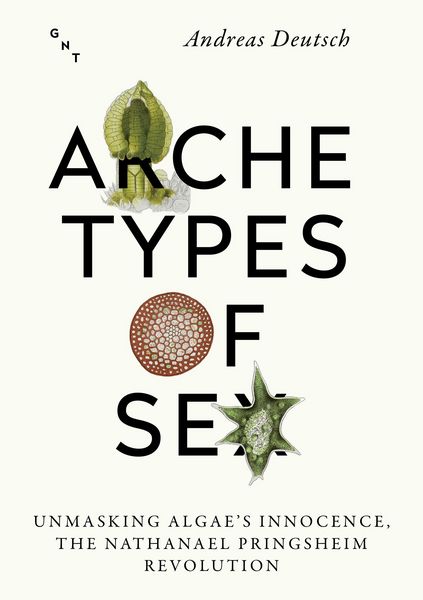
Produktbild: Archetypes of Sex

Archetypes of Sex Unmasking Algae's Innocence, the Nathanael Pringsheim Revolution

30,90 €

inkl. gesetzl. MwSt., Versandkostenfrei


Beschreibung

Algae have played a crucial role in shaping our planet’s atmosphere, as they transform CO2 into the oxygen we breathe. They contribute to building a sustainable future by aiding in the fight against climate change, providing new energy sources and essential resources for nutrition. NATHANAEL PRINGSHEIM...

Beschreibung

Algae have played a crucial role in shaping our planet’s atmosphere, as they transform CO2 into the oxygen we breathe. They contribute to building a sustainable future by aiding in the fight against climate change, providing new energy sources and essential resources for nutrition. NATHANAEL PRINGSHEIM (1823–1894), a pioneer of modern botany and a contemporary of Charles Darwin, revolutionized the understanding of biology. In his research on algae, Pringsheim revealed that sexuality was a fundamental principle even in organisms previously classified as “lower” life forms.

This book offers readers:

  • exciting insights into the development of modern biology illustrated through Pringsheim’s fascinating life and scientific achievements,
  • the first-ever account of the Pringsheim family, persecuted in the Third Reich, and their contributions to the natural sciences,
  • an enthralling narrative of the challenging journey to establish the first German marine biology research station on the island of Helgoland,
  • an appealing showcase of large-scale artistic interpretations of microscopic worlds, created by Pringsheim, also a master of scientific illustration
  • and last but not least, new perspectives on algae research, which is more relevant today than ever before.

Produktdetails

Einband

Taschenbuch

Erscheinungsdatum

15.09.2026

Abbildungen

130

Verlag GNT Publishing GmbH

Produktdetails

Einband

Taschenbuch

Erscheinungsdatum

15.09.2026

Abbildungen

130

Verlag GNT Publishing GmbH
Seitenzahl

256

Maße (L/B/H)

20,5/15,1/2,2 cm

Gewicht

376 g

Auflage

1

Sprache

Englisch

ISBN

978-3-86225-143-8

Herstelleradresse

Gnt- Verlag
Schloßstr. 1
49356 Diepholz
DE

Email: info@gnt-verlag.de

Noch keine Bewertungen vorhanden

Verfassen Sie die erste Bewertung zu diesem Artikel

Helfen Sie anderen Kundinnen und Kunden durch Ihre Meinung.

Kundinnen und Kunden meinen

Bewertungen (0)

  • Produktbild: Archetypes of Sex
    • PREFACE BY THE AUTHOR (p. 9)
    • 1 INFLUENCES: SCIENCE IN TRANSITION (p. 15)
      • 1.1 From a static to a dynamic world view (p. 18)
      • 1.2 Schleiden’s and Schwann’s cell theory (p. 23)
      • 1.3 Darwin’s and Wallace’s theory of evolution (p. 25)
      • 1.4 German natural philosophy and idealistic morphology (p. 29)
      • 1.5 Pringsheim’s approach to research (p. 33)
    • 2 CAREER: THE LIFE OF NATHANAEL PRINGSHEIM (p. 35)
      • 2.1 Childhood: Difficult school years together with Ferdinand Lassalle (p. 38)
      • 2.2 Study, important university teachers, and struggle for the doctorate (p. 40)
        • 2.2.1 From philosophy to medicine to botany (p. 40)
        • 2.2.2 The struggle for the doctorate (p. 46)
      • 2.3 Political activities: March 1848 (p. 49)
      • 2.4 Scientific and personal achievements (p. 52)
      • 2.5 Founder of one of the first botanical institutes (p. 58)
      • 2.6 The final years in Berlin (p. 63)
      • 2.7 Other founding activities (p. 68)
        • 2.7.1 Yearbooks for Scientific Botany (p. 68)
        • 2.7.2 German Botanical Society (p. 69)
        • 2.7.3 Reports of the German Botanical Society (p. 74)
      • 2.8 Other members of the Pringsheim family (p. 74)
        • 2.8.1 The chemist Albert Ladenburg (p. 78)
        • 2.8.2 The physicists in the Pringsheim family (p. 80)
          • Rudolf Ladenburg (p. 80)
          • Ernst Pringsheim (p. 82)
          • Peter Pringsheim (p. 83)
          • Agate Carst (p. 84)
        • 2.8.3 The mathematician Alfred Pringsheim (p. 86)
        • 2.8.4 The biologist Ernst Georg Pringsheim (p. 88)
        • 2.8.5 Victims of the Nazi regime (p. 90)
          • The niece Martha Liebermann (p. 90)
          • The granddaughter Irene Carst (p. 92)
    • 3 SCIENTIFIC WORK: ARCHETYPES OF SEXUALITY (p. 99)
      • 3.1 Origins of sexuality in biology (p. 102)
      • 3.2 Sexuality of plants (p. 106)
        • 3.2.1 Higher plants (p. 106)
        • 3.2.2 Lower plants (p. 108)
      • 3.3 The sexual archetypes of algae (p. 110)
        • 3.3.1 Archetype I: Internal fertilization (p. 110)
          • Discovery (p. 110)
          • Green algae (p. 114)
        • 3.3.2 Archetype II: External fertilization (p. 118)
          • Prototype Pandorina (p. 118)
        • 3.3.3 Archetype III: Sexual-asexual generation change (p. 121)
          • The principle of generation change (p. 121)
          • Prototype Coleochaete (p. 121)
      • 3.4 Evolution of land plants: The importance of sexuality (p. 125)
        • 3.4.1 Variation I: Sexual dominance in mosses (p. 126)
          • Pioneers of terrestrial life (p. 126)
          • Generation change of mosses (p. 127)
          • Apospory (p. 129)
        • 3.4.2 Variation II: Asexual dominance in ferns (p. 131)
          • Generation change of ferns (p. 131)
        • 3.4.3 Variation III: Protected sexuality in flowering plants (p. 133)
          • Generation change of flowering plants (p. 135)
          • The pollen tube: an extraordinary "invention" of nature (p. 137)
        • 3.4.4 On the advantage of sexual reproduction (p. 138)
      • 3.5 Classification of Pringheim’s work (p. 141)
    • 4 MARINE BIOLOGY: PRINGSHEIM'S LEGACY ON HELGOLAND (p. 145)
      • 4.1 The exploration of the sea (p. 148)
        • 4.1.1 Helgoland: a marine biological hotspot (p. 148)
        • 4.1.2 Other European research stations (p. 153)
        • 4.1.3 The idea of a German research station (p. 157)
      • 4.2 Biological Institute Helgoland (p. 159)
      • 4.3 North Sea Museum (p. 171)
        • The show aquarium (p. 176)
      • 4.4 Botanical experimental garden (p. 178)
      • 4.5 The Nathanael Pringsheim Foundation (p. 181)
    • 5 AESTHETICS: ART FORMS OF MICROSCOPY (p. 185)
    • 6 APPENDIX (p. 213)
      • 6.1 Documents (p. 215)
      • 6.2 Cited literature (p. 221)
      • 6.3 Image sources (p. 227)
      • 6.4 About the author (p. 230)
    • TABLE OF CONTENTS (p. 233)
    • INDEX (p. 237)