KI-Beratung Beta

Gutscheinbedingungen

**Gültig am 20.11.2026 ab einem Mindestbestellwert von 30€ auf Spielzeug, Schreibwaren, Filme, Geschenke & Trends, Musik, tolino eReader & Zubehör, Hörbücher und Hörbuch-Downloads, nicht preisgebundene Bücher und Kalender online auf thalia.at und in der Thalia App. Einzelne Artikel können ausgeschlossen sein. Aufgrund der Buchpreisbindung sind deutschsprachige Bücher und eBooks ausgenommen. Zusätzlich ausgenommen sind Abos & Flatrates, Games, Geschenkkarten/-boxen, Shelfies, Software, Zeitschriften sowie einzelne Artikel von tonies®. Pro Einkauf einmal einlösbar. Click & Collect nur bei Onlinevorabzahlung möglich. Keine Barauszahlung. Nicht kombinierbar mit anderen Aktionen und Gutscheinen. Gutschein wird auf max. 500€ Bestellwert angerechnet. Nicht gültig für Versandkosten und Services. Preisgebundene Artikel sind vom Mindestbestellwert ausgeschlossen.

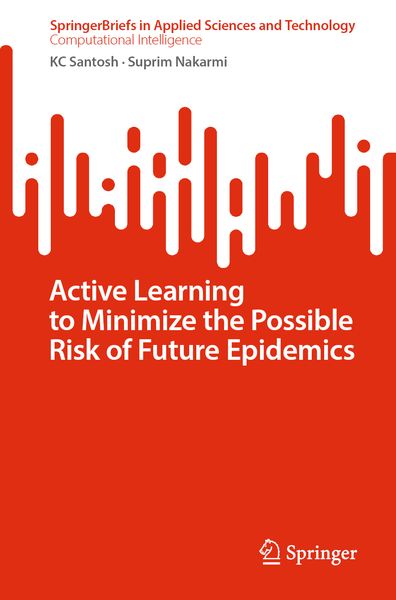
Produktbild: Active Learning to Minimize the Possible Risk of Future Epidemics

Active Learning to Minimize the Possible Risk of Future Epidemics

44,99 €

inkl. gesetzl. MwSt., Versandkostenfrei


Beschreibung

Future epidemics are inevitable, and it takes months and even years to collect fully annotated data. The sheer magnitude of data required for machine learning algorithms, spanning both shallow and deep structures, raises a fundamental question: how big data is big enough to effectively tackle future...

Beschreibung

Future epidemics are inevitable, and it takes months and even years to collect fully annotated data. The sheer magnitude of data required for machine learning algorithms, spanning both shallow and deep structures, raises a fundamental question: how big data is big enough to effectively tackle future epidemics? In this context, active learning, often referred to as human or expert-in-the-loop learning, becomes imperative, enabling machines to commence learning from day one with minimal labeled data. In unsupervised learning, the focus shifts toward constructing advanced machine learning models like deep structured networks that autonomously learn over time, with human or expert intervention only when errors occur and for limited data—a process we term mentoring. In the context of Covid-19, this book explores the use of deep features to classify data into two clusters (0/1: Covid-19/non-Covid-19) across three distinct datasets: cough sound, Computed Tomography (CT) scan, and chest x-ray (CXR). Not to be confused, our primary objective is to provide a strong assertion on how active learning could potentially be used to predict disease from any upcoming epidemics. Upon request (education/training purpose), GitHub source codes are provided.

Produktdetails

Einband

Taschenbuch

Erscheinungsdatum

23.11.2023

Abbildungen

XVI, 96 p. 20 illus., 15 illus. in color.

Verlag Springer Singapore

Produktdetails

Einband

Taschenbuch

Erscheinungsdatum

23.11.2023

Abbildungen

XVI, 96 p. 20 illus., 15 illus. in color.

Verlag Springer Singapore
Seitenzahl

96

Maße (L/B/H)

23,5/15,5/0,7 cm

Gewicht

184 g

Auflage

23001 Auflage 1st ed. 2023

Sprache

Englisch

ISBN

978-981-9974-41-2

Herstelleradresse

Springer-Verlag KG
Sachsenplatz 4-6
1201 Wien
AT

Email: ProductSafety@springernature.com

Noch keine Bewertungen vorhanden

Verfassen Sie die erste Bewertung zu diesem Artikel

Helfen Sie anderen Kundinnen und Kunden durch Ihre Meinung.

Kundinnen und Kunden meinen

Bewertungen (0)

  • Produktbild: Active Learning to Minimize the Possible Risk of Future Epidemics

  • Introduction.- Active learning – what, when, and where to deploy?.- Active learning – review (cases).- Active learning – methodology.- Active learning – validation.- Case study: Is my cough sound Covid-19?.