Gutscheinbedingungen

**Gültig nur für Bestellungen an die Wunsch-Poststation bis 10.06.2026 auf Spielzeug, Schreibwaren, Filme, Geschenke & Trends, Musik, tolino eReader & Zubehör, Hörbücher und Hörbuch-Downloads (außer Abo), nicht preisgebundene Bücher und Kalender online auf thalia.at und in der Thalia App. Einzelne Artikel können ausgeschlossen sein. Aufgrund der Buchpreisbindung sind deutschsprachige Bücher und eBooks ausgenommen. Zusätzlich ausgenommen sind preisgebundene Artikel, Abos & Flatrates, eBooks, Games, Geschenkkarten/-boxen, Shelfies, Software, Zeitschriften sowie einzelne Artikel von tonies®. Pro Einkauf einmal einlösbar. Kein Click & Collect möglich. Keine Barauszahlung. Nicht kombinierbar mit anderen Aktionen und Gutscheinen. Gutschein wird auf max. 500€ Bestellwert angerechnet. Nicht gültig für Versandkosten und Services.

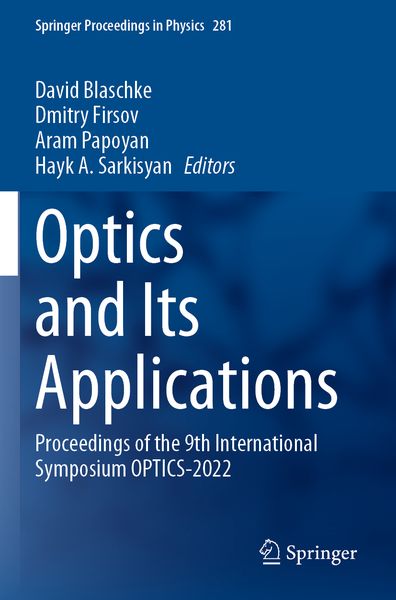
Produktbild: Optics and Its Applications
- 13%

Optics and Its Applications Proceedings of the 9th International Symposium OPTICS-2022

13% sparen

142,99 € UVP 164,99 €

inkl. gesetzl. MwSt., Versandkostenfrei


Beschreibung

Produktdetails

Einband

Taschenbuch

Erscheinungsdatum

07.10.2023

Herausgeber

David Blaschke + weitere

Verlag

Springer

Seitenzahl

213

Maße (L/B/H)

23,5/15,5/1,2 cm

Gewicht

401 g

Auflage

2022

Sprache

Englisch

ISBN

978-3-031-11289-8

Beschreibung

Portrait

David Blaschke obtained his PhD in theoretical physics from Rostock University in 1987 and habilitated in 1995. From 2001-2007 he was vice director of the Bogoliubov Laboratory of Theoretical Physics at the Joint Institute for Nuclear Research in Dubna. Since 2006, he is professor at the University of Wroclaw, where he is vice director of the Institute of Theoretical Physics since 2020. His works are mainly devoted to topics in quantum field theory at finite temperature, dense hadronic matter and QCD phase transitions, quark matter in heavy-ion collisions and in compact stars, as well as to pair production in strong fields with applications to high-intensity lasers. He obtained honorary doctorates from Dubna State University (2017) and Russian Armenian University in Yerevan (2019). In 2022, he was awarded the prize of the Minister for Science and Education for outstanding scientific achievements.

Dmitry Firsov received the M.S. degree in optoelectronics in 1977, the Ph.D.degree in 1984, and the Doctor of Science degree in 2000, all from St. Petersburg State Technical University, St. Petersburg, Russia. In 2009-2019 he was the head of the Department of Physics of Semiconductors and Nanoelectronics of this University. He is currently a Professor in the Higher School of Engineering Physics at Peter the Great St. Petersburg Polytechnic University. His interests are in the optics of nonequilibrium carriers in semiconductor quantum well and quantum dot nanostructures, including the development of new optoelectronic devices – terahertz light sources and detectors. In 2015, he received an honorary doctorate from Russian-Armenian University in Yerevan.

Aram Papoyan obtained his PhD in optics (1991) and DSc in Laser Physics (2004) from Institute for Physical Research (IPR) of National Academy of Sciences (NAS) of Armenia. Since 2006 he is a Director of IPR, and in 2010 was elected as a Corresponding Member of NAS. His research activitiesat IPR, where he also leads the Laboratory of Optics, encompass atomic physics, laser spectroscopy, optical imaging, and quantum optics. In 2003 he received the Award of the President of Armenia in Physics, in 2015 was awarded the Galileo Galilei medal from International Commission for Optics, in 2017 obtained honorary doctorate from Russian-Armenian University, and in 2019 he received OSA “Advocate for Optics” recognition.

Hayk Sarkisyan obtained his PhD in semiconductor physics from Yerevan State University in 1997 and Doctor of Science Degree in 2005. From 1997-2019 he was a Researcher and Senior Researcher of the Department of Physics of Yerevan State University. Since 2006, he is professor at the Russian-Armenian University, from 2008 to 2012 he was the Dean of the Faculty of Physics and Technology and from 2012-2018 head of chair of General Physics and Quantum Nanostructures of the Russian-Armenian University. Since 2018 he is Director of the Institute of Engineering and Physics of Russian-Armenian University. Since 2015 he is Professor of Physics of Peter the Great St. Petersburg State Technical University. The scientific interests of Professor Sarkisyan connected with the theoretical investigation of electronic, optical, statistical and spin characteristics of semiconductor nanostructures. In 2007, he was awarded the Republic of Armenia Presidential Award in Physics and in 2011, he received the State Award of the Republic of Armenia in the Area of Precise and Natural Sciences.

Produktdetails

Einband

Taschenbuch

Erscheinungsdatum

07.10.2023

Herausgeber

Verlag

Springer

Seitenzahl

213

Maße (L/B/H)

23,5/15,5/1,2 cm

Gewicht

401 g

Auflage

2022

Sprache

Englisch

ISBN

978-3-031-11289-8

Herstelleradresse

Springer-Verlag KG
Sachsenplatz 4-6
1201 Wien
AT

Email: ProductSafety@springernature.com

Kundinnen und Kunden meinen

0 Bewertungen

Informationen zu Bewertungen

Zur Abgabe einer Bewertung ist eine Anmeldung im Konto notwendig. Die Authentizität der Bewertungen wird von uns nicht überprüft. Wir behalten uns vor, Bewertungstexte, die unseren Richtlinien widersprechen, entsprechend zu kürzen oder zu löschen.

Die Bewertungen sind nach Format, Anzahl Sterne und Datum sortiert.

Verfassen Sie die erste Bewertung zu diesem Artikel

Helfen Sie anderen Kund*innen durch Ihre Meinung

Kundinnen und Kunden meinen

0 Bewertungen filtern

  • Produktbild: Optics and Its Applications
  • Current-induced Optical Activity: First Observation and Comprehensive Study.- Optically pumped terahertz radiation sources based on impurity carrier transitions in quantum wells.- Broadband Absorption of Microwaves in Periodic Cylindrical Structures.- Dielectric confinement affected exciton-polariton properties of the semiconductor nanowires.- Broadband Infrared Absorption Due to Low Q-factor Dipole Modes of Cr Strips.- Microwave and Joule heating visualization by a thermo-elastic microscope for carbon composite materials.- Acceptor-assisted intraband photoconductivity in GaAs/AlGaAs quantum wells.- Charge carriers’ states and optical transitions inCdS/HgS/CdS core/shell/shell cylindrical nanoststructure in the presence of strong uniform electrostatic field.- Quasi-conical quantum dot helium.- Radiation of surface polaritons in cylindrical waveguides.- Crossing points in spectra and light absorption in spheroidal and cone-shaped quantum dots.- Electronic and Magnetic Properties of Laser Dressed Quantum Dot and Ring with Rashba Spin-Orbit Coupling.- Magnetically induced atomic transitions of alkali metal atoms.- Effect of molecular and electronic geometries on the electronic density in FLO-SIC.- Approximate Solutions of a Kinetic Theory for Graphene.- Possibility of creating a low-cost robot assistant for use in general medical institutions during the COVID-19 pandemic.