Gutscheinbedingungen

**Gültig nur für Bestellungen an die Wunsch-Poststation bis 10.06.2026 auf Spielzeug, Schreibwaren, Filme, Geschenke & Trends, Musik, tolino eReader & Zubehör, Hörbücher und Hörbuch-Downloads (außer Abo), nicht preisgebundene Bücher und Kalender online auf thalia.at und in der Thalia App. Einzelne Artikel können ausgeschlossen sein. Aufgrund der Buchpreisbindung sind deutschsprachige Bücher und eBooks ausgenommen. Zusätzlich ausgenommen sind preisgebundene Artikel, Abos & Flatrates, eBooks, Games, Geschenkkarten/-boxen, Shelfies, Software, Zeitschriften sowie einzelne Artikel von tonies®. Pro Einkauf einmal einlösbar. Kein Click & Collect möglich. Keine Barauszahlung. Nicht kombinierbar mit anderen Aktionen und Gutscheinen. Gutschein wird auf max. 500€ Bestellwert angerechnet. Nicht gültig für Versandkosten und Services.

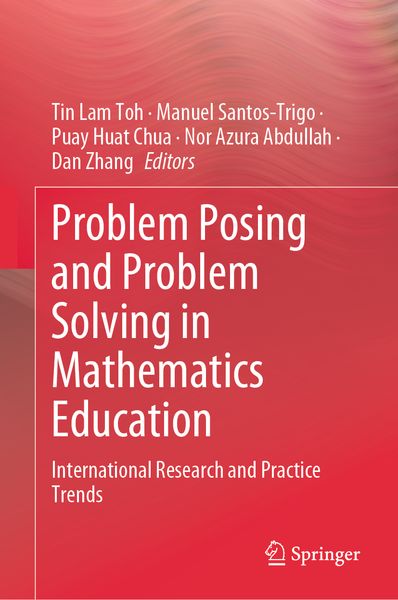
  • Produktbild: Problem Posing and Problem Solving in Mathematics Education
  • Produktbild: Problem Posing and Problem Solving in Mathematics Education
- 17%

Problem Posing and Problem Solving in Mathematics Education International Research and Practice Trends

17% sparen

117,99 € UVP 142,99 €

inkl. gesetzl. MwSt., Versandkostenfrei


Beschreibung

Produktdetails

Einband

Gebundene Ausgabe

Erscheinungsdatum

02.01.2024

Herausgeber

Tin Lam Toh + weitere

Verlag

Springer Singapore

Seitenzahl

259

Maße (L/B/H)

24,1/16/2,1 cm

Gewicht

576 g

Auflage

1. Auflage

Sprache

Englisch

ISBN

978-981-9972-04-3

Beschreibung

Portrait

Dr. Toh Tin Lam is Associate Professor at the National Institute of Education (NIE), Nanyang Technological University (NTU), Singapore, and obtained his Ph.D. from the National University of Singapore (NUS) in Mathematics. He is currently Head of the Mathematics and Mathematics Education Academic Group of the Institute. His involvement as Teacher Educator sparked an interest to develop a second wing of research in mathematics education over the years. He has published extensively in international refereed journals in both mathematics and mathematics education. His research interest in mathematics education involves mathematical problem solving, mathematics teacher professional development, and school mathematics curriculum. He has led two large-scale mathematics education research projects on mathematical problem solving and continues to publish papers on this subject.

Manuel Santos-Trigo is Professor at the Mathematics Education Department, Centre for Research and Advanced Studies, Cinvestav-IPN, Mexico. He is Member of the Mexican Academy of Sciences and of the National Researchers System. He teaches graduate courses and does research in mathematical problem solving. His area of interest involves analyzing and documenting teachers and students’ systematic and coordinated use of digital technologies in problem-solving activities. He completed his B.Sc. in mathematics at the National Polytechnic Institute in Mexico and a doctorate in mathematics education at the University of British Columbia, Canada. He did a post-doctorate research as Visiting Scholar at the University of California, Berkeley. He has been Visiting Professor at several institutions including Purdue University, l’université d’Orléans (France), and la Universidad de la Laguna (Spain). He has also been Principal Investigator of several research projects in the field of problem solving and the use of technology with national and international funding. He was Co-chair of the Topic Study Group on Mathematical Problem Solving of the 13th International Congress on Mathematical Education and has supervised doctoral and master’s students in mathematics education in México and abroad.

Dr. Puay Huat Chua is Senior Teaching Fellow with the Office of Education Research (OER) at the National Institute of Education (NIE), Nanyang Technological University (NTU), Singapore. He works actively on conceptualizing and operationalizing knowledge mobilization and also on collaboration work on data mining applications within education. He received his Doctor of Philosophy from the Nanyang Technological University (NTU) in mathematics education. He was a Senior Research Analyst with Research Evaluation in the Planning Division in the Ministry of Education (MOE), was involved in work on international comparative studies, and was also Vice Principal of three secondary schools. His main interest is in mathematics problem solving and posing. Besides conducting data literacy workshops, he also teaches mathematics pedagogical courses. His current interest is in enhancing school improvement through teacher data literacy and in examining knowledge translation, brokerage, and educational partnership.

Dr. Nor Azura Abdullah started as Tutor at the Sultan Hassanal Bolkiah Institute of Education (SHBIE) back in 2006. After obtaining her master’s degree in 2007, she was appointed Lecturer in the university and went on to pursue her graduate studies in Japan and Hong Kong, in 2011 and 2015, respectively. In SHBIE, she continues to teach mathematics education modules for teacher education, at both primary and secondary levels. Her initial research interest started from teachers’ pedagogical knowledge and development and has since expanded into teachers’ values in the teaching and learning of mathematics and professional development of teachers, such as in lesson study.

Zhang Dan, a professor of Beijing Academy of Educational Sciences, China, was a core member of the research team for the National Compulsory Education Mathematics Curriculum Standard ‘Experimental Edition’, and the National Compulsory Education Mathematics Curriculum Standard (2011 Edition). She is the vice chairman of the Primary School Mathematics Teaching Professional Committee of the Chinese Society of Education. Her research interests include problem posing and solving, 'problem leading learning' and primary school mathematics teaching.

Produktdetails

Einband

Gebundene Ausgabe

Erscheinungsdatum

02.01.2024

Herausgeber

Verlag

Springer Singapore

Seitenzahl

259

Maße (L/B/H)

24,1/16/2,1 cm

Gewicht

576 g

Auflage

1. Auflage

Sprache

Englisch

ISBN

978-981-9972-04-3

Herstelleradresse

Springer-Verlag KG
Sachsenplatz 4-6
1201 Wien
AT

Email: ProductSafety@springernature.com

Kundinnen und Kunden meinen

0 Bewertungen

Informationen zu Bewertungen

Zur Abgabe einer Bewertung ist eine Anmeldung im Konto notwendig. Die Authentizität der Bewertungen wird von uns nicht überprüft. Wir behalten uns vor, Bewertungstexte, die unseren Richtlinien widersprechen, entsprechend zu kürzen oder zu löschen.

Die Bewertungen sind nach Format, Anzahl Sterne und Datum sortiert.

Verfassen Sie die erste Bewertung zu diesem Artikel

Helfen Sie anderen Kund*innen durch Ihre Meinung

Kundinnen und Kunden meinen

0 Bewertungen filtern

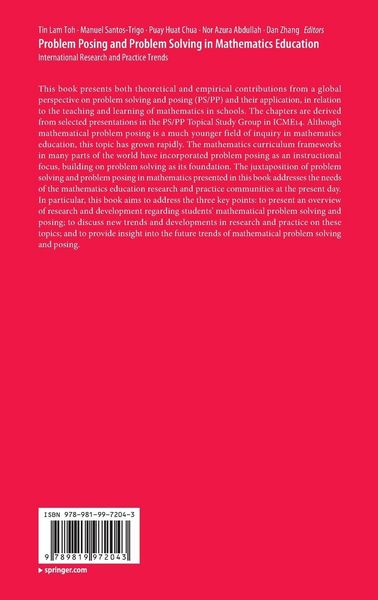
  • Produktbild: Problem Posing and Problem Solving in Mathematics Education
  • Produktbild: Problem Posing and Problem Solving in Mathematics Education
  • Problem posing and problem-solving developments: Issues and themes within and from ICME 14 Topical Study Group contributions.- Trends and developments of mathematical problem-solving research to update and support the use of digital technologies in post-confinement learning spaces.- Problem posing and modeling: Confronting the dilemma of rigor or relevance.- Types of mathematical reasoning promoted in the context of problem-solving instruction in Geneva.- Prospective secondary school mathematics teachers’ use of digital technologies to represent, explore and solve problems.- Primary school teachers’ behaviors, beliefs, and their interplay in teaching for problem-solving.- Movie clips in the enactment of problem solving in the mathematics classroom within the framework of communication model.- On teaching of word problems in the context of early algebra.- Problem posing by mathematics teachers: The problems they pose and the challenges they face in the classroom.- Problem posing among preservice and inservice mathematics teachers.- An approach to developing the problem-posing skills of prospective mathematics teachers: Focus on the “what if not” heuristics.- Regulation of cognition during problem posing : A case study.- Problem posing in Pósa problem threads.- Conclusion: Mathematics problem posing and problem solving: Some reflection on recent advances and new opportunities.