Gutscheinbedingungen

**Gültig bis 24.06.2026 auf tolino vision color (4016621130183, 4016621131456) online auf thalia.at, in der Thalia App und in allen Thalia Buchhandlungen in Österreich. In den Buchhandlungen nur gültig auf lagernde Ware. Pro Einkauf einmal einlösbar. Nur gültig gegen Vorlage oder im Onlineshop hinterlegter Bonuscard. Infos zur Einlösung in der Buchhandlung sind auf der Bonuscard-Vorteilspreisseite zu finden. Click & Collect nur bei Onlinevorabzahlung möglich. Keine Einlösung bei Scan & Go-Bezahlung. Keine Barauszahlung. Nicht kombinierbar mit anderen Aktionen und Gutscheinen. Nicht gültig für Geschenkkarten, Versandkosten und Services. Nur solange der Vorrat reicht.

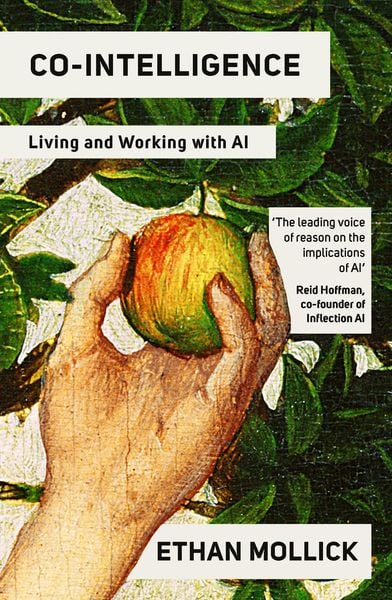
Produktbild: Co-Intelligence

Co-Intelligence The Definitive, Bestselling Guide to Living and Working with AI

1

14,99 €

inkl. gesetzl. MwSt.

Beschreibung

Produktdetails

Format

ePUB

Kopierschutz

Ja

Family Sharing

Nein

Text-to-Speech

Ja

Verkaufsrang

35217

Erscheinungsdatum

04.04.2024

Verlag

Ebury Publishing

Seitenzahl

256 (Printausgabe)

Dateigröße

2178 KB

Sprache

Englisch

EAN

9780753560785

Beschreibung

Produktdetails

Format

ePUB

eBooks im ePUB-Format erlauben eine dynamische Anpassung des Inhalts an die jeweilige Display-Größe des Lesegeräts. Das Format eignet sich daher besonders für das Lesen auf mobilen Geräten, wie z.B. Ihrem tolino, Tablets oder Smartphones.

Kopierschutz

Ja

Zum Lesen dieses eBooks auf Geräten der tolino Familie sowie auf sonstigen eReadern und am PC benötigen Sie eine Adobe ID. Weitere Hinweise zum Lesen von kopiergeschützten eBooks finden Sie unter Hilfe/Downloads.

Family Sharing

Nein

Mit Family Sharing können Sie eBooks innerhalb Ihrer Familie (max. sechs Mitglieder im gleichen Haushalt) teilen. Sie entscheiden selbst, welches Buch Sie mit welchem Familienmitglied teilen möchten. Auch das parallele Lesen durch verschiedene Familienmitglieder ist durch Family Sharing möglich. Um eBooks zu teilen oder geteilt zu bekommen, muss jedes Familienmitglied ein Konto bei Thalia oder einem anderen tolino-Buchhändler haben. Weitere Informationen finden Sie unter Hilfe/Family-Sharing.

Text-to-Speech

Ja

Bedeutet Ihnen Stimme mehr als Text? Mit der Funktion Text-to-Speech können Sie sich im tolino webReader und in der aktuellen Thalia – Lesen & Hören App das eBook vorlesen lassen. Weitere Informationen finden Sie unter Hilfe/Text-to-Speech.

Barrierefreiheit

  • navigierbares Inhaltsverzeichnis
  • alle Texte können angepasst werden
  • logische Lesereihenfolge eingehalten
  • hoher Kontrast zwischen Text und Hintergrund
  • keine Vorlesefunktionen des Lesesystems deaktiviert

Verkaufsrang

35217

Erscheinungsdatum

04.04.2024

Verlag

Ebury Publishing

Seitenzahl

256 (Printausgabe)

Dateigröße

2178 KB

Sprache

Englisch

EAN

9780753560785

Kundinnen und Kunden meinen

1 Bewertungen

Informationen zu Bewertungen

Zur Abgabe einer Bewertung ist eine Anmeldung im Konto notwendig. Die Authentizität der Bewertungen wird von uns nicht überprüft. Wir behalten uns vor, Bewertungstexte, die unseren Richtlinien widersprechen, entsprechend zu kürzen oder zu löschen.

Die Bewertungen sind nach Format, Anzahl Sterne und Datum sortiert.

5 Sterne

(0)

4 Sterne

(0)

3 Sterne

(1)

2 Sterne

(0)

1 Sterne

(0)

Understanding what AI is and is not

Chiara G am 11.12.2025

Bewertungsnummer: 2675749

Bewertet: Buch (Gebundene Ausgabe)

I had mixed feelings while reading Co-Intelligence. At times it felt a bit dry and technical, yet it still fascinated me enough to keep me engaged. Reading the book was an interesting experience, although the beginning was quite challenging for me. The first chapters include many technical explanations and because I am not very familiar with much AI terminology, I sometimes struggled to follow. Mollick talks about attention mechanisms, training data, "unknown unknowns" and different versions of language model and also about the evolution of Chat GPT from 3.5-4. For someone without a tech background, it can feel a bit overwhelming reading these first chapters. However, from chapter 3 onward the book becomes much easier to read. Mollick begins to use real-life examples of how AI appears in our every day lifes, for example at school, in businesses, and even in simple everyday tasks. These examples helped me to understand what he meant and made the read more accessible and practical. I was able to connect the theory to situations I recognised. One of the ideas I found especially interesting was AI as a coworker. Mollick suggests that humans and AI each have different strenghts. For example AI can be fast, creative and very efficient, while humans bring judgment, emotional understanding and responsibility. He explains that certain tasks should be done by AI, while it is crucial that others must remain in human hands. I thought this was a very realistic way of looking at collaborations. At the same time, Mollick warns that people might become lazy if they rely too much on AI. I agree with him, because if AI does everything for us, we risk losing our own skills. But if used correctly, AI can help us work better and faster. The real challenge I think is finding a healthy balance. Mollick also writes that nobody fully understands AI, not even the people who built it, this statement gave me a lot to think. Mollick states that systems behave like "alien minds", powerful but unpredictable. AI can do impressive things, like the example he mentions in the book; helping Amazon optimise packaging, but it also has serious limitations. For example, it can "hallucinate", meaning it invents facts or confidently states wrong information. I have experienced this myself. When I used AI for a calculation, it gave me a completely wrong answer. When I pointed it out, it didn't admit the mistake at first. Instead, it tried to talk around the problem, almost as if it were trying to protect itself. What surprised me even more was that when I asked the same question again, it gave a different wrong answer. It could not reproduce its own reasoning consistently. This personal experience made Mollick's point very real; AI can sound convincing while being completely incorrect, which can be very dangerous. Mollick also discusses the alignment problem and ethical issues such as bias, deepfakes, political misinformation and non-consensual image creation. Because AI is trained on data from the internet, often biased toward certain groups, it does not always reflect society fairly. This is why he argues for regulation and a broader societal response, not just government action. A chapter I found especially eye-opening was the one about treating AI like a person. Even though it speaks like a human, it is still a software and Mollick really points out the emotions-aspect. And forgetting this can create false trust or unrealistic expectations. In the end, Co-Intelligence helped me understand both the possibilities and risks of AI. Although the beginning was difficult, the later chapters were clear and practical. The book made me reflect on how AI might change the way we live, learn and work and how important it is to use AI thoughtfully.

Understanding what AI is and is not

Chiara G am 11.12.2025
Bewertungsnummer: 2675749
Bewertet: Buch (Gebundene Ausgabe)

I had mixed feelings while reading Co-Intelligence. At times it felt a bit dry and technical, yet it still fascinated me enough to keep me engaged. Reading the book was an interesting experience, although the beginning was quite challenging for me. The first chapters include many technical explanations and because I am not very familiar with much AI terminology, I sometimes struggled to follow. Mollick talks about attention mechanisms, training data, "unknown unknowns" and different versions of language model and also about the evolution of Chat GPT from 3.5-4. For someone without a tech background, it can feel a bit overwhelming reading these first chapters. However, from chapter 3 onward the book becomes much easier to read. Mollick begins to use real-life examples of how AI appears in our every day lifes, for example at school, in businesses, and even in simple everyday tasks. These examples helped me to understand what he meant and made the read more accessible and practical. I was able to connect the theory to situations I recognised. One of the ideas I found especially interesting was AI as a coworker. Mollick suggests that humans and AI each have different strenghts. For example AI can be fast, creative and very efficient, while humans bring judgment, emotional understanding and responsibility. He explains that certain tasks should be done by AI, while it is crucial that others must remain in human hands. I thought this was a very realistic way of looking at collaborations. At the same time, Mollick warns that people might become lazy if they rely too much on AI. I agree with him, because if AI does everything for us, we risk losing our own skills. But if used correctly, AI can help us work better and faster. The real challenge I think is finding a healthy balance. Mollick also writes that nobody fully understands AI, not even the people who built it, this statement gave me a lot to think. Mollick states that systems behave like "alien minds", powerful but unpredictable. AI can do impressive things, like the example he mentions in the book; helping Amazon optimise packaging, but it also has serious limitations. For example, it can "hallucinate", meaning it invents facts or confidently states wrong information. I have experienced this myself. When I used AI for a calculation, it gave me a completely wrong answer. When I pointed it out, it didn't admit the mistake at first. Instead, it tried to talk around the problem, almost as if it were trying to protect itself. What surprised me even more was that when I asked the same question again, it gave a different wrong answer. It could not reproduce its own reasoning consistently. This personal experience made Mollick's point very real; AI can sound convincing while being completely incorrect, which can be very dangerous. Mollick also discusses the alignment problem and ethical issues such as bias, deepfakes, political misinformation and non-consensual image creation. Because AI is trained on data from the internet, often biased toward certain groups, it does not always reflect society fairly. This is why he argues for regulation and a broader societal response, not just government action. A chapter I found especially eye-opening was the one about treating AI like a person. Even though it speaks like a human, it is still a software and Mollick really points out the emotions-aspect. And forgetting this can create false trust or unrealistic expectations. In the end, Co-Intelligence helped me understand both the possibilities and risks of AI. Although the beginning was difficult, the later chapters were clear and practical. The book made me reflect on how AI might change the way we live, learn and work and how important it is to use AI thoughtfully.

Kundinnen und Kunden meinen

Co-Intelligence

von Ethan Mollick

0 Bewertungen filtern

Weitere Artikel finden Sie in

Die Leseprobe wird geladen.
  • Produktbild: Co-Intelligence