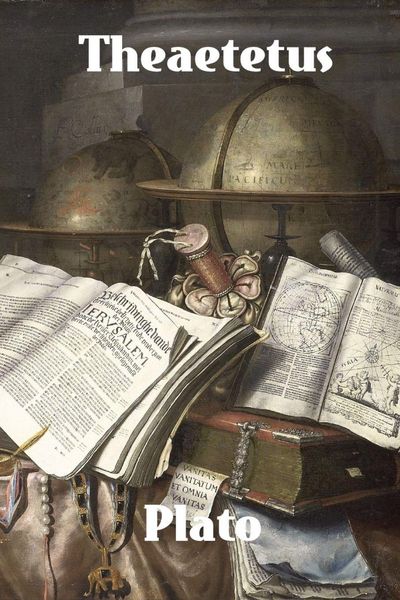
Theaetetus
-
- Hardcover
- Taschenbuch ausgewählt
- eBook
-
Sprache:Englisch
-
Verlag:Binker North
- Outlook 44,99 €
- Alpha Editions 25,99 €
- The Library of Alexandria 24,99 €
- Tredition 13,30 €
- Double 9 Books LLP 18,99 €
- Oxford University Press 15,99 €
- 1st World Publishing 26,99 €
- Serenity Publishers, LLC 15,99 €
- Alpha Edition 27,99 €
- Digireads.com 11,99 €
- Creative Media Partners, LLC 29,99 €
- Penguin Books UK 18,99 €
- Binker North 19,99 € ausgewählt
- Antigonos Verlag 44,99 €
- Pharos Books Private Limited 19,99 €
19,99 €
inkl. gesetzl. MwSt.,
- Kostenlose Lieferung ab 30 € Einkaufswert
- Versandkostenfrei für Bonuscard-Kund*innen
Beschreibung
Produktdetails
Einband
Taschenbuch
Erscheinungsdatum
27.08.2023
Verlag
Binker NorthSeitenzahl
128
Maße (L/B/H)
22,9/15,2/0,7 cm
Gewicht
198 g
Sprache
Englisch
ISBN
978-1-77441-996-0
The Theaetetus is a philosophical work written by Plato in the early-middle 4th century BCE that investigates the nature of knowledge, and is considered one of the founding works of epistemology. Like many of Plato's works, the Theaetetus is written in the form of a dialogue, in this case between Socrates and the young mathematician Theaetetus. In the dialogue, Socrates and Theaetetus attempt to come up with a definition of episteme, or knowledge, and discuss three definitions of knowledge: knowledge as nothing but perception, knowledge as true judgment, and, finally, knowledge as a true judgment with an account. Each of these definitions is shown to be unsatisfactory as the dialogue ends in aporia as Socrates leaves to face a hearing for his trial for impiety. As one of the major works of Plato's theory of knowledge, the Theaetetus was influential on Platonism from at least the time of the Skeptical Academy of the 3rd century BCE through the Neoplatonism of the 6th century CE. It has also been the subject of increased attention in modern times as a result of its influence on Edmund Gettier, who challenged the existing definitions of knowledge as a "justified true belief" in a paper that investigated Plato's theory of knowledge as outlined in this work.
Noch keine Bewertungen vorhanden
Verfassen Sie die erste Bewertung zu diesem Artikel
Helfen Sie anderen Kundinnen und Kunden durch Ihre Meinung.
Kurze Frage zu unserer Seite
Vielen Dank für Ihr Feedback
Wir nutzen Ihr Feedback, um unsere Produktseiten zu verbessern. Bitte haben Sie Verständnis, dass wir Ihnen keine Rückmeldung geben können. Falls Sie Kontakt mit uns aufnehmen möchten, können Sie sich aber gerne an unseren Kund*innenservice wenden.
zum Kundenservice