KI-Beratung Beta

Gutscheinbedingungen

**Gültig bis 18.11.2026 auf englischsprachige Klassiker (klassiker-32728) online auf thalia.at und in der Thalia App. Einzelne Artikel können ausgeschlossen sein. Ausgenommen sind preisgebundene Artikel & eBooks. Pro Einkauf einmal einlösbar. Click & Collect nur bei Onlinevorabzahlung möglich. Keine Barauszahlung. Nicht kombinierbar mit anderen Aktionen und Gutscheinen. Gutschein wird auf max. 500€ Bestellwert angerechnet. Nicht gültig für Geschenkkarten, Versandkosten und Services.

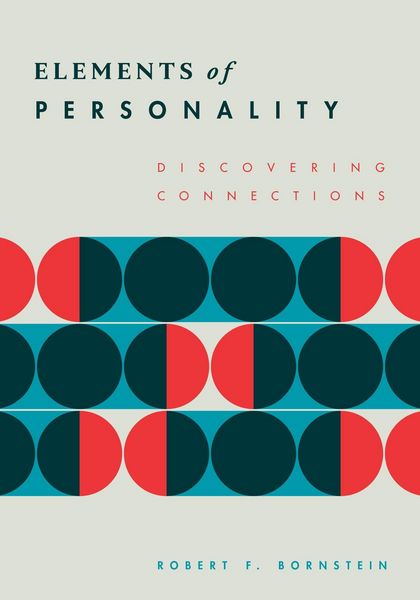
Produktbild: Elements of Personality

Elements of Personality Discovering Connections

69,99 €

inkl. gesetzl. MwSt., Versandkostenfrei


Beschreibung

The fascinating field of personality psychology not only helps us understand human behavior and mental life, but also provides an important lens to understanding ourselves in ways we never did before.   In his concise and timely textbook, Dr. Robert F. Bornstein provides a fresh and appealing approach...

Beschreibung

The fascinating field of personality psychology not only helps us understand human behavior and mental life, but also provides an important lens to understanding ourselves in ways we never did before.
 

In his concise and timely textbook, Dr. Robert F. Bornstein provides a fresh and appealing approach to personality theory and research that embeds personality in the broader intellectual landscape of psychology today. Elements of Personality focuses on the four major theoretical approaches to understanding personality: psychodynamic, behavioral and cognitive-behavioral, trait/interpersonal, and humanistic/existential. The author provides detailed coverage of these four major viewpoints and ignores the extraneous amp ldquo mini-theories amp rdquo covered in other textbooks. The result is a textbook that offers complex material in an accessible, student-friendly way. Chapters build upon one another, showing how these four perspectives differ alongside various points of convergence.
 
Further drawing on the theme of amp ldquo connections, amp rdquo Dr. Bornstein integrates feature boxes to illustrate how the study of personality intersects with work in related psychological subfields (social, cognitive, developmental, and neuropsychology), disciplines outside of psychology, and with aspects of students amp rsquo own lives. Rich and relevant examples cover contemporary topics such as social media and online self, personality and politics, friendship formation and maintenance, self-actualization and activism, and more.  The book closes by integrating ideas and findings into a holistic understanding of the psychology of personality, with an eye firmly aimed toward the future of personality theory and research.
 
To help with comprehension and retention of the material and provide flexibility for the professor, each chapter ends with a review of key concepts and principles, critical thinking and discussion questions, key terms, and additional readings and resources. For instructors: a companion website is available containing PowerPoint slides, a testbank with multiple-choice and essay questions, sample syllabi, tables and figures files, and more.

Produktdetails

Einband

Taschenbuch

Erscheinungsdatum

16.01.2024

Verlag American Psychological Association
Seitenzahl

224

Produktdetails

Einband

Taschenbuch

Erscheinungsdatum

16.01.2024

Verlag American Psychological Association
Seitenzahl

224

Maße (L/B/H)

25,1/17,4/1,5 cm

Gewicht

440 g

Sprache

Englisch

ISBN

978-1-4338-3890-3

Herstelleradresse

Libri GmbH
Europaallee 1
36244 Bad Hersfeld
DE

Email: gpsr@libri.de

Noch keine Bewertungen vorhanden

Verfassen Sie die erste Bewertung zu diesem Artikel

Helfen Sie anderen Kundinnen und Kunden durch Ihre Meinung.

Kundinnen und Kunden meinen

Bewertungen (0)

  • Produktbild: Elements of Personality
  • Preface
    Acknowledgements

    Chapter . What Is Personality?
    Why Study Personality?
    Four Perspectives on Personality
    Culture and Personality
    Personality Research Methods
    Personality: Discovering Connections
    Chapter Review
    Critical Thinking and Discussion Questions
    Key Terms
    Additional Readings and Resources
    Chapter 2. The Psychodynamic Perspective
    Eels, Brains, Cocaine, and Hypnosis
    Key Assumptions of the Psychodynamic Perspective
    The Topographic Model
    The Structural Model
    The Psychosexual Stages
    Psychoanalytic Treatment
    Psychoanalysis Reimagined: Object Relations Theory
    The Self-Representation and the Self amp ndash Other Dialectic
    Integrating Representations of Self and Other People: Attachment Theory
    Contemporary Psychoanalytic Treatments
    Chapter Review
    Critical Thinking and Discussion Questions
    Key Terms
    Additional Readings and Resources
    Chapter 3. Behavioral and Cognitive-Behavioral Models
    Psychology as the Behaviorist Views It
    Key Assumptions of the Behavioral Perspective
    Pavlov and Classical Conditioning
    Skinner and Operant Conditioning
    Conditioning and Personality
    Conditioning and Psychopathology
    Behavior Modification and the Token Economy
    The Shift From Radical Behaviorism to an Integrative Behavioral Perspective
    Cognitive Behavioral Treatments
    Chapter Review
    Critical Thinking and Discussion Questions
    Key Terms
    Additional Readings and Resources
    Chapter 4. Trait and Interpersonal Frameworks
    A Visit to Vienna and the Birth of Trait Theory
    Trait Theory in Context
    Key Assumptions of the Trait Perspective
    Allport amp rsquo s Lexical Approach
    Cattell and Factor Analysis
    A Consensus Emerges: The Five-Factor Model
    Traits and Dynamics: The Interpersonal Perspective
    Assessing Interpersonal Constructs
    Interpersonal Dynamisms
    Psychopathology and Psychotherapy
    Chapter Review
    Critical Thinking and Discussion Questions
    Key Terms
    Additional Readings and Resources
    Chapter 5. Humanistic and Existential Approaches
    Divergent Experiences, Converging Philosophies
    Key Assumptions of the Humanistic Perspective
    A Radical Departure
    Maslow: A Hierarchy of Needs
    Rogers: Self-Discrepancies
    Existential Personality Theory
    Existentialism Quantified: Terror Management Theory
    Effects of Mortality Salience on Behavior
    Chapter Review
    Critical Thinking and Discussion Questions
    Key Terms
    Additional Readings and Resources
    Chapter . The Future of Personality
    Paradigms of Personality: Past, Present, and Future
    Where Are We Now? Converging Themes
    Where Are We Going? The Future of Personality
    Why Are We Here?
    Chapter Review
    Critical Thinking and Discussion Questions
    Key Terms
    Additional Readings and Resources

    References
    Index
    About the Author