Gutscheinbedingungen

**Gültig bis 28.07.2026 auf Spielzeug, Schreibwaren, Filme, Geschenke & Trends, Musik, tolino eReader & Zubehör, Hörbücher und Hörbuch-Downloads (außer Abo), nicht preisgebundene Bücher und Kalender in der Thalia App. Einzelne Artikel können ausgeschlossen sein. Aufgrund der Buchpreisbindung sind deutschsprachige Bücher und eBooks ausgenommen. Zusätzlich ausgenommen sind preisgebundene Artikel, Abos & Flatrates, eBooks, Games, Geschenkkarten/-boxen, Shelfies, Software, Zeitschriften sowie einzelne Artikel von tonies®. Pro Einkauf einmal einlösbar. Click & Collect nur bei Onlinevorabzahlung möglich. Keine Barauszahlung. Nicht kombinierbar mit anderen Aktionen und Gutscheinen. Gutschein wird auf max. 500€ Bestellwert angerechnet. Nicht gültig für Versandkosten und Services.

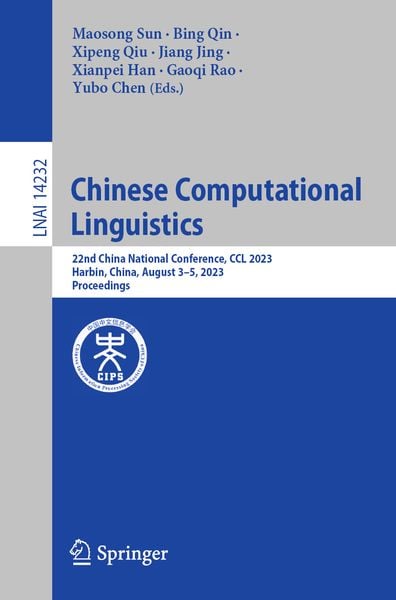
  • Produktbild: Chinese Computational Linguistics
  • Produktbild: Chinese Computational Linguistics
Band 14232 - 12%

Chinese Computational Linguistics 22nd China National Conference, CCL 2023, Harbin, China, August 3–5, 2023, Proceedings

12% sparen

76,99 € UVP 87,99 €

inkl. gesetzl. MwSt., Versandkostenfrei


Beschreibung

Produktdetails

Einband

Taschenbuch

Erscheinungsdatum

20.09.2023

Herausgeber

Maosong Sun + weitere

Verlag

Springer Singapore

Seitenzahl

466

Maße (L/B/H)

23,5/15,5/2,7 cm

Auflage

1st ed. 2023

Sprache

Englisch

ISBN

978-981-9962-06-8

Beschreibung

Produktdetails

Einband

Taschenbuch

Erscheinungsdatum

20.09.2023

Herausgeber

Verlag

Springer Singapore

Seitenzahl

466

Maße (L/B/H)

23,5/15,5/2,7 cm

Auflage

1st ed. 2023

Sprache

Englisch

ISBN

978-981-9962-06-8

Herstelleradresse

Springer-Verlag KG
Sachsenplatz 4-6
1201 Wien
AT

Email: GPSR Kontakt

Noch keine Bewertungen vorhanden

Verfassen Sie die erste Bewertung zu diesem Artikel

Helfen Sie anderen Kundinnen und Kunden durch Ihre Meinung.

Kundinnen und Kunden meinen

Bewertungen (0)

  • Produktbild: Chinese Computational Linguistics
  • Produktbild: Chinese Computational Linguistics
  • Fundamental Theory and Methods of Computational Linguistics.- The Contextualized Representation of Collocation.-  Information Retrieval, Dialogue and Question Answering.- Ask to Understand: Question Generation for Multi-hop Question Answering.- Learning on Structured Documents for Conditional Question Answering.- Overcoming Language Priors with Counterfactual Inference for Visual Question Answering.- Rethinking Label Smoothing on Multi-hop Question Answering.-  Text Generation, Dialogue and Summarization.- Unsupervised Style Transfer in News Headlines via Discrete Style Space.- Lexical Complexity Controlled Sentence Generation for Language Learning.- Improving Zero-shot Cross-lingual Dialogue State Tracking via Contrastive Learning.-  Knowledge Graph and Information Extraction.- Document Information Extraction via Global Tagging.- A Distantly-Supervised Relation Extraction Method Based on Selective Gate and Noise Correction.- Improving Cascade Decoding with Syntax-aware Aggregator and Contrastive Learning for Event Extraction.- TERL: Transformer Enhanced Reinforcement Learning for Relation Extraction.- P-MNER: Cross Modal Correction Fusion Network with Prompt Learning for Multimodal Named Entity Recognitiong.- Self Question-answering: Aspect Sentiment Triplet Extraction via a Multi-MRC Framework based on Rethink Mechanism.- Enhancing Ontology Knowledge for Domain-Specific Joint Entity and Relation Extraction.-  Machine Translation and Multilingual Information Processing.- FACT:A Dynamic Framework for Adaptive Context-Aware Translation.-  Language Resource and Evaluation.- MCLS: A Large-Scale Multimodal Cross-Lingual Summarization Dataset.- CHED: A Cross-Historical Dataset with a Logical Event Schema for Classical Chinese Event Detection.- Training NLI Models Through Universal Adversarial Attack.-  Pre-trained Language Models.- Revisiting k-NN for Fine-tuning Pre-trained Language Models.- Adder Encoder for Pre-trained Language Model.- Exploring Accurate and Generic Simile Knowledge from Pre-trained Language Models.-  Social Computing and Sentiment Analysis.- Learnable Conjunction Enhanced Model for Chinese Sentiment Analysis.- Enhancing Implicit Sentiment Learning via the Incorporation of Part-of-Speech for Aspect-based Sentiment Analysis.- Improving Affective Event Classification with Multi-Perspective Knowledge Injection.-  NLP Applications.- Adversarial Network with External Knowledge for Zero-Shot Stance Detection.- Few-Shot Charge Prediction with Multi-Grained Features and Mutual Information.- SentBench: Comprehensive Evaluation of Self-Supervised Sentence Representation with Benchmark Construction.