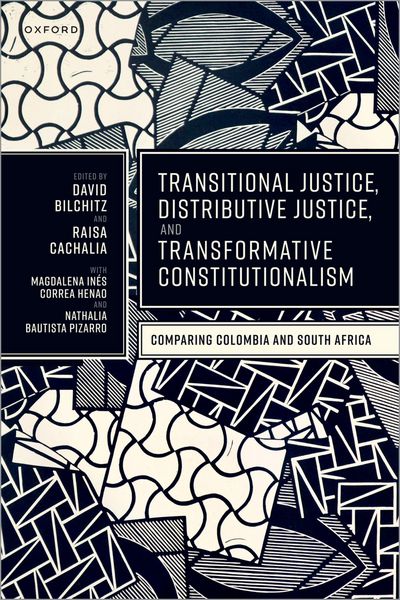
Produktbild: Transitional Justice, Distributive Justice, and Transformative Constitutionalism

Transitional Justice, Distributive Justice, and Transformative Constitutionalism Comparing Colombia and South Africa

187,99 €

inkl. gesetzl. MwSt., Versandkostenfrei


Beschreibung

Produktdetails

Einband

Gebundene Ausgabe

Erscheinungsdatum

21.03.2024

Herausgeber

Bilchitz David + weitere

Verlag

Oxford University Press

Seitenzahl

512

Maße (L/B/H)

22,9/16,3/5,3 cm

Gewicht

998 g

Sprache

Englisch

ISBN

978-0-19-288762-7

Beschreibung

Produktdetails

Einband

Gebundene Ausgabe

Erscheinungsdatum

21.03.2024

Herausgeber

Verlag

Oxford University Press

Seitenzahl

512

Maße (L/B/H)

22,9/16,3/5,3 cm

Gewicht

998 g

Sprache

Englisch

ISBN

978-0-19-288762-7

Herstelleradresse

Libri GmbH
Europaallee 1
36244 Bad Hersfeld
DE

Email: GPSR Kontakt

Noch keine Bewertungen vorhanden

Verfassen Sie die erste Bewertung zu diesem Artikel

Helfen Sie anderen Kundinnen und Kunden durch Ihre Meinung.

Kundinnen und Kunden meinen

Bewertungen (0)

Die Leseprobe wird geladen.
  • Produktbild: Transitional Justice, Distributive Justice, and Transformative Constitutionalism

    • 1: David Bilchitz and Raisa Cachalia: Developing a Conceptual Framework for Global South Comparisons: Colombian and South African Contributions


    • PART I: INNOVATIVE WAYS OF CONCEIVING AND IMPLEMENTING TRANSITIONAL JUSTICE


    • Theme 1: Re-Conceiving Reconciliation as Relationships: the Role of African and Latin American Values


    • 2: Thaddeus Metz: The Role of Economic Goods in National Reconciliation: Evaluating South Africa and Colombia


    • 3: Nathalia Elena Bautista Pizarro: Building Peace and Restoring Law upon the Ethos: A Comparison between South Africa and Colombia


    • 4: Thaddeus Metz and Nathalia Elena Bautista Pizarro: Joint Reflection - Economic Goods and Communitarian Values


    • Theme 2: Art and Transitional Justice


    • 5: Kim Berman and Michelle LeBaron: Aesthetic Negotiation and Artefactual Agency: Key Processes for Symbolic Repair in Transitional Justice


    • 6: Yolanda Sierra León: Aesthetic Litigation as a Mechanism for Building the Truth in the Colombian Truth Commission


    • 7: Kim Berman, Michelle LeBaron, and Yolanda Sierra León: Joint Reflection - How Do Arts Function in Symbolic Reparation? A Comparative Reflection Between Colombia and South Africa


    • Theme 3: History, Museums and Transitional Justice


    • 8: Emilia Potenza and Adrienne van den Heever: Journey to a New Space: The Apartheid Museum's Truth and Reconciliation Exhibition within the Context of Restorative and Transitional Justice


    • 9: Nancy Rocio Rueda Esteban: Exploring Visitor Expectations and Experiences of Conflict and Transitional Justice Exhibitions in Bogota, Colombia


    • 10: Emilia Potenza, Adrienne van den Heever, and Nancy Rocío Rueda Esteban: Joint Reflection - Journey to a New Space: A Comparative Reflection of Museum Exhibitions within the Context of Restorative and Transitional Justice


    • PART II: SOCIO-ECONOMIC RIGHTS AND THE RELATIONSHIP BETWEEN TRANSITIONAL AND DISTRIBUTIVE JUSTICE


    • Theme 4: The Role of History in Socio-Economic Rights Jurisprudence: Linking Transitional and Distributive Justice


    • 11: David Bilchitz: Does History Make a Difference? Exploring the Role of History in the Interpretation of Socio-Economic Rights


    • 12: Magdalena Ines Correa Henao: Historical Injustice and Socio-Economic Rights in Colombia Constitutional Jurisprudence: The Case of Victims of Forced Displacement


    • 13: David Bilchitz and Magdalena Ines Correa Henao: Joint reflection - The Difference History Makes: Comparative Reflections on Socio-Economic Rights and Historical Consciousness in South Africa and Colombia


    • Theme 5: Collective Mechanisms for the Advancement of Socio-Economic Rights


    • 14: Meghan Finn: Class Actions and the Scarce Resource of the Law


    • 15: Andres Mauricio Gutierrez Beltran: Forced Displacement and Social Change: Light and Shadows in the Implementation of the Judgment T-025 of 2004


    • 16: Meghan Finn and Andrés Mauricio Gutiérrez Beltrán: Joint reflection - Litigating for a Collective: Structural Judgments and Class Actions in Colombia and South Africa


    • PART III: THE ROLE OF NOVEL LEGAL STRUCTURES IN REALISING TRANSITIONAL AND DISTRIBUTIVE JUSTICE


    • Theme 6: Indigenous Peoples and Transitional Justice


    • 17: Sindiso Mnisi Weeks: Twenty-five Years of Democracy: The Consequences of South Africa's Post-Apartheid Constitution and Political Economy for Traditional Peoples


    • 18: Diana Carolina Rivera Drago and Filipo Ernesto Burgos Guzman: Evaluating the Impact of the Peace Agreement on the Indigenous Peoples of Colombia: Land Rights and Compensation


    • 19: Sindiso Mnisi Weeks and Diana Carolina Rivera Dragos: Joint reflection - The South African and Colombian 'Peace Agreements': Restoration of Rights or Continuing Difficulties for Indigenous Peoples?


    • Theme 7: Procedural Justice, the Law and Transitional Justice


    • 20: Raisa Cachalia: Exploring the Relationship between Violent Protest and Procedural Injustice in South Africa's Democratic Transition


    • 21: Julián Andrés Pimiento Echeverri and Irit Milkes: Beyond Democracy: Meaningful Public Participation as a New Approach to Public Decision-Making in the Context of Colombia's Transitional Justice Process


    • 22: Raisa Cachalia and Irit Milkes: Joint reflection - Comparative Reflections on Transitional Justice and Political Inclusion in South Africa and Colombia


    • Theme 8: The Role of International Law in Advancing Transitional Justice


    • 23: Mispa Roux: South Africa and the International Criminal Court: Perpetuating the Legacy of Overlooking the Ergo Omnes Obligation to Prosecute International Crimes by Prioritising Peace


    • 24: Natalia Silva Santaularia: Colombia and the International Criminal Court: A Case of Positive Complementarity in Transitional Justice Contexts


    • 25: Mispa Roux and Natalia Silva Santaularia: Joint reflection - South Africa and Colombia as Transitional Justice Societies