Beschreibung
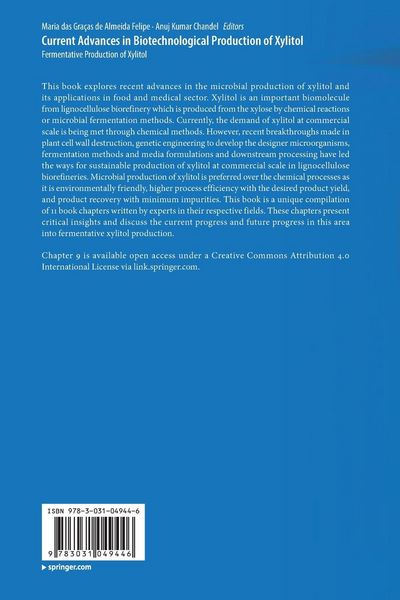
This book explores recent advances in the microbial production of xylitol and its applications in food and medical sector. Xylitol is an important biomolecule from lignocellulose biorefinery which is produced from the xylose by chemical reactions or microbial fermentation methods. Currently, the demand of xylitol at commercial scale is being met through chemical methods. However, recent breakthroughs made in plant cell wall destruction, genetic engineering to develop the designer microorganisms, fermentation methods and media formulations and downstream processing have led the ways for sustainable production of xylitol at commercial scale in lignocellulose biorefineries. Microbial production of xylitol is preferred over the chemical processes as it is environmentally friendly, higher process efficiency with the desired product yield, and product recovery with minimum impurities. This book is a unique compilation of 11 book chapters written by experts in their respective fields. These chapters present critical insights and discuss the current progress and future progress in this area into fermentative xylitol production.
Chapter 9 is licensed under the terms of the Creative Commons Attribution 4.0 International License. For further details see license information in the chapter.
Portrait
Dr. Maria das Graças de Almeida Felipe is a Full Professor in the Department of Biotechnology at the School of Engineering of Lorena – EEL, University of São Paulo – USP since 2020. She is working for almost 34 years at EEL-USP teaching in the area of applied microbiology and conducting research on the sustainable production of xylitol and other biomolecules such as ethanol from lignocellulosic biomass. Her line of research is advancing the scientific and technological knowledge to limit the bottlenecks in the biotechnological use of plant biomass concurrently imparting the training to undergraduate, and post-graduate students. Prof. Felipe in the Scopus database (March, 2022) figures as the second author with the largest number of publications in the world on the scientific work on “xylitol production” with the H-index of 33, while in Web of Science database she had H-index of 30, and 43 according to The Scholar Google database. Prof. Felipe has published 111 peer reviewed journals and 25 book chapters in the area of lignocellulose biotechnology, in a context of circular bioeconomy.
Professor Anuj K. Chandel has 22 years research experience in industrial biotechnology working with Dalas Biotech Ltd, Bhiwadi India, University of Delhi, Celestial Biolabs Ltd, Hyderabad, India and Sugarcane Technology Centre-Piracicaba, Brazil. Dr. Chandel has also awarded MBA in agri-business having specialization in Biorefinery commercialization. Anuj has worked as a post doctorate fellow at University of Stellenbosch, South Africa, EEL-University of São Paulo, Brazil and University of Arkansas, Fayetteville, USA for 6 years. Anuj has worked at EEL-University of São Paulo-Lorena as a visiting professor for 3 years. Currently, he is working as a professor at USP-Lorena. He is an editor of 12 books on D-xylitol, lignocellulose degradation and Brazilian Biofuels Development, Biogas production, amongst others. Dr. Chandel has published 98 articles inpeer-reviewed journals, 44 book chapters and recorded one Brazilian Patent. His contributions span industrial biotechnology, the circular carbon economy and policy domains. Dr. Chandel is an active consultant to some Biotech companies and startups in biomass conversion and biorefinery and industrial enzymes production.