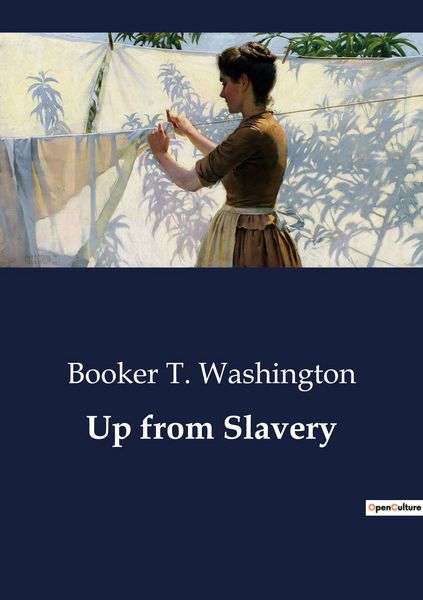
Up from Slavery The Journey from Enslavement to Empowerment
-
- Hardcover
- Taschenbuch ausgewählt
- eBook
- Hörbuch
-
Sprache:Englisch
-
Verlag:Culturea
- W. W. Norton & Company 16,99 €
- Wilder Publications 15,99 €
- Tredition 13,30 €
- Oxford University Press 9,99 €
- Sharp Ink 10,50 €
- Random House N.Y. 17,99 €
- Culturea 19,99 € ausgewählt
- Alpha Edition 21,99 €
- Digireads.com 13,99 €
- KNV Besorgung 7,99 €
- Cosimo Classics 17,99 €
- Benediction Classics 15,99 €
- Carlton Publishing 9,99 €
- Ingram Publishers Services 12,99 €
- E-artnow 11,00 €
- Random House Publishing Group 21,99 €
19,99 €
inkl. gesetzl. MwSt.,
- Kostenlose Lieferung ab 30 € Einkaufswert
- Versandkostenfrei für Bonuscard-Kund*innen
Beschreibung
Produktdetails
Einband
Taschenbuch
Erscheinungsdatum
13.07.2023
Verlag
CultureaSeitenzahl
266
Maße (L/B/H)
21/14,8/1,5 cm
Gewicht
349 g
Auflage
1. Tirage
Sprache
Englisch
ISBN
979-10-418-0754-3
"Up from Slavery" is an autobiographical account by Booker T. Washington, detailing his life from his early years as a slave to his rise as a prominent African American leader and educator. Born in Franklin County, Virginia, Washington's early life was marked by the harsh realities of slavery, including living in a small log cabin with his family and working from a young age. Despite these challenges, he developed a strong desire for education, which was initially self-taught through a spelling book. After the Emancipation Proclamation, Washington's family moved to West Virginia, where he continued to pursue education while working in salt furnaces. His determination led him to attend the Hampton Institute, where he excelled and later became a teacher. Washington's narrative highlights the struggles and triumphs of African Americans during the Reconstruction era, emphasizing the importance of education and self-reliance. He founded the Tuskegee Institute in Alabama, focusing on vocational training and practical skills for African Americans. Washington's philosophy of racial uplift through education and economic progress, rather than direct confrontation, was both influential and controversial. His work at Tuskegee and his public speaking efforts made him a national figure, advocating for the advancement of African Americans in a post-slavery society.
Noch keine Bewertungen vorhanden
Verfassen Sie die erste Bewertung zu diesem Artikel
Helfen Sie anderen Kundinnen und Kunden durch Ihre Meinung.
Kurze Frage zu unserer Seite
Vielen Dank für Ihr Feedback
Wir nutzen Ihr Feedback, um unsere Produktseiten zu verbessern. Bitte haben Sie Verständnis, dass wir Ihnen keine Rückmeldung geben können. Falls Sie Kontakt mit uns aufnehmen möchten, können Sie sich aber gerne an unseren Kund*innenservice wenden.
zum Kundenservice