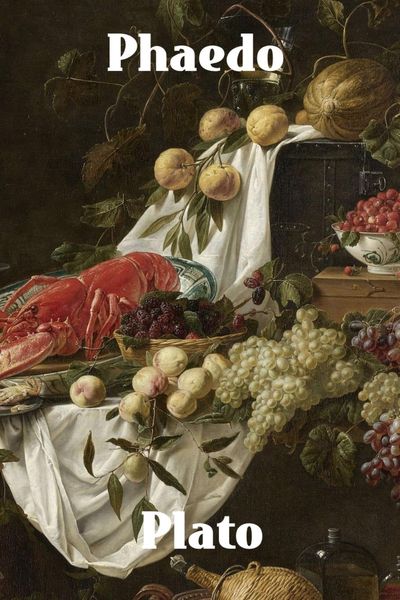
Phaedo
-
- Hardcover
- Taschenbuch ausgewählt
- eBook
-
Sprache:Englisch
-
Verlag:Binker North
- Outlook 22,99 €
- Akasha Classics 19,99 €
- Tredition 10,20 €
- 1st World Publishing 22,99 €
- Arc Manor 19,99 €
- Martino Fine Books 12,99 €
- Digireads.com 11,99 €
- Creative Media Partners, LLC 19,99 €
- Sanage Publishing House 18,99 €
- Independently Published 11,99 €
- Oxford Academic 11,99 €
- Binker North 18,99 € ausgewählt
- Hansebooks 24,60 €
- Antigonos Verlag 22,99 €
- Antiquum Novum Verlag 13,99 €
- Pharos Books Private Limited 17,99 €
- Double 9 Books 21,99 €
18,99 €
inkl. gesetzl. MwSt.,
- Kostenlose Lieferung ab 30 € Einkaufswert
- Versandkostenfrei für Bonuscard-Kund*innen
Beschreibung
Produktdetails
Einband
Taschenbuch
Erscheinungsdatum
15.07.2023
Verlag
Binker NorthSeitenzahl
110
Maße (L/B/H)
22,9/15,2/0,6 cm
Gewicht
173 g
Sprache
Englisch
ISBN
978-1-77441-988-5
Phaedo, also known to ancient readers as On The Soul, is one of the best-known dialogues of Plato's middle period, along with the Republic and the Symposium. The philosophical subject of the dialogue is the immortality of the soul. It is set in the last hours prior to the death of Socrates, and is Plato's fourth and last dialogue to detail the philosopher's final days, following Euthyphro, Apology, and Crito. One of the main themes in the Phaedo is the idea that the soul is immortal. In the dialogue, Socrates discusses the nature of the afterlife on his last day before being executed by drinking hemlock. Socrates has been imprisoned and sentenced to death by an Athenian jury for not believing in the gods of the state (though some scholars think it was more for his support of "philosopher kings" as opposed to democracy)[2] and for corrupting the youth of the city. By engaging in dialectic with a group of Socrates's friends, including the two Thebans, Cebes, and Simmias, Socrates explores various arguments for the soul's immortality in order to show that there is an afterlife in which the soul will dwell following death and, for couples and good people, be more at one with "every loving thing" and be more powerful than the Greek gods. Phaedo tells the story that following the discussion, he and the others were there to witness the death of Socrates. The Phaedo was first translated into Latin from Greek by Apuleius but no copy survived, so Henry Aristippus produced a new translation in 1160.
Noch keine Bewertungen vorhanden
Verfassen Sie die erste Bewertung zu diesem Artikel
Helfen Sie anderen Kundinnen und Kunden durch Ihre Meinung.
Kurze Frage zu unserer Seite
Vielen Dank für Ihr Feedback
Wir nutzen Ihr Feedback, um unsere Produktseiten zu verbessern. Bitte haben Sie Verständnis, dass wir Ihnen keine Rückmeldung geben können. Falls Sie Kontakt mit uns aufnehmen möchten, können Sie sich aber gerne an unseren Kund*innenservice wenden.
zum Kundenservice