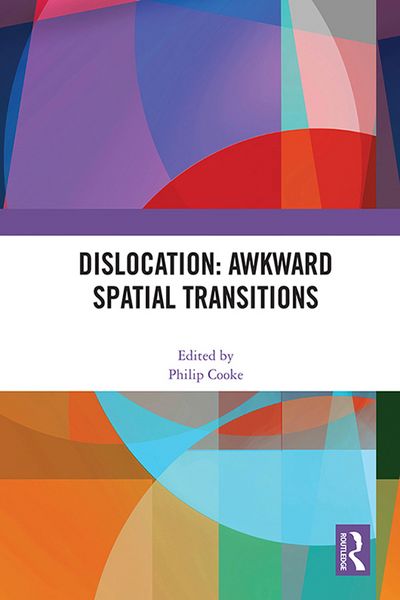
Dislocation: Awkward Spatial Transitions
-
- Hardcover
- Taschenbuch ausgewählt
- eBook
-
Sprache:Englisch
52,99 €
inkl. gesetzl. MwSt.,
Beschreibung
Produktdetails
Einband
Taschenbuch
Erscheinungsdatum
25.09.2023
Herausgeber
Cooke PhilipVerlag
Taylor & FrancisSeitenzahl
328
Maße (L/B)
24,6/17,4 cm
Gewicht
453 g
Sprache
Englisch
ISBN
978-0-367-67962-0
Today, the world is in the most serious turmoil it has experienced for many centuries. These multiple crises arise from the fundamental mistreatment by capitalist competition of the carrying capacity of the planet. Even before coronavirus, evidently morbid symptoms of over-development led many spatial planners to write of the threat of a new Dark Age. Many advocated a return to policy decentralisation as the Covid-19 crisis demonstrated once again the failure of 'global controller' mindsets to manage complex systems successfully.
Dislocation: Awkward Spatial Transitions is a critical exploration of where spatial development processes and rules have gone wrong across many economies. The chapters lay out which mindsets have been responsible for this and gives pointers to new practices that aim to ameliorate the effects of past failings. In the first nine chapters, a mapping of key elements of the prevailing omni-crisis are summarised. These range from an exegesis of the Anthropocene, the rise of populism, the transition to neoliberalist anti-planning, and migration as planning issues with pleas for evolutionary change in spatial policy and process dynamics. Finally, a group of chapters explores the flailing as territorial governances tried to plot the rise of creative cities, 4.0 era industry and services, and in the built form, the role of 'starchitects' in city renewal. In the last part, attention is devoted to territorial innovation, knowledge recombination, sustainable mobility and, finally, green entrepreneurship, as necessary elements of a post-coronavirus, climate change mitigation and sustainable mobility set of survival strategies.
The chapters in this book were originally published in the journal European Planning Studies.
Noch keine Bewertungen vorhanden
Verfassen Sie die erste Bewertung zu diesem Artikel
Helfen Sie anderen Kundinnen und Kunden durch Ihre Meinung.
Kurze Frage zu unserer Seite
Vielen Dank für Ihr Feedback
Wir nutzen Ihr Feedback, um unsere Produktseiten zu verbessern. Bitte haben Sie Verständnis, dass wir Ihnen keine Rückmeldung geben können. Falls Sie Kontakt mit uns aufnehmen möchten, können Sie sich aber gerne an unseren Kund*innenservice wenden.
zum Kundenservice