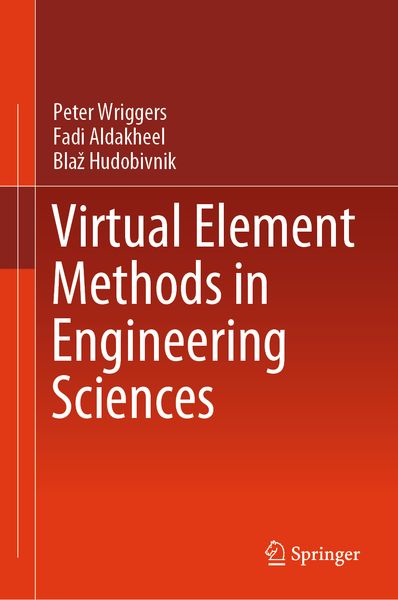
Virtual Element Methods in Engineering Sciences
-
- Hardcover ausgewählt
- Taschenbuch
- eBook
-
Sprache:Englisch
166,99 €
UVP
197,99 €
inkl. gesetzl. MwSt.,
Beschreibung
Produktdetails
Einband
Gebundene Ausgabe
Erscheinungsdatum
29.10.2023
Abbildungen
XV, 452 p. 240 illus., 181 illus. in color.
Verlag
SpringerSeitenzahl
452
Maße (L/B/H)
24,1/16/2,9 cm
Gewicht
948 g
Auflage
23001 Auflage 1st edition 2024
Sprache
Englisch
ISBN
978-3-031-39254-2
This book provides a comprehensive treatment of the virtual element method (VEM) for engineering applications, focusing on its application in solid mechanics. Starting with a continuum mechanics background, the book establishes the necessary foundation for understanding the subsequent chapters. It then delves into the VEM's Ansatz functions and projection techniques, both for solids and the Poisson equation, which are fundamental to the method. The book explores the virtual element formulation for elasticity problems, offering insights into its advantages and capabilities. Moving beyond elasticity, the VEM is extended to problems in dynamics, enabling the analysis of dynamic systems with accuracy and efficiency. The book also covers the virtual element formulation for finite plasticity, providing a framework for simulating the behavior of materials undergoing plastic deformation. Furthermore, the VEM is applied to thermo-mechanical problems, where it allows for the investigation ofcoupled thermal and mechanical effects. The book dedicates a significant portion to the virtual elements for fracture processes, presenting techniques to model and analyze fractures in engineering structures. It also addresses contact problems, showcasing the VEM's effectiveness in dealing with contact phenomena. The virtual element method's versatility is further demonstrated through its application in homogenization, offering a means to understand the effective behavior of composite materials and heterogeneous structures. Finally, the book concludes with the virtual elements for beams and plates, exploring their application in these specific structural elements. Throughout the book, the authors emphasize the advantages of the virtual element method over traditional finite element discretization schemes, highlighting its accuracy, flexibility, and computational efficiency in various engineering contexts.
Noch keine Bewertungen vorhanden
Verfassen Sie die erste Bewertung zu diesem Artikel
Helfen Sie anderen Kundinnen und Kunden durch Ihre Meinung.
Kurze Frage zu unserer Seite
Vielen Dank für Ihr Feedback
Wir nutzen Ihr Feedback, um unsere Produktseiten zu verbessern. Bitte haben Sie Verständnis, dass wir Ihnen keine Rückmeldung geben können. Falls Sie Kontakt mit uns aufnehmen möchten, können Sie sich aber gerne an unseren Kund*innenservice wenden.
zum Kundenservice