Gutscheinbedingungen

**Gültig bis 15.06.2026 auf Spiele & Spielzeug online auf thalia.at, in der Thalia App ab einem Mindestbestellwert von 30€ und in allen Thalia Buchhandlungen in Österreich. In den Buchhandlungen nur gültig auf lagernde Ware. Einzelne Artikel können ausgeschlossen sein. Ausgenommen sind preisgebundene Artikel sowie online auf thalia.at und in der Thalia App einzelne Artikel von tonies®. Pro Einkauf einmal einlösbar. Nur gültig gegen Vorlage oder im Onlineshop hinterlegter Bonuscard. Infos zur Einlösung in der Buchhandlung sind auf der Bonuscard-Vorteilspreisseite zu finden. Click & Collect nur bei Onlinevorabzahlung möglich. Keine Einlösung bei Scan & Go-Bezahlung. Keine Barauszahlung. Nicht kombinierbar mit anderen Aktionen und Gutscheinen. Gutschein wird auf max. 500€ Bestellwert angerechnet. Nicht gültig für Geschenkkarten, Versandkosten und Services.

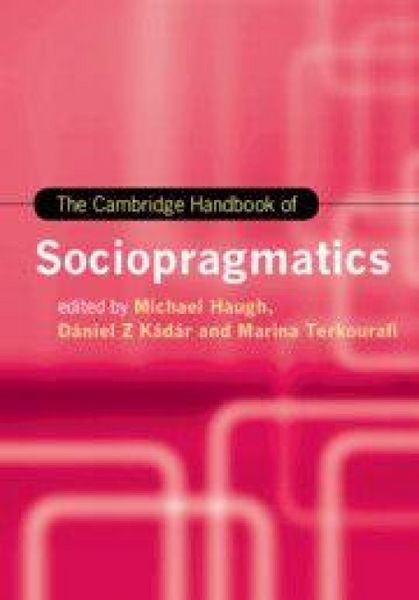
  • Produktbild: The Cambridge Handbook of Sociopragmatics
  • Produktbild: The Cambridge Handbook of Sociopragmatics

The Cambridge Handbook of Sociopragmatics

64,99 €

inkl. gesetzl. MwSt., Versandkostenfrei


Beschreibung

Produktdetails

Einband

Taschenbuch

Erscheinungsdatum

03.08.2023

Herausgeber

Michael Haugh + weitere

Verlag

Cambridge Academic

Seitenzahl

797

Maße (L/B/H)

24,6/16,5/4 cm

Gewicht

1258 g

Sprache

Englisch

ISBN

978-1-108-94930-9

Beschreibung

Portrait

Michael Haugh's research interests centre on the role of language in social interaction. He has published widely in pragmatics on topics such as (im)politeness, face, conversational humour and metapragmatics. He is an elected Fellow of the Australian Academy of Humanities and co-editor of the new Cambridge Elements in Pragmatics series, as well a former co-editor in chief of the Journal of Pragmatics (2015-2020).

Dániel Z. Kádár has a research background in cross-cultural, intercultural and historical pragmatics, as well as linguistic politeness and impoliteness, interactional rituals and Chinese pragmatics. He is Research Chair in both China and Hungary. He is Co-Editor of Contrastive Pragmatics.

Marina Terkourafi is interested in the interface of language with society and has published widely in all areas of pragmatics, including post-Gricean, sociocultural, historical and experimental pragmatics. She is currently professor and chair of sociolinguistics at Leiden University in the Netherlands and co-editor in chief of the Journal of Pragmatics.

Produktdetails

Einband

Taschenbuch

Erscheinungsdatum

03.08.2023

Herausgeber

Verlag

Cambridge Academic

Seitenzahl

797

Maße (L/B/H)

24,6/16,5/4 cm

Gewicht

1258 g

Sprache

Englisch

ISBN

978-1-108-94930-9

Herstelleradresse

Libri GmbH
Europaallee 1
36244 Bad Hersfeld
DE

Email: gpsr@libri.de

Kundinnen und Kunden meinen

0 Bewertungen

Informationen zu Bewertungen

Zur Abgabe einer Bewertung ist eine Anmeldung im Konto notwendig. Die Authentizität der Bewertungen wird von uns nicht überprüft. Wir behalten uns vor, Bewertungstexte, die unseren Richtlinien widersprechen, entsprechend zu kürzen oder zu löschen.

Die Bewertungen sind nach Format, Anzahl Sterne und Datum sortiert.

Verfassen Sie die erste Bewertung zu diesem Artikel

Helfen Sie anderen Kund*innen durch Ihre Meinung

Kundinnen und Kunden meinen

0 Bewertungen filtern

Die Leseprobe wird geladen.
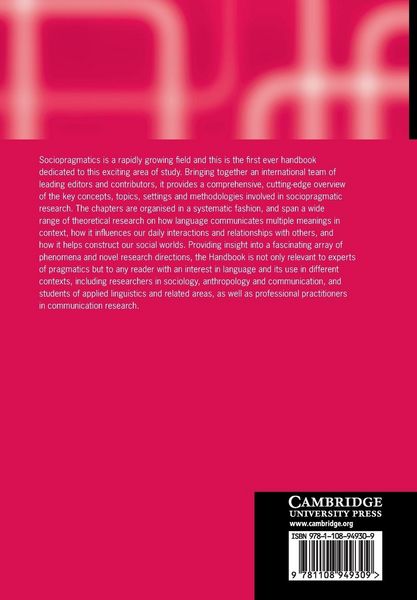
  • Produktbild: The Cambridge Handbook of Sociopragmatics
  • Produktbild: The Cambridge Handbook of Sociopragmatics
  • 1. Introduction: directions in sociopragmatics Michael Haugh, Dániel Z. Kádár and Marina Terkourafi; Part I. Fundamentals of Sociopragmatics: 2. Sociopragmatics: roots and definition Jonathan Culpeper; 3. Inference and implicature Marina Terkourafi; 4. Speaker meaning, commitment and accountability Chi-Hé Elder; 5. Social actions Arnulf Deppermann; 6. Stance and evaluation Maarit Siromaa and Mirka Rauniomaa; 7. Reflexivity and meta-awareness Jef Verschueren; 8. Participation and footing Elizabeth Holt and Jim O'Driscoll; 9. Conventionalisation and conventions Dániel Z. Kádár and Juliane House; 10. Synchronic and diachronic pragmatic variability Anne Barron; 11. Activity types and genres Dawn Archer, Piotr Jagodzi¿ski and Rebecca Jagodzi¿ski; 12. Social groups and relational networks Diana Boxer and Florencia Cortés-Conde; Part II. Topics and Settings in Sociopragmatics: 13. Face, facework and face-threatening acts Maria Sifianou and Angeliki Tzanne; 14. Relationships and relating Robert Arundale; 15. Analysing identity Pilar Garcés -Conejos Blitvich and Alexandra Georgakopoulou; 16. (Im)politeness and sociopragmatics Jonathan Culpeper and Michael Haugh; 17. Affect and emotion Laura Alba-Juez; 18. Power Michiel Leezenberg; 19. Morality in sociopragmatics Pilar Blitvich and Dániel Z. Kádár; 20. Conversational humour Marta Dynel and Valeria Sinkeviciute; 21. Gesture and prosody in multimodal communication Lucien Brown and Pilar Prieto; 22. Digitally-mediated communication Chiaoqun Xie and Francisco Yus; 23. Workplace and institutional discourse Meredith Marra and Shelley Dawson; 24. Service encounter discourse J. César Félix-Brasdefer and Rosina Márquez-Reiter; 25. Argumentative, political and legal discourse Anita Fetzer and Iwona Witczak-Plisiecka; 26. The pragmatics of translation Juliane House; Part III. Approaches and Methods in Sociopragmatics: 27. Interpersonal pragmatics Miriam Locher and Sage Lambert Graham; 28. Sociocognitive pragmatics Istvan Kecskes; 29. Conversation analysis and sociopragmatics Rebecca Clift and Michael Haugh; 30. Corpus pragmatics Svenja Adolphs and Yaoyao Chen; 31. Variational pragmatics Klaus P. Schneider; 32. Historical sociopragmatics Magdalena Leitner and Andreas H. Jucker; 33. Emancipatory pragmatics Scott Saft, Sachiko Ide and Kishiko Ueno; 34. Cross-cultural and intercultural pragmatics Troy McConachy and Helen Spencer-Oatey; 35. Second-language pragmatics Elly Ifantidou.