Gutscheinbedingungen

**Gültig bis 14.09.2026 auf Spielzeug, Schreibwaren, Filme, Geschenke & Trends, Musik, tolino eReader & Zubehör, Hörbücher, nicht preisgebundene Bücher und Kalender in der Thalia App. Einzelne Artikel können ausgeschlossen sein. Aufgrund der Buchpreisbindung sind deutschsprachige Bücher und eBooks ausgenommen. Zusätzlich ausgenommen sind Abos & Flatrates, Games, Geschenkkarten/-boxen, Shelfies, Software, Zeitschriften sowie einzelne Artikel von tonies®. Pro Einkauf einmal einlösbar. Nur gültig mit im Onlineshop hinterlegter Bonuscard. Click & Collect nur bei Onlinevorabzahlung möglich. Keine Barauszahlung. Nicht kombinierbar mit anderen Aktionen und Gutscheinen. Gutschein wird auf max. 500€ Bestellwert angerechnet. Nicht gültig für Versandkosten und Services.

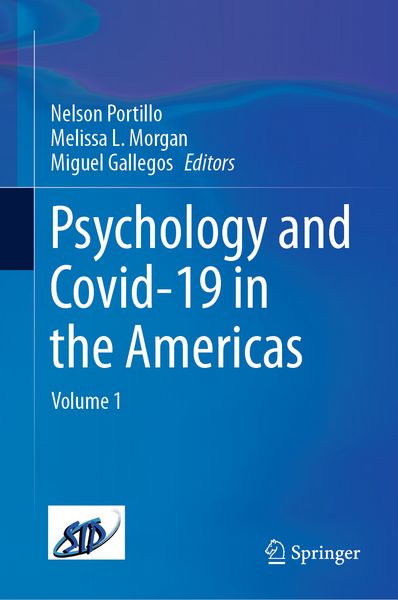
  • Produktbild: Psychology and Covid-19 in the Americas
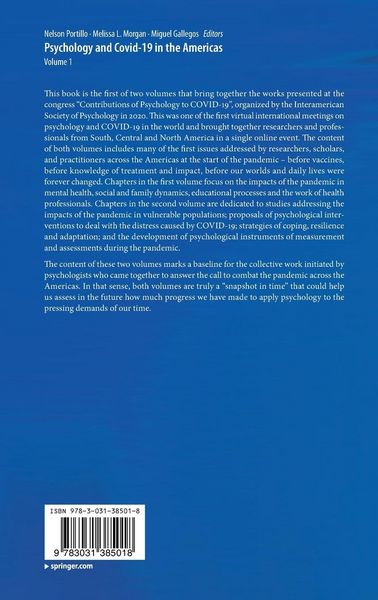
  • Produktbild: Psychology and Covid-19 in the Americas
- 13%

Psychology and Covid-19 in the Americas Volume 1

13% sparen

142,99 € UVP 164,99 €

inkl. gesetzl. MwSt., Versandkostenfrei


Beschreibung

Produktdetails

Einband

Gebundene Ausgabe

Erscheinungsdatum

26.11.2023

Abbildungen

XIII, 351 p. 17 illus., 9 illus. in color.

Herausgeber

Nelson Portillo + weitere

Verlag

Springer

Seitenzahl

351

Maße (L/B/H)

24,1/16/2,6 cm

Gewicht

717 g

Auflage

23001 Auflage 1st edition 2023

Sprache

Englisch

ISBN

978-3-031-38501-8

Beschreibung

Portrait

Nelson Portillo is the Interamerican Society of Psychology’s Vice-President for North America and an applied social psychologist at the Thompson Island Outward Bound Education Center (TIOBEC) in Boston, MA, USA.

Melissa L. Morgan is the Interamerican Society of Psychology's Executive Secretary for North America and Professor at the Gevirtz Graduate School of Education, University of California Santa Barbara, CA, USA.

Miguel Gallegos is the Interamerican Society of Psychology's Vice-President for South America and a researcher at the Pontifical Catholic University of Minas Gerais, Brazil, and the National Council for Scientific and Technological Research, Argentina. He is also Professor at the Department of Psychology, National University of Rosario, Argentina.

Produktdetails

Einband

Gebundene Ausgabe

Erscheinungsdatum

26.11.2023

Abbildungen

XIII, 351 p. 17 illus., 9 illus. in color.

Herausgeber

Verlag

Springer

Seitenzahl

351

Maße (L/B/H)

24,1/16/2,6 cm

Gewicht

717 g

Auflage

23001 Auflage 1st edition 2023

Sprache

Englisch

ISBN

978-3-031-38501-8

Herstelleradresse

Springer-Verlag KG
Sachsenplatz 4-6
1201 Wien
AT

Email: ProductSafety@springernature.com

Noch keine Bewertungen vorhanden

Verfassen Sie die erste Bewertung zu diesem Artikel

Helfen Sie anderen Kundinnen und Kunden durch Ihre Meinung.

Kundinnen und Kunden meinen

Bewertungen (0)

  • Produktbild: Psychology and Covid-19 in the Americas
  • Produktbild: Psychology and Covid-19 in the Americas
  • PART I. MENTAL HEALTH PROBLEMS.- Chapter 1. Distress reactions during the pandemic and fear of COVID-19 in Brazil.- Chapter 2. COVID-19 related stress and risks of mental health problems.- Chapter 3. "I'd rather die than get fat in quarantine": Psychological effects of fatphobia during the Covid-19 pandemic in Brazil.- Chapter 4. Anxiety and emotional intelligence among caregivers and non-caregivers during the COVID-19 pandemic in Ecuador.- Chapter 5. The impact of virtual social contact on mental health during the COVID-19 pandemic in Mexico.- Chapter 6. Relationship between subjective well-being, living conditions, anxiety/depression and drug use in Mexican adults in the early stage of the COVID-19 Pandemic.- Chapter 7. Perceptions of work-related stress factors in Brazilian public university employees at the beginning of the COVID-19 pandemic.- Chapter 8. What has COVID-19 meant to people's lives in Mexico? A psychosocial analysis based on semantic networks.- Chapter 9. Professional and occupational perfectionism: A protective and psychosocial risk factor.- Chapter 10. Anxiety and depression in Mexican adults: Differences in remaining, or not, in confinement.-PART II. SOCIAL AND FAMILY DYNAMICS.- Chapter 11. Favela fashion and the avatars of the COVID-19 pandemic in Brazil.- Chapter 12. The day after: Collective behaviors for the prevention of COVID-19 during and after the Paraguay’s national quarantine period.- Chapter 13. Social distancing due to COVID-19 as a family violence risk factor among Mexican university students: An analysis from a gender perspective.- Chapter 14. An exploratory study on family and economic conflicts in Mexican university students during the COVID-19 pandemic.- Chapter 15. A look at violence in the time of COVID-19 in Mexico.- Chapter 16. Financial perception and subjective wellbeing among Colombian university students in the context of the "Free Tuition" program during the COVID-19 pandemic.- Chapter 17. Social isolation and its effect on subjective well-being and sociocultural adjustment in Mexico.- Chapter 18. Jealousy in the context of social distancing due to COVID-19 in Mexico.- Chapter 19. COVID-19 and intimate partner relationships in Puerto Rico: A phenomenological perspective.- Chapter 20. The state of the practices and the practices of the states: The case of ArgentinaPART III. EDUCATIONAL PROCESSES, LEARNING, AND INTERVENTIONS.- Chapter 21. The day after: Impact of COVID-19 on teachers and their work in Paraguay.- Chapter 22. Psychologists in training in times of pandemic: Experiences from home/school with partners/family in Mexican undergraduate students.- Chapter 23. Education in times of pandemic: A systematic review of its implications for students’ mental health.- Chapter 24. Teacher training in virtual communities of practice at the University of Buenos Aires, Argentina.- Chapter 25. Characteristics of teaching and learning for Argentine teachers during mandatoryquarantine and the perception of their work at home.- Chapter 26. The COVID-19 pandemic and its implications in education: E-learning challenges in Latin American contexts.- Chapter 27. (Re)adapting parenting education interventions from face-to-face to online format in Brazil.- Chapter 28. Inequalities and construction of meanings in the educational psychology curriculum for training the trainers in Argentina during the COVID-19 pandemic.- Chapter 29. Redesigning inclusive education practices: From the epistemic shock of artifact appropriation to the paradox of caring for one another through social distancing.- Chapter 30. Students with high academic achievement and their experience during lockdown due to COVID-19.- Chapter 31. The COVID-19 pandemic and the voices of Brazilian school education stakeholders.- Chapter 32. Schooled Argentine children and adolescents in times of COVID-19: Comprehensive sexual education from a human rights approach.- Chapter 33. The virtual historical archive as a tool for teaching the history of psychology in the context of COVID-19.-PART IV. PRACTICES AND EXPERIENCES OF HEALTH PERSONNEL.- Chapter 34. The therapist in a pandemic context: Self-care in times of crisis.- Chapter 35. Experiences of suffering in narratives of female psychologists delivering mental health services in Brazil during the COVID-19 pandemic.- Chapter 36. Professional burnout risk factors for medical personnel working in primary health care in Cuba during the COVID-19 pandemic.- Chapter 37. Psychological impact of COVID-19 on students of medicine in Los Palacios, Cuba.- Chapter 38. Treating anxiety and depression during the COVID-19 pandemic: Discussing issues and prospects among psychologists from Cuba, Puerto Rico, and Canada.- Chapter 39. Supporting each other in a community of practice to address the pandemic in Mexico: The experience of teachers and psychologists in a virtual workshop on self-knowledge.- Chapter 40. Mental health and stress in medical students in Cuba during the COVID-19 pandemic.- Chapter 41. Psychological safety in health emergencies: On being safe to provide safety in Cuba.