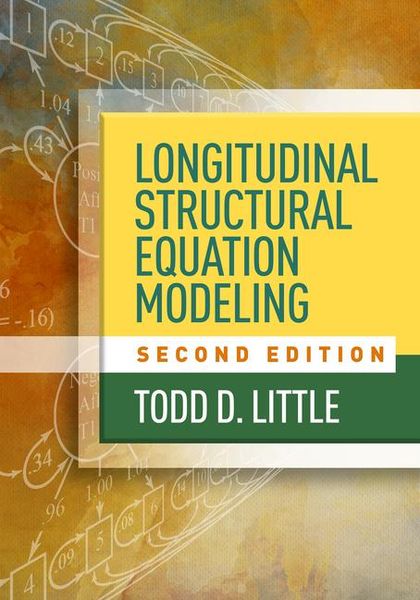
Produktbild: Longitudinal Structural Equation Modeling, Second Edition

Longitudinal Structural Equation Modeling, Second Edition

104,99 €

inkl. gesetzl. MwSt., Versandkostenfrei


Beschreibung

Produktdetails

Einband

Gebundene Ausgabe

Erscheinungsdatum

07.02.2024

Verlag

Taylor and Francis

Seitenzahl

616

Maße (L/B/H)

26,1/18,6/3,7 cm

Gewicht

1220 g

Auflage

2. Auflage

Sprache

Englisch

ISBN

978-1-4625-5314-3

Beschreibung

Produktdetails

Einband

Gebundene Ausgabe

Erscheinungsdatum

07.02.2024

Verlag

Taylor and Francis

Seitenzahl

616

Maße (L/B/H)

26,1/18,6/3,7 cm

Gewicht

1220 g

Auflage

2. Auflage

Sprache

Englisch

ISBN

978-1-4625-5314-3

Herstelleradresse

Libri GmbH
Europaallee 1
36244 Bad Hersfeld
DE

Email: gpsr@libri.de

Noch keine Bewertungen vorhanden

Verfassen Sie die erste Bewertung zu diesem Artikel

Helfen Sie anderen Kundinnen und Kunden durch Ihre Meinung.

Kundinnen und Kunden meinen

Bewertungen (0)

  • Produktbild: Longitudinal Structural Equation Modeling, Second Edition
  • Foreword, Noel A. Card
    1. Overview and Foundations of Structural Equation Modeling
    - An Overview of the Conceptual Foundations of SEM
    - Sources of Variance in Measurement
    - Characteristics of Indicators and Constructs
    - A Simple Taxonomy of Indicators and Their Roles
    - Rescaling Variables
    - Parceling
    - What Changes and How?
    - Some Advice for SEM Programming
    - Philosophical Issues and How I Approach Research
    - Summary
    - Key Terms and Concepts Introduced in This Chapter
    - Recommended Readings
    2. Design Issues in Longitudinal Studies
    - Timing of Measurements and Conceptualizing Time
    - Modeling Developmental Processes in Context
    - Summary
    - Key Terms and Concepts Introduced in This Chapter
    - Recommended Readings
    3. Modern Approaches to Missing Data in Longitudinal Studies
    - Planning for Missing Data
    - Planned Missing Data Designs in Longitudinal Research
    - Summary
    - Key Terms and Concepts Introduced in This Chapter
    - Recommended Readings
    4. The Measurement Model
    - Drawing and Labeling Conventions
    - Defining the Parameters of a Construct
    - Scale Setting
    - Identification
    - Adding Means to the Model: Scale Setting and Identification with Means
    - Adding a Longitudinal Component to the CFA Model
    - Adding Phantom/Rescaling Constructs to the CFA Model
    - Summary
    - Key Terms and Concepts Introduced in This Chapter
    - Recommended Readings
    5. Model Fit, Sample Size, and Power
    - Model Fit and Types of Fit Indices
    - Sample Size
    - Power
    - Summary
    - Key Terms and Concepts Introduced in This Chapter
    - Recommended Readings
    6. The Longitudinal CFA Model
    - Factorial Invariance
    - A Small (Nearly Perfect) Data Example
    - A Larger Example Followed by Tests of the Latent Construct Relations
    - An Application of a Longitudinal SEM to a Repeated‑Measures Experiment
    - Summary
    - Key Terms and Concepts Introduced in This Chapter
    - Recommended Readings
    7. Specifying and Interpreting a Longitudinal Panel Model
    - Basics of a Panel Model
    - The Basic Simplex Change Process
    - Building a Panel Model
    - Illustrative Examples of Panel Models
    - Summary
    - Key Terms and Concepts Introduced in This Chapter
    - Recommended Readings
    8. Multiple-Group Longitudinal Models
    - A Multiple-Group SEM
    - A Multiple-Group Longitudinal Model for Conducting an Intervention Evaluation
    - A Dynamic P-Technique Multiple‑Group Longitudinal Model
    - Summary
    - Key Terms and Concepts Introduced in This Chapter
    - Recommended Readings
    9. The Random Intercept Cross-Lagged Panel Model, Danny Osborne and Todd D. Little
    - Problems with Traditional Cross-Lagged Panel Models
    - The Random Intercept Cross‑Lagged Panel Model
    - Illustrative Examples of the RI‑CLPM
    - Extensions to the RI‑CLPM
    - Final Considerations
    - Summary
    - Key Terms and Concepts Introduced in This Chapter
    - Recommended Readings
    10. Mediation and Moderation
    - Making the Distinction between Mediators and Moderators
    - Moderation
    - Summary
    - Key Terms and Concepts Introduced in This Chapter
    - Recommended Readings
    11. Multilevel Growth Curves and Multilevel SEM
    - Longitudinal Growth Curve Model
    - Multivariate Growth Curve Models
    - Multilevel Longitudinal Model
    - Summary
    - Key Terms and Concepts Introduced in This Chapter
    - Recommended Readings
    12. Longitudinal Mixture Modeling: Finding Unknown Groups, E. Whitney G. Moore and Todd D. Little
    - General Background
    - Analysis Types
    - Finite Mixture Modeling Overview
    - Latent Class Analysis
    - Latent Profile Analysis
    - Latent Transition Analysis
    - Other LTA Modeling Approaches
    - Developments and Extensions into the Future of Finite Mixture Modeling
    - Summary
    - Key Terms and Concepts Introduced in This Chapter
    - Recommended Readings
    13. Bayesian Longitudinal Structural Equation Modeling, Mauricio Garnier-Villarreal and Todd D. Little
    - The Bayesian Perspective
    - Bayesian Inference
    - Advantages of a Bayesian Framework
    - MCMC Estimation
    - Bayesian Structural Equation Modeling
    - Information Criteria
    - Bayes Factor
    - Applied Example
    - Summary
    - Key Terms and Concepts Introduced in This Chapter
    - Recommended Readings
    14. Jambalaya: Complex Construct Representations and Decompositions
    - Multitrait–Multimethod Models
    - Pseudo‑MTMM Models
    - Bifactor and Higher‑Order Factor Models
    - Contrasting Different Variance Decompositions
    - Digestif
    - Key Terms and Concepts Introduced in This Chapter
    - Recommended Readings
    References
    Author Index
    Subject Index
    About the Author